


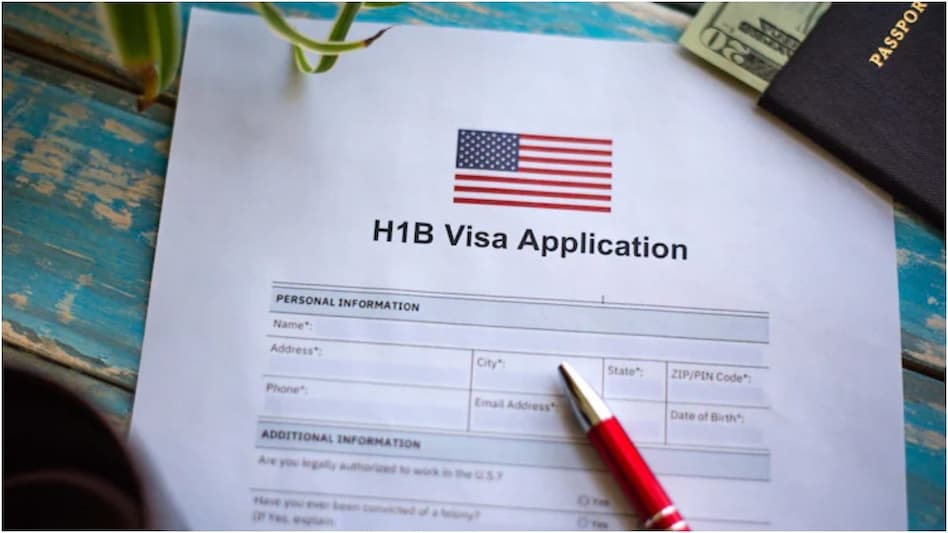
 Indian IT services firms, historically among the largest users of H-1B visas, have been steadily reducing their dependence on the programme.
The H-1B visa is fast losing its sheen for Indian IT companies, with registrations for FY2027 expected to fall 30-50% as a $100,000 fee, stricter rules and a cooling tech job market dampen demand.
The decline builds on last year’s drop, when filings fell from 442,000 for FY2025 to 339,000 for FY2026, signalling a structural shift in how companies approach hiring for the US market.
“Applications from Indian IT companies had already dropped significantly last year and will go down further this year,” said an IT analyst. He added that the H-1B visa has “lost its significance for the IT industry” and is now “more of a nostalgic benchmark of performance rather than an actual indicator.”
“The issues facing IT companies and hiring have more to do with the economic environment and the impact of Gen AI,” he said.
Costs and rules reshape demand
At the centre of the shift is a sharp rise in costs. A new $100,000 fee for companies bringing in overseas workers, applicable to fresh petitions filed after September 2025, has altered the economics of the programme.
With median H-1B salaries in the $80,000–$120,000 range, the additional levy effectively matches or exceeds annual compensation for many roles, making mid- and junior-level hiring economically unviable.
“The $100,000 fee is definitely a factor behind the lower visa registrations, along with the economic and geo-political uncertainty,” said Dhana Kumarasamy, CEO of Fulcrum Digital.
He said the company now uses the programme selectively. “We are adding more employees to our locations in India, Dublin and Mexico, along with hiring locally in the US for roles that need to be closer to the customer,” he said.
The shift is compounded by a move away from a random lottery to a wage-based selection system that prioritises higher-paying roles, along with an increase in the registration fee to $215.
“Honestly, the drop in H-1B registrations this year feels like a mix of reality finally catching up with the system,” said immigration attorney Nandini Nair. “Over the past couple of years, the process has become a lot more expensive and complicated for employers—higher fees, stricter rules, and more scrutiny on applications—so companies are being way more selective about who they sponsor instead of just submitting tons of registrations to increase their odds.”
Indian IT pivots away
Indian IT services firms, historically among the largest users of H-1B visas, have been steadily reducing their dependence on the programme.
Companies such as Infosys, Tata Consultancy Services and Wipro are increasingly hiring locally in the US and building nearshore teams in Canada and Mexico to navigate visa constraints.
For most large Indian IT firms, over half of their US workforce is now non-visa dependent, including citizens, green card holders and local hires.
According to an ICICI Direct report, visa allocations for these firms have already declined sharply between 2022 and 2025, by nearly 45% for TCS, over 71% for Infosys and almost 33% for Wipro.
Brokerages expect this shift to deepen. “We believe companies will increase local hiring, use more of L-1 visas, limit use of H1B visas (to extremely critical & highly skilled/paid resource), shift work offshore/nearshore and over a period of time, build cost escalation in contracts,” the report said.
Cooling demand, tighter scrutiny
The broader slowdown in tech hiring is also weighing on demand.
“The job market, especially in tech and other H-1B-heavy industries, has cooled off compared to the hiring surge a few years ago. With layoffs, hiring freezes, and tighter budgets, companies just aren’t sponsoring at the same scale,” said Nair.
At the same time, regulators have cracked down on duplicate filings by shifting to a beneficiary-based system that allows only one application per person, reducing inflated application volumes.
Data reflects the shift. Only three Indian-based companies featured among the top 25 employers for initial H-1B approvals in FY2025. The top seven Indian firms secured just 4,573 approvals, down 70% from FY2015 and 37% lower than FY2024, according to the National Foundation for American Policy.
By contrast, Amazon topped the list with 4,644 approvals.
A narrower, costlier route
While the annual H-1B cap remains unchanged at 85,000 visas, including 20,000 reserved for US master’s graduates, registrations are still expected to exceed the quota, pointing to continued demand. But the nature of that demand is changing.
Proposed revisions to prevailing wage calculations could push entry-level salaries closer to mid-level benchmarks, further nudging employers toward local hiring or more experienced candidates.
For applicants too, the system is becoming less attractive.
“From the applicant side, the whole process still feels like a gamble: the lottery is unpredictable, approval isn’t guaranteed, and policy changes can happen anytime, so some people are choosing to explore other countries or opportunities instead,” said Nair.
For Unparalleled coverage of India's Businesses and Economy – Subscribe to Business Today Magazine

 Who is Pralhad Joshi? Modi names veteran Karnataka BJP leader to lead Education Ministry after Pradhan's exit
 Third round of talks: CJP ends 49-day-long protest, says govt accepted 'key demands'
 Dharmendra Pradhan resigns, says decision taken to protect students' future amid NEET row
 All about Dharmendra Pradhan's educational qualification, wealth, assets and more
 India's first REIT mutual fund is here. Can it change how Indians invest in real estate?
  FDs vs Markets: Where Should You Keep Your Short-Term Money?
 Why Term Insurance Is Essential for Every Earning Member | Sum Assured & Coverage Explained
 Pakistan's Alleged Terror-Politics Nexus: Lashkar Links Spark Questions Over Fazlur Rehman
 Think Life Insurance Is Optional? Here's Why Every Indian Family Needs It Today
 FD Vs Arbitrage Fund: Which Is Better For High Taxpayers?
 Adani Power: 45 GW target, Rs 2 lakh crore capex plan among conference call highlights
  ITC Hotels, Chalet, Ventive, IHCL, SAMHI: Hotel stocks to buy despite travel disruptions
 ITC shares: Rs 307 a key short-term level to watch; here's target price
 Mphasis shares: FY27 guidance maintained; brokerages keep 'Buy' after Q1; check target price
 Should you buy every IPO? Research suggests patience may be the smarter strategy
 New York's $400 million climate bet: How a million trees are cooling a city the city from extreme heat Who is Pralhad Joshi? Modi names veteran Karnataka BJP leader to lead Education Ministry after Pradhan's exit
 Houthis target Saudi Aramco sites in Jizan and Yanbu as Red Sea tensions take a new turn
  Lifestyle inflation, delayed investing, high-interest debt: 3 biggest money mistakes young professionals makeThird round of talks: CJP ends 49-day-long protest, says govt accepted 'key demands'









