Barely days into the escalating US-Israel-Iran conflict, disruptions to global technology infrastructure have already begun.
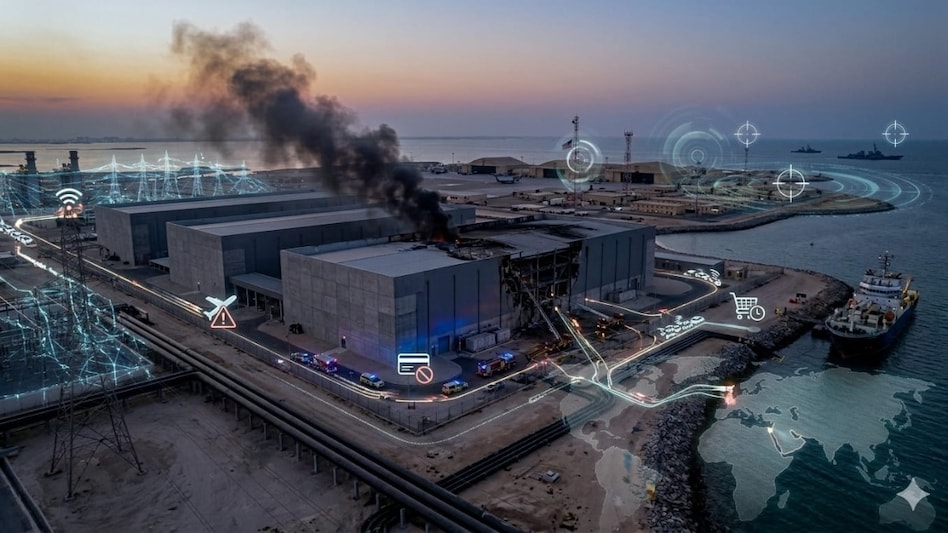
On 1 March, an Amazon Web Services (AWS) data centre in the United Arab Emirates was struck by unidentified objects, triggering a fire and forcing a partial shutdown of the facility. AWS subsequently reported power and connectivity issues across multiple availability zones in the UAE, along with related disruptions in its Bahrain region.
While global attention remains fixed on military strategy and oil markets, the incident underscores a more structural vulnerability: in an interconnected world, wars increasingly test the resilience of digital infrastructure.
Global cloud stability at risk
Over the past decade, major cloud providers have built significant data centre capacity across West Asia, turning the region into a critical node of the global digital economy. Artificial intelligence workloads are increasingly hosted there and key internet routes linking Europe, Asia and Africa pass through West Asian corridors.
That concentration of infrastructure has also increased exposure. Data centres, long perceived as remote and secure, are physically grounded assets and vulnerable to the same risks as other strategic targets.
The recent AWS disruption shows how a single incident can affect multiple availability zones. Whether through direct physical damage or instability in power grids, even short outages can cascade into banking systems, aviation networks and e-commerce platforms far beyond the region.
“The Digital Infrastructure in Gulf states (UAE, Bahrain, Saudi Arabia, Kuwait, Qatar) is at the highest risk due to hosting US military bases and being direct targets of retaliatory strikes. Digital Infrastructure in Israel is also at risk, but it is under constant threat and would have built resiliency around it,” says Pareekh Jain, CEO at EIIRTrend & Pareekh Consulting.
Outages in the UAE triggered large-scale traffic rerouting to US and European servers, creating networking bottlenecks and errors for AI platforms such as Claude and Copilot that rely on low-latency, seamless data flows.
“Cloud disruptions can cause inference delays, stall model training, and impact real-time, edge-dependent applications,” Jain adds.
The financial sector has already felt the strain. Cloud-dependent banking systems in the Gulf and Israel have faced downtime, with mobile payments and app-based transactions disrupted, including outages at institutions such as Abu Dhabi Commercial Bank. Enterprises have also reported hosting interruptions, forcing failovers to more expensive regions and exposing risks tied to single-availability-zone dependencies.
Subsea cable chokepoints
A significant share of global internet traffic flows through undersea cables near the Red Sea and the Strait of Hormuz, both strategic chokepoints in West Asia.
While deliberate cable attacks remain rare, naval conflict or sabotage can disrupt traffic flows and increase latency across continents. In September last year, damage to undersea cables in the Red Sea disrupted internet access across parts of Asia and West Asia and caused latency issues for Microsoft Azure services routed through the region.
The episode highlighted how even isolated cable damage can ripple across global digital ecosystems. Any further disruption, whether to terrestrial data centres or subsea routes, could have immediate and widespread effects.
Cyber warfare: the parallel escalation
Modern conflicts are no longer confined to physical battlefields. Digital networks have become a parallel theatre of war, where communication systems, financial networks and critical infrastructure are targeted to weaken adversaries.
In February 2022, when Russia invaded Ukraine, a cyberattack disabled modems communicating with Viasat Inc’s KA-SAT satellite network, which provided high-speed communications to Ukraine. The disruption extended into the European Union, affecting 5,800 wind turbines in Germany.
In the current conflict, cybersecurity firm Check Point Software Technologies has warned that cyber activity is likely to intensify across West Asia, the United States and other countries that Iran views as aligned against it.
“Cyber operations scale faster, travel further and offer deniability that physical attacks do not,” says Sanchit Vir Gogia, CEO and chief analyst at Greyhound Research.
Escalation patterns tend to follow a predictable arc, he notes. Denial-of-service campaigns surge to create noise and signalling. Hacktivist-aligned actors amplify narrative impact through defacement and disruption. Credential harvesting and phishing campaigns rise during periods of operational stress. More advanced actors may attempt destructive or wiper-style activity against high-leverage targets. Supply chain compromises become especially attractive because they multiply downstream impact.
Energy and utility networks are often the first targets, followed by banking, telecom, cloud, aviation and government systems. Disruptions in these sectors can quickly cascade across industries and affect everyday services.
Even companies with indirect exposure, through supply chains or operational links to West Asia, face elevated risk.
For now, the disruptions remain contained. But the evolving conflict has already revealed how tightly global cloud networks, subsea cables and critical digital systems are intertwined with geopolitical stability.



 For now, the disruptions remain contained. But the evolving conflict has already revealed how tightly global cloud networks, subsea cables and critical digital systems are intertwined with geopolitical stability.
 'AI Jobocalypse': Raghuram Rajan proposes AI token tax to curb job losses, boost govt coffers
 Rays of Belief, parent of Mom's Belief, to launch IPO on September 1
 Core sector growth eases to 5.4% in July from 6% in June; iron ore, cement lead
 India’s digital shopping story is reversing: Bill payments move back offline, shows study
 Indian Oil close to signing LPG import deal with Algeria’s Sonatrach for 2027: Report
 #PROMO | Business Today Presents India@100: India’s Manufacturing Champions | Building Viksit Bharat
 Nifty Bounces Back After 7-Day Fall, Relief Rally Or Fresh Uptrend? Piyush Pandey Decodes
 Augmont Enterprises IPO Opens August 21: Price Band, Dates, & Should You Apply
 Top 5 Fixed Income Products To Invest | Investment Guide | Money Today
 These ETFs Are Quietly Taking The Lead As Global Markets, Gold And Metals Gain Momentum
 Large cap stocks may lead market recovery; Anand Rathi analyst cites key factors
  Sensex, Nifty rebound sharply; can the recovery sustain?
 Hold ITC, avoid averaging despite underperformance, says Ruchit Jain of MOFSL
 HAL, BEL, MDL, Cochin Shipyard, Solar Ind shares: Kotak picks top defence stock
 Merck, Moderna cancer vaccine clears Phase 3 milestone in melanoma
 Niva Bupa barred from opening new branches for six months by IRDAI
 Delhi Master Plan 2047: Union Minister Manohar Lal Khattar lays out 24-hour cities, metro expansion and new development rules












