The claims have attracted attention from technology and investment enthusiasts, including questions about whether artificially produced gold could eventually challenge the economics of the precious metal. However, the distinction between demonstrating a nuclear reaction and producing gold commercially at scale is crucial.
How does mercury turn into gold?
The process is called nuclear transmutation. Unlike chemical reactions, which rearrange atoms without changing their nuclei, nuclear transmutation changes an atom's nucleus to produce a different element or isotope.
Marathon Fusion's proposed method uses neutrons generated by a deuterium-tritium fusion reaction to transform mercury-198 into mercury-197. The latter is radioactive and can decay through electron capture into gold-197, the stable isotope of gold.
- Start with mercury: The proposed process uses mercury-198, a naturally occurring stable isotope of mercury, as its starting material.
- Use fusion-generated neutrons: High-energy neutrons strike mercury-198 nuclei, triggering a reaction that ejects two neutrons and produces mercury-197.
- Produce gold Mercury-197 decays into stable gold-197: The challenge is to achieve this at an industrial scale while safely managing radioactive byproducts.
The underlying nuclear physics is established. Scientists have previously produced gold in particle-physics experiments, including at CERN's Large Hadron Collider. The difficulty is producing meaningful quantities economically. CERN's ALICE experiment estimated that it generated only about 29 picograms of gold during four years of operation.
The important distinction: Marathon's 2025 research paper described a proposed production method supported by nuclear simulations. Its latest claim of an experimental breakthrough is a separate development and requires independent scientific validation before its scale and significance can be established.
What do the latest experimental results show?
In its posts on X, Marathon Fusion says it has moved beyond its earlier theoretical proposal, reporting mercury-to-gold transmutation using fusion neutrons at a rate it claims is 10 times the record set by CERN in 2025.
The company has also shared energy-spectrum plots showing peaks attributed to specific isotopes. The first chart labels copper-64 and copper-67 signals following neutron irradiation of zinc, while the second identifies mercury-197 and gold-197 signatures associated with the mercury-to-gold process.
Such spectra can help identify radioactive isotopes through their characteristic gamma-ray emissions. However, the plots alone do not establish the total quantity of gold produced, its purity, the efficiency of the process or whether it can be scaled commercially.
The distinction matters because Marathon's original gold-production proposal, published in 2025, relied on simulations of a future fusion reactor. Its latest experimental claims are a significant new assertion, but independent confirmation of the results is essential.
Why is the startup focusing on medical isotopes?
Gold production has captured public attention, but medical isotopes could offer a more immediate practical application for Marathon Fusion's technology.
Radioisotopes are used in nuclear medicine to diagnose diseases, image tumours and deliver radiation to cancer cells. Some targeted radiotherapies use radioactive isotopes attached to molecules that bind to specific cancer cells, helping concentrate treatment where it is needed.
Marathon says it has already started producing radioactive copper isotopes by irradiating zinc with fusion-generated neutrons. Copper-64 has applications in diagnostic imaging, while copper-67 is being investigated and used in targeted radionuclide therapy.
The company's argument is that fusion reactors could eventually provide an additional source of medical isotopes as demand grows. However, commercial supply would depend on production yields, isotope purity, processing facilities, regulatory approval and reliable delivery.
The radiotherapy chart shared alongside the company's announcement illustrates the growing interest in targeted treatment. It shows cumulative targeted-radiotherapy trials rising to approximately 390 by 2025. That trend supports the case for developing isotope supply chains, although the chart alone does not establish a shortage or quantify how much additional production is required.
Why Marathon wants to build a fusion reactor in San Francisco?
The company says its immediate objective is not simply to generate electricity. It wants to produce neutrons at sufficiently high rates and concentrations to manufacture medical isotopes and potentially gold.
In its announcement, Marathon described a demanding target: directing a trillion neutrons every second at a target measuring just 1 cm across, continuously for years. The company says it intends to increase its reactor's power density by doubling it every month as it scales up. That is an ambitious development target, not evidence that such a growth rate can be sustained in practice.
The broader challenge is that a successful fusion reaction is not the same as a commercially viable fusion power plant. Engineers must demonstrate sustained operation, reliable equipment, efficient energy conversion, fuel-cycle management, materials durability and competitive costs.
A 2026 analysis by the Belfer Center at Harvard's Kennedy School also cautioned against assuming that recent fusion advances mean commercial deployment is imminent.
Marathon says it has spent years developing capabilities in plasma diagnostics, vacuum systems, high-power components and lithium handling. These are part of the engineering foundation needed to advance its technology.
Could lab-grown gold crash gold prices?
The prospect has prompted comparisons with lab-grown diamonds, which expanded supply and changed the economics of the diamond market.
Tushar Jain, founder and CIO of Multicoin Capital, raised the question in a post on X: if lab-grown diamonds disrupted diamond prices, what could lab-grown gold do to gold prices?
The comparison is intriguing, but there is a major difference between the two technologies.
Lab-grown diamonds are produced through chemical vapour deposition or high-pressure, high-temperature processes that replicate the conditions needed to form diamonds. Gold production through nuclear transmutation requires changing atomic nuclei, a much more complex and energy-intensive undertaking.
Marathon's 2025 paper estimated that a suitably designed fusion plant could produce around two tonnes of gold annually per gigawatt of thermal power. The company's broader projections have also cited thousands of kilograms per year at gigawatt scale. These are modelled projections, not demonstrated commercial output.
Even if the process works as envisaged, several factors would determine its impact on the gold market:
- Fusion economics: The reactor must generate commercially useful energy and operate reliably.
- Production costs: Mercury processing, isotope separation, radiation management and plant operations must be economically viable.
- Radioactive byproducts: The original proposal identified a need to manage radioactive gold isotopes and allow time for them to decay before the material could be used safely.
- Market supply: Any additional gold output would have to be assessed against global mine production, recycling and investment demand.
The possibility of lower-cost gold is therefore conditional on solving several difficult engineering and economic problems first.
Marathon's ambitions extend beyond gold and medical isotopes. The company argues that building small fusion systems for specialised industrial applications could help develop the components, expertise and supply chains needed for larger power plants.



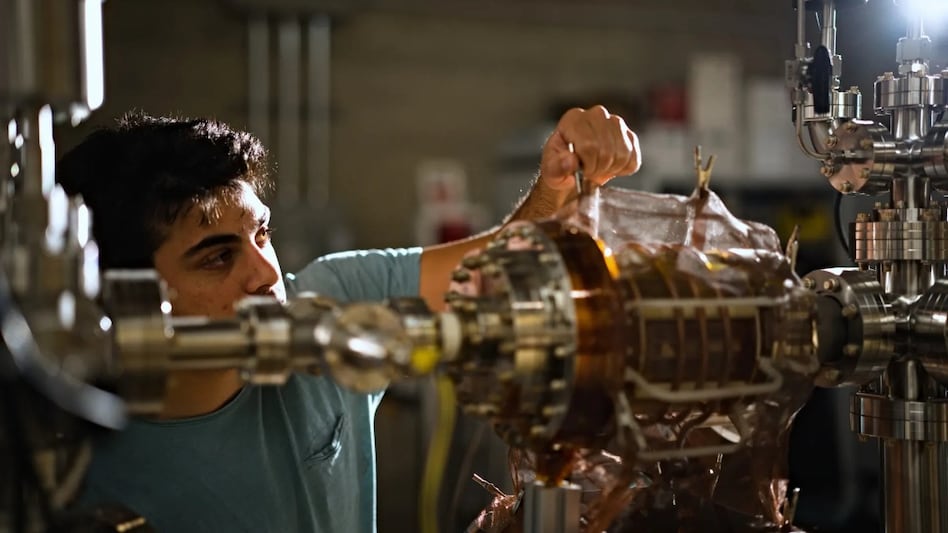 The company has also reported experiments involving isotope separation and the production of radioactive copper isotopes from zinc.

 Jio Platforms IPO: Retail portion fully booked; issue subscribed 3.5x on Day 2
 eMudhra shares plunge 14%, take three-day fall to 34%; here's why
 BT BIG STORY: India has failed to build an ecosystem of battery cells. Can a new PLI change this?
 ‘Rate cuts are off the table in the near term’: RBI in October MPC minutes
 SpaceX's AI push: Elon Musk-led company offers 20% pay rise if employees relocate to Memphis or Southaven. Details here
 PROMO | 23rd Edition Of Business Today’s Most Powerful Women Awards 2026: Celebrating India’s Women Leaders
 Chennai Floods Again! Why Does Tamil Nadu Face The Same Monsoon Crisis Every Year?
 India’s Biggest IPO Is Here! Why Investors Are Betting Big On Jio
 IMF Warns Tokenisation Could Amplify Financial Risks
 Amit Shah Meets Families Of Punjab Drug Crisis Victims, Targets Bhagwant Mann Ahead Of Polls

 360 ONE WAM shares gain as company converts UBS warrants into shares
 Jio Platforms IPO: Applying in two categories? Avoid these mistakes
 Garden Reach, Mazagon Dock shares: Goldman Sachs says 'Sell' GRSE, MDL; stocks fall up to 8%
 Swiggy shares fall 5% as Citi sees Eternal food delivery push to cloud outlook
 ‘Key US goal is to weaken the Indo-Russian relationship': Brahma Chellaney on Marco Rubio's visit
 Apple Music redesign drops its signature red look: What’s new in its visual identity?
 USPS Releases New Diwali Stamp Featuring Rangoli | Vinay Mohan Kwatra
 Skoda Kylaq buyers could help you save up to Rs 90,000 this Diwali, but how much will you actually get?
 Gold At Risk Of More Losses? Expert Flags Crucial Levels To Watch













