


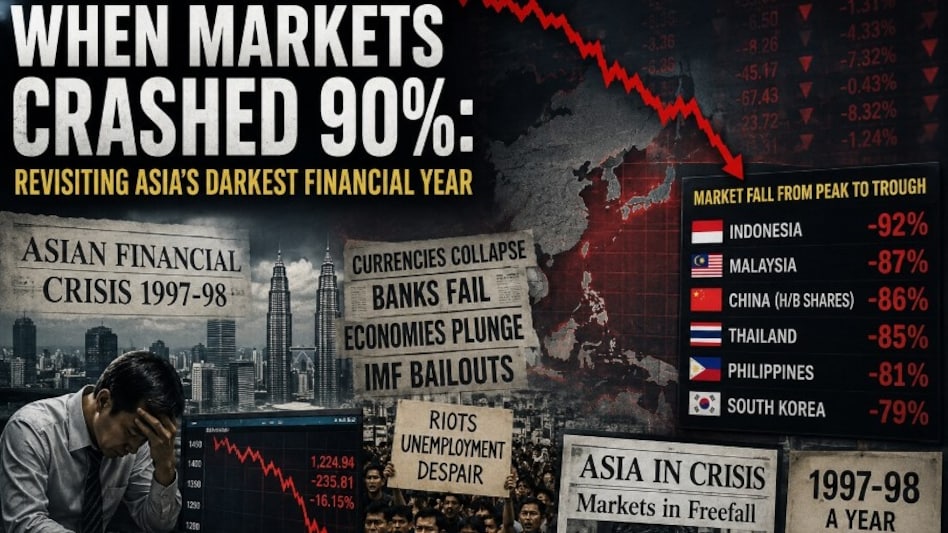
 The crisis began on July 2, 1997, when Thailand floated the baht, triggering currency collapses, bank failures and deep recessions across Southeast Asia.
Nearly three decades after the Asian Financial Crisis sent shockwaves through financial markets, toppled currencies and pushed several economies into recession, Asia is in a much stronger position to withstand external shocks than it was in 1997, according to a new report by global brokerage CLSA. Revisiting one of the region's defining financial events, the report argues that stronger corporate balance sheets, healthier banking systems, larger foreign exchange reserves and more prudent borrowing have transformed Asia's economic resilience.
The crisis began on July 2, 1997, when Thailand abandoned its quasi-fixed exchange rate and allowed the baht to float after intense speculative attacks. What started as a currency crisis quickly spread across Southeast Asia, triggering sharp devaluations, banking failures, corporate bankruptcies and deep recessions. CLSA describes the difference between Asia then and now as being "like chalk and cheese," noting that many companies in the 1990s had accumulated excessive US dollar debt while operating under fixed exchange-rate regimes that eventually became unsustainable.

 Big victory for Anthropic: US court strikes down Pentagon blacklist over 'illegal retaliation'
 NSDL, CDSL, BSE shares: Check key technical levels to watch out for
 SBI Funds share price: Jefferies initiates coverage with Buy, 26% upside target
 India, Canada eye Bilateral Investment Treaty to unlock ₹4.65 lakh crore trade by 2030
  Beyond factory floors: Piyush Goyal outlines next generation India-Japan economic partnership
 IDV Explained: How It Impacts Your Motor Insurance Premium & Claim
 Nepal Flood Crisis: Massive Floods Leave Trail Of Destruction Across Rasuwa, Nuwakot And Chitwan
 Oseltamivir Shortage Explained: Why H1N1 Cases Are Driving Demand & Prices Are Varying Sharply
 Stock Market Outlook: Strong Earnings, Global Risks; What’s Next For Nifty Above 24,000?
 Lupin Stock Outlook: Citi Downgrade Vs Bernstein Buy; Is The Pharma Stock A Buy Now?
 Nifty IT surges 3%: TCS, Infosys, LTM, HCLTech shares climb after Nvidia's strong results
 Ather Energy shares rise 7% after Rs 1,758 crore block deals; here's why
 Multibagger listing: Tempsens Instruments shares rally over 111% on debut
 Tejas Networks shares rally 10% on Rs 1,537 crore TCS order win; key details SBI Funds share price: Jefferies initiates coverage with Buy, 26% upside target
 Delhi race club demolition: Centre takes over 53 acres after HC refuses interim relief
 'Nothing’s Too Far': Tata Motors unifies all passenger vehicles under new TATA.CARS identity
 Varanasi’s Rajghat: Ancient heritage faces new challenges amid rapid development
 Gaggan Anand returns to India with RAGA: 22 courses, ₹11,111 price tag and months-long wait
 Sonia Gandhi’s memoir 'Belonging' faces setback as Penguin India pulls out over proposed changes












