












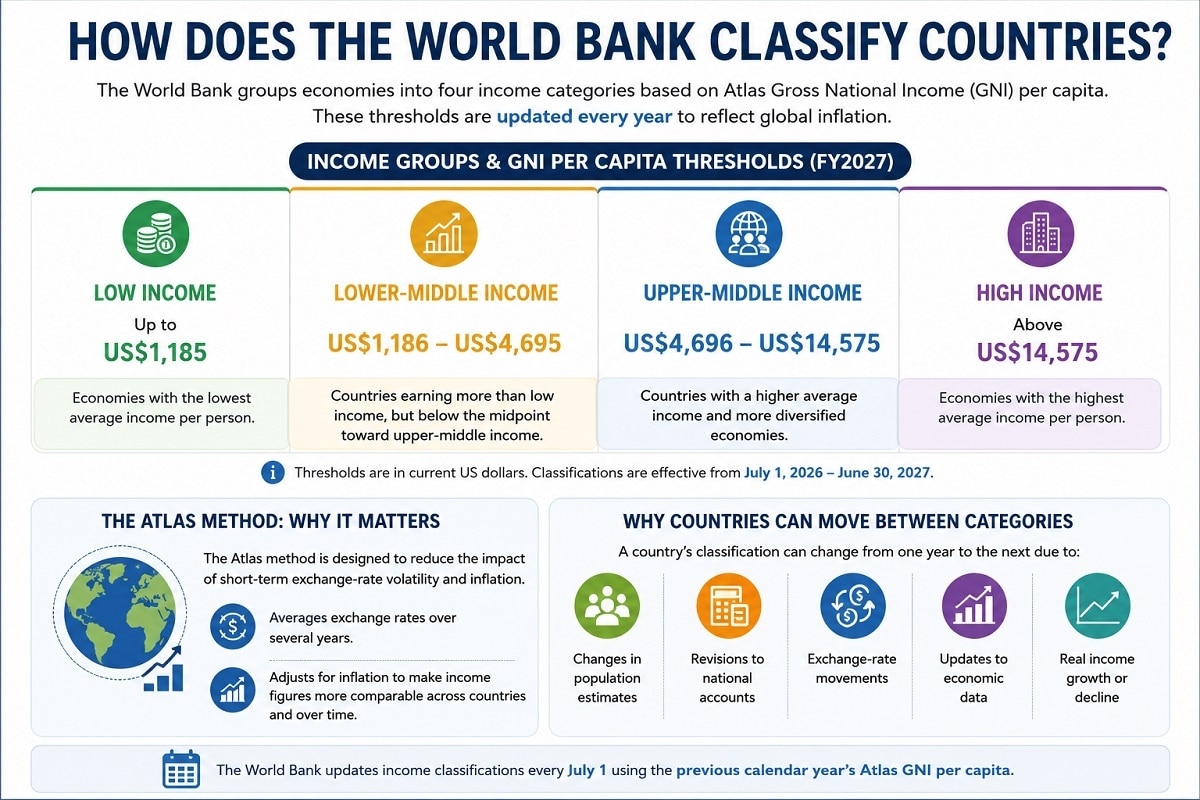


 While India is now among the world's largest economies in absolute size, its income is spread across a population of more than 140 crore people, keeping average income below the threshold for upper-middle income status.
 After years of economic turbulence, Sri Lanka has regained its upper-middle income economy status in the World Bank's latest country income classification. The move marks a symbolic milestone for the island nation following its severe economic crisis in 2022.
Sri Lanka's promotion is part of a broader reshuffle in the World Bank's latest income classifications, which took effect on July 1, 2026 and will remain valid until June 30, 2027. The annual update covers 218 economies, with six countries moving to a higher income category this year.
 NSE IPO: Exchange raises Rs 6,746 crore from 189 anchor investors; LIC, GIC, Fidelity among buyers
 India’s chip push goes global: Semiconductor heavyweights deepen footprint ahead of SEMICON 2026
 NSE IPO opens tomorrow: Brokerage weighs growth prospects, valuation; what GMP indicates
 UPI MDR: No rollback of 0.4% fee above Rs 2,000; govt says move will make UPI self-sustainable
 From Rs 300 to Rs 25,000: How the wage ceiling under EPFO has increased over the years
 “Onion Prices Down 9% In 9 Days”: Nidhi Khare On Availability And ₹35/Kg Retail Sales
 Indian Markets At A Crucial Juncture: Nifty, Crude, Fed & Smallcaps | Jaipuria
 Nifty At 23,200: Crude Oil, U.S. Fed Rate Hike Fears & Market Outlook Explained
 “7.8% Growth Is Not Random”: FM Sitharaman Credits India’s People, Industry And MSMEs
 Indian I.T. Stocks: Why AI Disruption & Weak Growth Are Making Investors Rethink Their Bets
 NSE IPO: 26 crore investor accounts and 3,000+ listed companies — 10 numbers to know
 US Fed rate hike: Why India could face pressure from higher US yields and a stronger dollarNSE IPO: Exchange raises Rs 6,746 crore from 189 anchor investors; LIC, GIC, Fidelity among buyersNSE IPO opens tomorrow: Brokerage weighs growth prospects, valuation; what GMP indicates
 Paytm, KRN Heat Exchanger, Ather Energy, Vishal Mega Mart: Expert shares key entry levels, targets
 Only 5,000 boxes: Realme's Harry Potter phone comes with a Hogwarts surprise
 EPFO ceiling hike: From ₹15,000 to ₹25,000, check your pension gain with this formula
 UPI MDR: Surjewala says govt should have charged foreign players $50-100 million annual fee
 Widowhood risk in retirement: Why a well-planned financial future may still fall short
 'I am not complicit': Ed Sheeran responds to Macklemore’s removal from US tour


