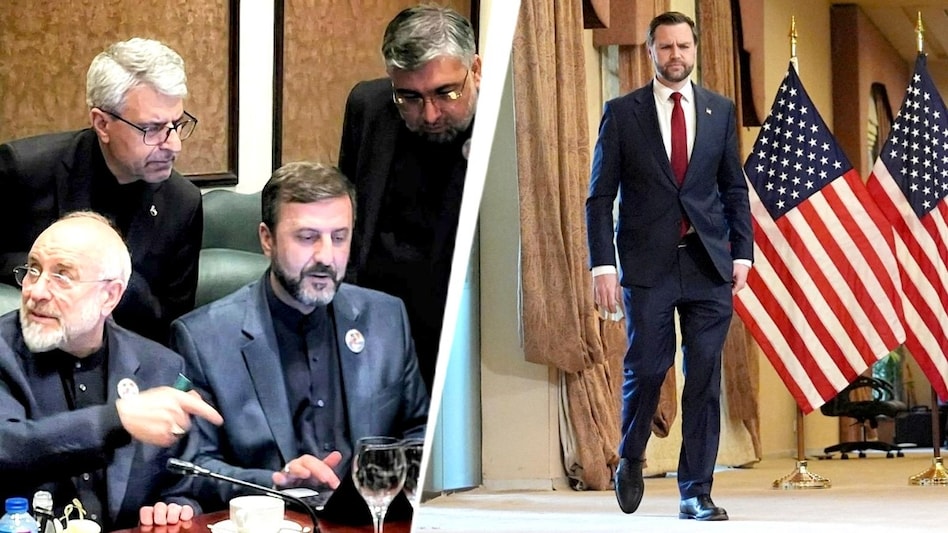
Hormuz, Gulf added to agenda: Iran on why Islamabad talks collapsed
Hormuz, Gulf added to agenda: Iran on why Islamabad talks collapsed
"We've reached an understanding on a number of issues, that's the reality, but regarding two or three important issues, the views were quite distant and ultimately did not lead to an agreement," says Iran's foreign ministry spokesperson
Iran cites Hormuz, Gulf issues among reasons for failed Islamabad talks
Hours after talks with the United States failed in Islamabad, Iran said on Sunday that both sides could not agree on two or three important issues, despite some progress being made during the negotiations.
Iran's foreign ministry spokesperson Esmaeil Baqaei said the two sides had narrowed gaps on certain areas but remained far apart on key questions. "We've reached an understanding on a number of issues, that's the reality, but regarding two or three important issues, the views were quite distant and ultimately did not lead to an agreement," he said.
Baqaei said negotiations took place after 40 days of imposed war, and a few days after the ceasefire, "in an atmosphere filled with mistrust, suspicion, and ill will."
Therefore, he added, it was natural that from the beginning, one should not have expected that we could reach an agreement in a single session. "I don’t think anyone had such an expectation, despite the fact that I said this session was the longest we’ve had in the past year."
Advertisement
Baghaei, the spokesperson of the Iranian Foreign Ministry:
"In the past 24 hours, various aspects of the main issues of the negotiations, including the Strait of Hormuz, the nuclear issue, war reparations, the lifting of sanctions, and a complete end to the war against Iran and… pic.twitter.com/amyIEjjZM6
He also pointed to an expanded agenda as a complicating factor. According to him, some new topics were added to the negotiation agenda this time, such as the Strait of Hormuz or the Gulf region. "These have their own conditions, characteristics, and necessities."
Despite the lack of a deal, Baqaei said diplomatic engagement would continue. He added that contacts and consultations between Iran, Pakistan, and other friends in the region will continue.
Advertisement
More than 21 hours of direct talks between the US and Iranian delegations ended on Sunday without agreement.
US Vice President JD Vance said the discussions were "substantive" but failed to produce a breakthrough.
"We've had a number of substantive discussions with the Iranians, that's the good news. The bad news is that we have not reached an agreement, and I think that's bad news for Iran much more than it's bad news for the United States of America," he said during a briefing.
Vance said Washington had presented its "final and best offer," but Tehran did not accept it. "We just could not get to a situation where the Iranians would accept our terms."
He added that the US was seeking a clear commitment from Iran on its nuclear programme. "The simple fact is that we need to see an affirmative commitment that they will not seek a nuclear weapon and they will not seek the tools that will enable them to quickly achieve a nuclear weapon."
Business Today brings you the latest news, views and analysis from the world of finance, economy, markets, corporates, startups, tech, and the digital economy. You can find everything from breaking news to deep dives to immersive essays and more on a variety of subjects across all formats - online, magazine, television, data visualisation, et al.