BT Infra Summit 2026: How Sagarmala 2.0 is going to steer India's maritime growth
BT Infra Summit 2026: How Sagarmala 2.0 is going to steer India's maritime growth
While passenger transportation often dominates public conversations, cargo transportation and multimodal logistics are equally vital to India's economic future, say experts.
While passenger transportation often dominates public conversations, cargo transportation and multimodal logistics are equally vital to India's economic future, the panel explained.
India's infrastructure story is no longer just about building more roads, ports, or railways, it is about connecting them into a single, seamless logistics ecosystem.
That was the central message that emerged from a panel discussion featuring policymakers, industry leaders, consultants, and shipping executives, who argued that initiatives such as PM Gati Shakti and Sagarmala are collectively reshaping how goods move across the country while laying the foundation for lower logistics costs, greater industrial growth, and a more competitive economy.
Advertisement
Sagarmala 2.0, proposed as the next phase of the Sagarmala Programme launched in March 2015, envisages total budgetary support of ₹85,482 crore with total investment of ₹3.6 lakh crore, to be utilised for identified interventions across ports, inland waterways & coastal infrastructure, maritime services, coastal development, research & development and institutional strengthening during the scheme period.
Sagar Kadu, Director of Logistics at the Ministry of Commerce and Industry, linked Sagarmala to the PM Gati Shakti National Master Plan, describing it as an integrated framework that brings multiple ministries together to eliminate planning silos and coordinate the country's next generation of infrastructure.
While passenger transportation often dominates public conversations, cargo transportation and multimodal logistics are equally vital to India's economic future, he explained.
Advertisement
According to Kadu, Sagarmala is about far more than ports. It is a comprehensive strategy for developing India's maritime economy by modernizing ports, improving first-mile and last-mile connectivity, strengthening coastal communities, and enhancing the country's export-import ecosystem. "Sagarmala is all about liberating the port-led economy."
With 11,000 km of coastline and around 70 operational cargo ports, Kadu explained even relatively small improvements in port infrastructure can produce significant gains in logistics efficiency and ease of doing business.
Captain Rahul Bhargava, CEO of Cerros Shipping, said that India's logistics costs have traditionally hovered around 13–15% of GDP, significantly higher than the global benchmark of 7–8%. This challenge, he said, became the driving force behind the original Sagarmala initiative.
The first phase focused primarily on coastal shipping and inland waterways to transport cargo more economically. But, according to Bhargava, Sagarmala 2.0 represents a much broader ambition. "Now with Sagarmala 2.0... the concept has changed. Now it is a maritime economic development,” he said.
Advertisement
Rather than simply modernising ports, the new strategy seeks to create industrial clusters around them. To illustrate the idea, Bhargava compared today's shipping industry to India's automobile industry in the early 1980s.
He explained that when Maruti Suzuki entered the Indian market, its greatest contribution was not merely manufacturing cars but creating an ecosystem of suppliers, ancillary industries, and employment. Sagarmala 2.0, he argued, seeks to achieve something similar by developing industrial corridors connected to ports.
"Sagarmala 2.0 is actually going to make industrial corridors... there is going to be a lot of employment, new development, which is in line with Atmanirbhar Bharat," Bhargava said.
Vishal Gupta, Executive Director at Deloitte India, argued that the real strength of Sagarmala lies in its end-to-end integration rather than infrastructure alone.
"Sagarmala 2.0 is about easing the multimodal integration. It's not about infrastructure creation at port only."
Using the example of the upcoming Vadhvan Port, Gupta described how deep-water facilities capable of accommodating larger ships would be supported by digital customs clearance systems, including the recently launched MAITRI digital information exchange platform connecting ports.
He explained that once cargo leaves the ship, it can move efficiently through an integrated network of rail corridors, highways, dedicated freight corridors, industrial corridors, and multimodal logistics parks.
Advertisement
Infrastructure expert Vaibhav Dange, who had previously served as private secretary to the Minister for Road Transport, Highways, and Shipping, emphasized that every major infrastructure initiative from Bharatmala and Sagarmala to PM Gati Shakti shares a common objective. "The whole idea is about larger vision in improving the logistic efficiency,” he said.
According to Dange, the government has already established the physical backbone through sustained investments in roads, railways, ports, and airports.
"Government... has created the necessary infrastructure and the environment. Now it's... time for private sector to build on this," said Dange. He argued that while governments construct ports and multimodal infrastructure, private companies must now invest in logistics parks, warehouses, terminals, and operational facilities that unlock the full value of these public investments.
Sunil Vaswani, Executive Director of the Container Shipping Lines Association of India, said the last five and a half years have taught the shipping industry to survive during trying times.
Vaswani described how container shipping first adapted to the unprecedented demand surge during the COVID-19 pandemic. Indian ports, he said, continued functioning effectively despite global uncertainty, while shipping companies invested heavily in additional capacity to meet rising demand.
The industry was then tested again during the Red Sea crisis, when many shipping lines were forced to reroute vessels around the Cape of Good Hope instead of using the Suez Canal. Those longer voyages required additional ships and significantly increased operational costs.
Advertisement
Fortunately, Vaswani explained, those earlier adjustments have left the industry better prepared for the latest geopolitical tensions. "There is no real cause for alarm under the current circumstances because we have more or less handled the situation already," said Vaswani.
Although disruptions around the Strait of Hormuz initially stranded several vessels, the industry quickly rerouted services through ports such as Fujairah, Sohar, and Salalah, said Vaswani.
Karan Dhar is Associate Editor at Business Today. He has over a decade of experience as a business journalist. He tracks mobility, retail, FMCG and other corporate developments.



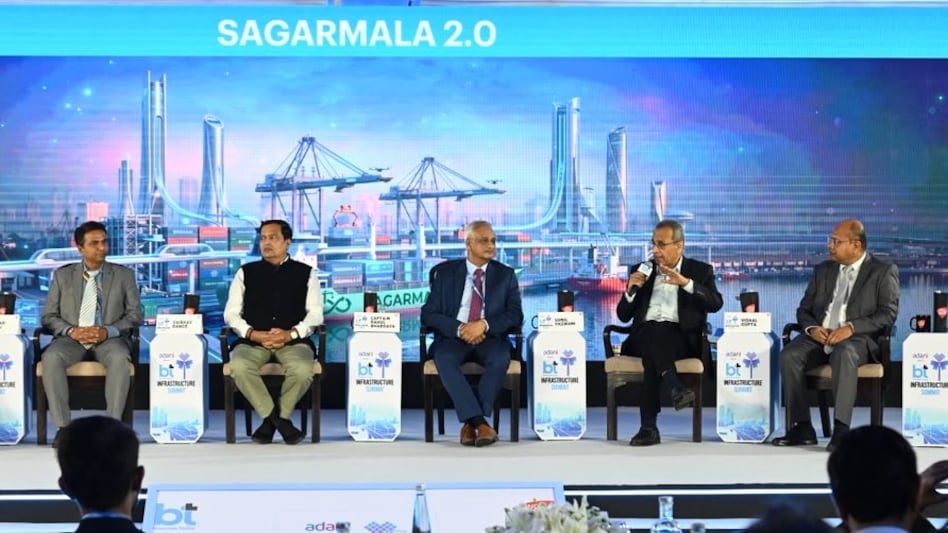 While passenger transportation often dominates public conversations, cargo transportation and multimodal logistics are equally vital to India's economic future, the panel explained.
 BT Infra Summit 2026: India's energy security needs a new playbook as clean power, storage and grid modernisation take centre stage
 Maruti Suzuki Q1 results: Profit slips 9% YoY to Rs 3,447 crore; revenue climbs 36%
 Will the July 31 ITR deadline be extended? Everything salaried taxpayers need to know
 Got a lift in your apartment? Survey says 46% residents were trapped at least once last year
 Over 1 lakh Zomato, Blinkit delivery partners file ITRs; Rs 18 crore in tax refunds facilitated
 PROMO | BT Infra Summit 2026: Policymakers & Leaders To Outline 'Infra India 2047' Vision In Delhi
 M&M CEO Rajesh Jejurikar On SUVs, EVs, Margins, Capacity Expansion, Festive Demand Outlook
 Why Karnataka Still Doesn't Have A Full Cabinet 58 Days After DKS Took Oath
 Parliament Erupts Over Delhi Protest Pellet Gun Allegations | SC Steps In
 Parliament Security Scare: Exclusive CCTV Reveals How Protesters Reached The Perimeter
 ITC Q1 results: Profit slips 16% to Rs 4,394 crore YoY; revenue climbs 28%
 BTTV Exclusive: M&M CEO Rajesh Jejurikar on Q1 earnings, business outlook, order book and more
  Nifty IT stocks rebound in July as semiconductor shares falter; reverse AI trade at play?
 Dixon Technologies Q1 earnings: Net profit at Rs 718 crore, revenue rises 21%
 Unified metropolitan transport authority key to solving urban public transport woes, says Vinayak Chatterjee of Infravision
 ITR filing 2026: Invested in REITs or InvITs? Here's how to report the income correctly while filing your tax returns
 BT Infra Summit 2026: Mineral security at the core of national security, says Minister of Coal and Mines
 2020 Delhi riots: Delhi court hands life sentence to ex-AAP councillor in IB staffer murder case










