


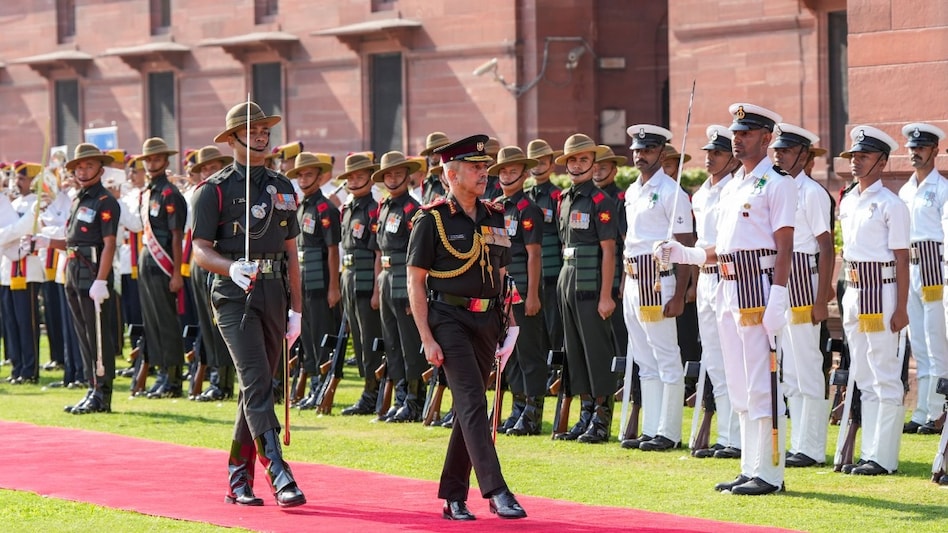
 Gen NS Raja Subramani took charge as the country's top military commander, succeeding Gen Anil Chauhan
India on Sunday got a new Chief of Defence Staff with a mandate that could shape the future structure of its armed forces.
Gen NS Raja Subramani, widely regarded as an expert on Pakistan and China, took charge as the country's top military commander, succeeding Gen Anil Chauhan. His immediate priority will be one of the Indian military's most ambitious reforms: implementing integrated theatre commands and deepening synergy among the Army, Navy and Air Force.
Soon after assuming office, Gen Subramani signalled continuity on military modernisation and self-reliance. "We will accelerate the development, induction and integration of indigenous weapons in our armed forces," he said.
Before being appointed CDS, Gen Subramani was serving as Military Advisor at the National Security Council Secretariat. He had earlier served as Vice Chief of Army Staff until his retirement in July 2025.
Mission theatreisation
Gen Subramani said organisational reforms and greater integration among the three services would remain central to his agenda.
"Innovation in thought and action will drive our capability development. Greater collaboration between the military, the industry, academia, startups and the research ecosystem will be the key enabler for modernisation," he said.
He also underlined a "whole of nation approach" to national security and said the armed forces were committed to implementing Prime Minister Narendra Modi's vision of "JAI" — Jointness, Atma Nirbharta and Innovation.
As CDS, Gen Subramani's most significant assignment will be rolling out the long-pending theatreisation model, which seeks to integrate military assets and command structures across services for greater operational efficiency.
From Garhwal Rifles to CDS
A graduate of the National Defence Academy and the Indian Military Academy, Gen Subramani was commissioned into the 8th Battalion of the Garhwal Rifles in December 1985.
Over a career spanning more than four decades, he served across diverse operational environments, from counter-insurgency missions in Assam and Jammu and Kashmir to high-altitude deployments along India's sensitive frontiers.
He commanded the 16 Garhwal Rifles during Operation Rhino in Assam, led the 168 Infantry Brigade in Jammu and Kashmir, and later commanded the 17 Mountain Division in the Central Sector. He also headed two Army corps, including one of the Indian Army's premier strike corps on the Western Front.
His career included several key staff and intelligence assignments. He served as Defence Attaché in Kazakhstan, Deputy Director General of Military Intelligence, Brigadier General Staff (Operations) in the Eastern Command, Chief Instructor at the Defence Services Staff College in Wellington, and Chief of Staff at the Northern Command.
Gen Subramani is also an alumnus of the Joint Services Command and Staff College in the United Kingdom and the National Defence College in New Delhi. He holds a Master's degree from King's College London and an MPhil in Defence Studies from Madras University.
For his distinguished service, he has been awarded the Param Vishisht Seva Medal, Ati Vishisht Seva Medal, Sena Medal and Vishisht Seva Medal.

 Gautam Adani tops Hurun real estate rich list, overtaking DLF's Rajiv Singh
 Rupee falls 57 paise to 96.20 against dollar; further weakness likely, say analysts
 SC slaps ₹10 lakh fine on Samay Raina, says taken the court for a ride and has brazenly violated the orders
 Mahadev betting app case: ED arrests EBIX Chairman Vikas Garg
 Census 2027 SIR guide: How to register, submit details and get your SE ID
 Crude Oil Rises To A 1-Month-High Above $86. What Does This Mean Fot The Indian Market?
 Indian Railways Unveils One Pan-India Licence to Transform Container Freight Business
 Market Commentary LIVE | DSP Quant Fund & Multi Allocation Fund | Aparna Karnik
 Ashwini Vaishnaw Unveils Container-Based Fly Ash Transport to Cut Pollution And Truck Use
 Audit Flags ₹22.74 Crore Irregularities At Butati Dham, Missing Gold And Suspect Bills Under Scanner
 Sensex falls 561 pts as crude oil price boils, rupee sinks; what's next for investors? Rupee falls 57 paise to 96.20 against dollar; further weakness likely, say analysts
 Is Swiggy the next Eternal? Quest PMS' Vyas reveals portfolio view after stock correction
 Brent crude rally revives pressure on paint, tyre and aviation stocks; should investors be worried?
 Suzlon, BHEL, Adani Power, Waaree, Adani Green, Tata Power: Check fresh ratings & targets









