"The future of education is a one-to-one tutor. A hyper-personalised one-to-one tutor for every kid," PhysicsWallah co-founder Prateek Maheshwari told Business Today in an interview. "We are committed to produce our AI tutor this year."
As generative AI tools such as ChatGPT and Gemini increasingly become a part of students' learning journeys, the question facing the education industry is whether global AI companies could eventually dominate tutoring and test preparation. Maheshwari believes success in India will depend less on the underlying AI model and more on understanding how students learn.
Must read: PhysicsWallah shares in focus as Q4 loss narrows; what it says on AI integration
"A company which has the maximum amount of behavioural data and Q&A data will be able to produce the most relevant AI tutor," he said.
PhysicsWallah claims to have more than 135 million free learners on its platform and around 3.5 million daily active learners who spend roughly two hours a day engaging with content.
"Daily, they generate billions of data points," Maheshwari said. "We have complete dominance in online learning and teach many times more paid students than our competition."
That combination of student interactions, academic data and distribution reach, he believes, creates a moat even if OpenAI or Google were to launch dedicated education products in India.
"Hypothetically, if any other company builds it, chances are very less that it will be relevant to the Indian test-prep ecosystem," he said.
End of the recorded-video era
Maheshwari believes the next phase of education will move away from the recorded-video model that defined the first generation of edtech companies.
"The course completion rates of recorded learning are less than 3%. This is not just our data; it is global data," he said.
Instead, he expects conversational AI tutors to become the dominant learning format over the next decade because of significantly better engagement and outcomes.
"The course completion rates of one-to-one tutoring are 60-90%, which is 20-30 times more than recorded learning," he said. "Similarly, learning outcomes are also proportionately higher."
PhysicsWallah is already seeing early traction from AI-powered learning tools. According to Maheshwari, the company's AI Guru has solved more than 100 million questions, evaluated over 2 million answer sheets and handled more than 3 million voice queries within a month.
Accuracy over automation
While students are increasingly turning to AI assistants for answers, Maheshwari argues that educational AI products will ultimately be judged on trust and accuracy rather than convenience alone.
Maheshwari said PhysicsWallah has built a human-in-the-loop layer because academic credibility cannot be compromised.
"90% of the students' queries are being solved by AI," he said. However, whenever a student gives a thumbs-down rating, the query is escalated to a human expert who provides a corrected response, Maheshwari added.
"As academicians, we cannot guarantee 90% accuracy of our platform. We have to guarantee 100% accuracy," he said.
Teachers won't disappear
Despite the company's aggressive push into AI tutoring, Maheshwari does not see teachers being replaced by technology.
"The teacher and the content are like an art. Teaching is essentially storytelling and everybody tells their story in their own way," he said.
Instead, he expects educators to build AI agents trained on their teaching methods, allowing them to scale personalised tutoring without losing their individual teaching styles.
"The teacher will create agentic solutions which will do tutoring on behalf of them and the teacher will continuously improve that output," he said.
Maheshwari also believes younger learners are becoming increasingly comfortable interacting with AI because it removes the fear of judgment.
"Students are endorsing AI as a companion, a mentor and a coach because AI doesn't judge them," he said. "They can ask as many doubts as they want, even silly doubts again and again."
Must read: From $22 billion peak to debt traps and lawsuits: How Byju's empire collapsed over the years
Business behind the bet
PhysicsWallah's AI ambitions come as the company reports a sharp improvement in its financial performance.
The company reported a 76% year-on-year decline in net loss to Rs 69.1 crore in the March quarter, while revenue from operations rose 51% to Rs 918 crore. For FY26, revenue climbed to Rs 3,899.5 crore while annual losses narrowed 90% to Rs 24.3 crore.
According to Maheshwari, the turnaround has so far been driven almost entirely by growth in the core business rather than AI products.
"Essentially 100% of the improvement came from core business growth," he said. "Revenue is up strongly and that is the primary reason for the reduction in losses and improvement in profitability."
The company continues to expand its physical footprint and now operates more than 350 offline centres. However, Maheshwari does not view offline and online learning as competing formats.
"Education has not completely shifted online. Hybrid is the new normal," he said. "A fraction of our online students join our offline learning centres."
Going forward, he expects online learning to grow faster than offline operations, with online revenue expanding 30-35% annually compared with 20-25% for offline learning centres.
Digital NEET opportunity
Beyond AI, Maheshwari sees another major shift underway in India's education ecosystem, the digitisation of high-stakes examinations such as NEET.
He welcomed the government's move to conduct the medical entrance examination online, arguing that it could help restore confidence after paper leak controversies that have shaken students and parents.
"Conducting NEET online is a big relief because it will give much more confidence to students," he said.
Maheshwari also advocated conducting major examinations multiple times a year and moving vulnerable tests online before security breaches occur.
"A fair examination is not just a nice-to-have thing. It's a must-have thing," he said.



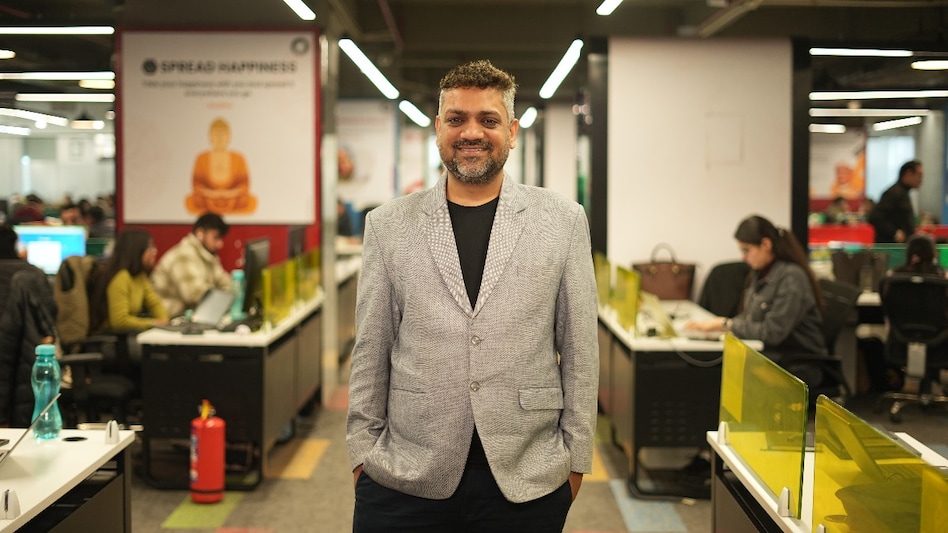 PhysicsWallah co-founder Prateek Maheshwari
 'RBI letter does not mention listing': Noel Tata seeks full briefing on Tata Sons-RBI talks
 Tata Trusts asks Tata Sons to explore options other than listing, says ‘Tata Model has to be saved’
 Tata Trusts proposes ₹25,000 crore plan for SP Group, says Tata Sons listing is not an option
 Chandrasekaran had assured all necessary steps were being taken to remain private: Noel Tata
 'We cannot put the cart before...': Noel Tata's argument against N Chandrasekaran's reappointment
 How India Changed In 12 Years: PM Modi’s Journey From Economic Reforms To Viksit Bharat
 Modi @76: From Twitter To Instagram, How His Digital Outreach Has Evolved
 Stock Picks To Watch: Shibani Kurian Reveals Kotak AMC’s Market Bets
 Gold ETF vs Physical Gold: Know the Tax Rules, Charges and Key Differences
  PPF vs NPS: Tax Benefits, Returns and Lock-in Period Explained for Retirement Planning
 Hero Motors IPO subscribed 3.37 times on Day 2; retail portion subscribed over 5 times
 NSE IPO: India's largest exchange gets 43% subscription on Day 1; NIIs, retail see strong demand
 Rentomojo shares settle maiden trade nearly 32% above IPO price; what should investors do now?
 Sensex slips, Nifty settles higher; Tata stocks gain after N Chandrasekaran reappointment
 Cochin Shipyard, KRBL, RITES, Ramky Infrastructure among stocks to turn ex-dividend on September 18
 Vijay’s UK visit brings ₹15,300 crore investment commitments to Tamil Nadu, over 10,000 jobs
 From seafood waste to reef recovery: How 500,000 tons of oyster shells helped restore the Gulf
 Micron workers reject 68 months’ pay, demand 15% of AI boom profits
  Australia to restrict family visas for international students: What Indian applicants need to know
 ₹11.5 lakh fine after 132 years! Magazine borrowed in 1894 finally returned to library












