









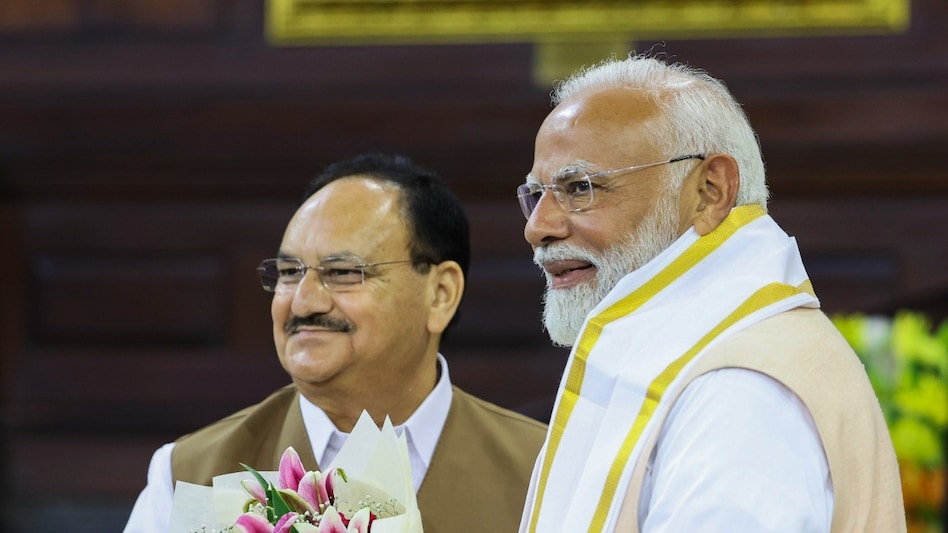
 Modi cabinet 3.0: Spotlight on healthcare sector as JP Nadda takes charge as health minister (PC: PTI)

 Modi cabinet 3.0: Spotlight on healthcare sector as JP Nadda takes charge as health minister (PC: PTI)
Modi cabinet 3.0: As the Modi 3.0 government begins its term with Jagat Prakash Nadda assuming the charge of Union Health Minister, the spotlight is on the Bharatiya Janata Party's (BJP) healthcare promises made for winning the 2024 Lok Sabha elections. While the saffron party promised a continuation and enhancement of past achievements in healthcare, several challenges lie ahead in implementing these plans.
Financial Implications and Funding Needs
Over the past decade, the government asserted significant progress in augmenting and enhancing healthcare services, emphasising holistic well-being through yoga, fitness, clean air, pure water, and nutritious food. These endeavours include key milestones, including the development of COVID-19 vaccines during the pandemic and establishing the Ministry of Ayurveda, Yoga & Naturopathy, Unani, Siddha, and Homoeopathy (AYUSH) to advocate traditional medicine. Moreover, the expansion of medical colleges aims to address the shortage of doctors.
Initiatives such as opening more All India Institute of Medical Sciences (AIIMS) and Ayushman Bharat have been pivotal in extending medical care to millions, with Ayushman Bharat providing free treatment up to Rs 5 lakh, the government claimed. As the government pledges to further boost AIIMS, increase medical education seats, and amplify initiatives like Ayushman Arogya Mandirs and Pradhan Mantri Bhartiya Janaushadhi Pariyojana (Jan Aushadhi Kendras), several challenges arise, according to health economists.
“Strengthening AIIMS and other healthcare institutions requires substantial investments in infrastructure, manpower, and resources to maintain quality healthcare services nationwide. Increasing seats in medical education demands meticulous planning and coordination with regulatory bodies to ensure the availability of qualified healthcare professionals,” noted Arup Mitra, Professor of Economics at South Asian University, New Delhi.
"Expanding medical education and hospital facilities is indispensable. The current infrastructure needs considerable enhancements to meet the rising demand. Addressing specific healthcare gaps and ensuring adequate facilities for various illnesses while bridging mismatches in care provision is crucial. Overcrowded public hospitals and costly private facilities disproportionately affect low-income households, underscoring the need for balanced and accessible healthcare solutions," he added.
Industry Perspectives on Policy Directions
The expansion of the Pradhan Mantri Ayushman Health Infrastructure Mission (PM-ABHIM) and Ayushman Arogya Mandirs, coupled with the launch of an Emergency and Trauma Care Mission, necessitates robust funding, skilled personnel, and efficient management to provide immediate and effective healthcare services, especially in rural and underserved areas, experts said. Additionally, intensifying efforts to eradicate diseases like tuberculosis and leprosy requires comprehensive strategies, timely testing, and nationwide access to medicines, they affirm.
"Given the nature of the mandate, several populist measures can be expected in the coming months. There is a strong possibility that some of this gets converted into increased public health spending and the introduction of measures that bring down health-related out-of-pocket expenditure for the masses," remarked Himanshu Sikka, Lead - Health, Nutrition, and Water, Sanitation, and Hygiene (WASH) at IPE Global, an international development consulting firm.
One of the critical areas of focus is the diagnostic industry, which has long been unorganised and unregulated. Anand K, Managing Director & CEO of Agilus Diagnostics Ltd, emphasised the need for enforcing minimum standards in laboratories, which generate 70 per cent of structured clinical data influencing clinical decisions. "Policy-making should be based on population health studies to address economic and social disparities," Anand said, citing substantial examples like the National Family Health Survey (NFHS) and the Global Burden of Disease Study.
Roadmap for Improving Healthcare Access
Furthermore, while the vaccine production and distribution sector is set for significant changes, regulatory compliance, supply chain logistics, and the adoption of new technologies are key challenges that need addressing to meet the escalating vaccine demand. Additionally, boosting health human resources calls for improved training, recruitment, and career development programmes.
Dr Rashmi Saluja, Executive Chairperson of Religare Enterprises and Chairperson of the Global Trade and Technology Council (India), highlighted the potential of the healthcare and pharmaceutical industry as a catalyst for economic growth. "Investing in segments such as expanding hospitals in non-metro cities, establishing more diagnostic centres, and focusing on domestic manufacturing of essential drugs is vital," she said. Technological advancements like Artificial Intelligence (AI), wearables, and the Internet of Things (IoT) also present promising investment avenues.
Religare Enterprises (REL) is already pioneering public-private partnerships (PPP) to bolster healthcare services. In 2023, a collaboration between the Government of Arunachal Pradesh, Sir Ganga Ram Hospital, and REL aims to make Arunachal Pradesh a hub for advanced medical care in the North-East region.
Amid growing discussions on enhancing India’s healthcare framework, the government is considering comprehensive incentive schemes aimed at boosting private sector investments in health infrastructure, particularly in tier 2 and tier 3 towns and rural regions. “This can be through the use of blended finance instruments such as risk guarantees and interest subvention, which increase the infusion of private capital for hard-to-reach areas and vulnerable populations,” Sikka stated, underscoring the necessity of this directed focus.
Improving mental healthcare services remains another pivotal element within the government's plans. Addressing mental health challenges demands a multi-faceted approach, combining traditional practices like yoga and meditation with expanded mental health initiatives to meet the increasing needs of India’s populace. Additionally, significant reforms in the area of rare diseases are on the horizon, experts said.
"As patients of thalassaemia, we request the government to introduce a consolidated blood law ensuring safe blood through mandatory Nucleic Acid Testing (NAT) for HIV, Hepatitis C Virus (HCV), etc. Moreover, a national-level thalassaemia prevention programme is imperative, along with ensuring job reservations under the Rights of Persons with Disabilities (RPWD) Act and the encouragement of Indian gene therapy," urged Anubha Taneja-Mukherjee, Corporate Lawyer and Member Secretary, Thalassaemia Patients Advocacy Group (TPAG).
Nadda taking charge of the Union Health Ministry on Tuesday, highlighted the pivotal role of the Ministry of Health and Family Welfare in the nation’s progress. "India’s healthcare system, recognised globally for its quality and affordability, has positioned the nation as a significant destination for medical tourism," he remarked in a tweet.
Dr Vaibhav Kapoor, Co-founder of Pristyn Care, advocated for substantial investments focusing on modern healthcare services for rural populations, aiming to bridge the urban-rural healthcare divide. “We envisage a healthcare ecosystem that is both affordable and accessible to all, prioritising high-quality, sustainable treatment. Expanding health insurance coverage to include modern treatments and promoting digital healthcare benefits are crucial steps forward,” he said.
 Delhi EV policy 2026: Should you buy these premium electric SUVs & MPVs under ₹30 lakh?
 Big news for commercial petrol, diesel buyers: India lifts emergency curbs on retail sales from July 1
  'Never seen so many tankers': India's Russian crude imports may hit record high in June
 Delhi EV Policy 2026 Explained: What's changing for car, bike and auto buyers
 Why Jio BlackRock feels hybrid long-short is the perfect fund to launch now as it enters the SIF space
 Why Jio BlackRock AMC Is Launching Hybrid Long-Short As It's First SIF
 Delhi Unveils ₹15,000 Crore EV Policy: What It Means For Auto Companies And Consumers
 Gold, Silver Or Crude? Where Should Investors Bet Now? | Vandana Bharti
 How India Strategically Managed LPG & Crude Oil Supplies During West Asia War | K. Surana Explains
 Delhi’s Green Revolution: CM Rekha Gupta Unveils Massive ₹15,000 Crore EV Policy To Combat Pollution
 Why Jio BlackRock feels hybrid long-short is the perfect fund to launch now as it enters the SIF space
 Where should investors put their money? PL Wealth CEO has some tips
  Axis Bank CFO Puneet Sharma steps down; stock likely in focus on Tuesday
 Apollo Hospitals, Medanta, Healthcare Global, Max Healthcare, Artemis Medicare: Check target prices, outlook
 Polycab: Amid record FII buying, shares at all-time high but brokerages expect more upside