









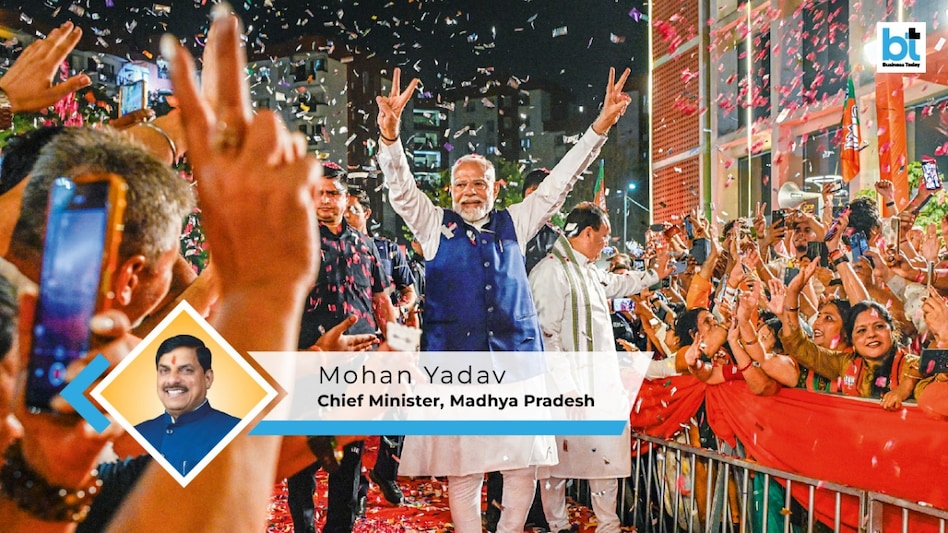
 Modi is now India's longest-serving elected Prime MinisterModi is now India's longest-serving elected Prime Minister
When our revered Narendra Modi ji took oath as Prime Minister in May 2014, the people of the country did not merely elect a government. They also expressed their expectation for a new style of governance and a new political culture.
Twelve years later, it would be more appropriate to understand this journey not only through schemes, statistics and achievements, but through the broader vision that has influenced the thinking behind governance. If these twelve years were to be summed up in three words, they would be: Service, Good Governance and Resolve.
Don't Miss: 12 years of Modi government: Service, development and national renewal
THE SPIRIT OF SERVICE BEYOND POLITICS
For a long time in Indian politics, power was viewed as a right and a privilege. Our revered leader, Narendra Modi ji, successfully sought to present it as a form of service. He has repeatedly referred to himself as the "Pradhan Sevak" (Chief Servant). This was not merely a political slogan, but a perspective reflected in the language and style of governance.
Service does not mean merely running welfare schemes. Service means that the government sees itself not as the guardian of the people but as their servant. From this perspective, the priorities of governance over the past twelve years have reflected concern for reaching the last person in society. Efforts have been made to place the poor, farmers, women, youth and deprived sections not merely as vote banks but at the centre of the development process.
This is the same thinking whose roots can be seen in Pandit Deendayal Upadhyaya ji’s philosophy of Integral Humanism. Modi ji’s government has repeatedly conveyed the message that development has real meaning only when its benefits reach the weakest person in society.
Must Read: Twelve years of transformation: Trust, development and India's rise
GOOD GOVERNANCE: RESTORING FAITH IN THE SYSTEM
Democracy functions not merely through elections but through the people’s trust in institutions and systems. For a long time, Indian citizens complained that the government was distant, procedures were complicated and the system was difficult for ordinary people.
Over the past twelve years, good governance has emerged as a key term in discussions on governance. Good governance does not merely mean reducing corruption or increasing the use of technology. Its true meaning lies in making government more transparent, accountable and effective.
The use of digital technology was part of this philosophy. Technology was viewed not merely as a symbol of modernity but as a means of achieving good governance. Continuous efforts have been made to reduce the distance between the government and citizens, simplify processes and make decisions more transparent.
An important aspect of good governance is also the ability to make decisions. Dialogue is essential in a democracy, but indecision is the greatest enemy of development. It has been clearly visible in the working style of our distinguished Prime Minister Narendra Modi ji’s government that instead of avoiding major decisions, efforts were made to take them to their logical solutions. This is what decisive leadership means. It is undeniable that the ability to make decisions has been a defining feature of this period of governance.
Don't Miss: Modi era: From the resolve of a developed India to the renaissance of Devbhoomi
RESOLVE: THE DREAM OF A DEVELOPED INDIA
Every era of politics has a central idea. The idea of the freedom movement was self-rule. After independence, the focus was nation-building. In the third decade of the twenty-first century, the Modi government has presented a Developed India as a national resolve.
This resolve is not limited to economic progress. It also encompasses self-confidence, self-reliance and national pride. Over the past twelve years, the message has repeatedly been conveyed that India should not remain satisfied as merely a developing nation but should aspire to become one of the world’s leading powers.
This vision fosters a new confidence within Indian society. For a long time, India spoke about its potential but often lacked the courage to fully realise it. Today, the idea of a Developed India has become established as a national goal.
MODI JI'S BLESSINGS FROM MADHYA PRADESH
Inspired by our revered “Pradhan Sevak,” we too envisioned a Developed Madhya Pradesh. It fills me with emotion to say that at every step and in every decision, we received Modi ji’s guidance, affection and blessings.
Whether it was the long-pending Ken-Betwa and Parvati-Kalisindh-Chambal Link Projects or the PM MITRA Park, he stepped forward to remove obstacles. Leadership like his is rare.
When the decision was taken to establish PM MITRA Parks in seven states, Madhya Pradesh was included in that list. It is a matter of great happiness that, so far, only Madhya Pradesh has witnessed the foundation stone laying of a PM MITRA Park. It was a matter of pride that the Prime Minister himself attended the ceremony in Dhar. This is a result of his special affection for Madhya Pradesh.
Whether it is the successful implementation of Cyber Tehsil in the state or the Metro Rail projects in Bhopal and Indore, all are outcomes of the Prime Minister’s affection, blessings and guidance. Today, the state has nine airports, and his guidance has been instrumental in that as well.
Today, Madhya Pradesh is free from Naxalism, and this too is the result of his direction and guidance. From time to time, he advised us and also cautioned us. He said that bullets should be answered with bullets, but for those abandoning violence and returning to the mainstream, the best possible rehabilitation arrangements should also be made. It is the result of his advice and warnings that Madhya Pradesh has today bid a final farewell to "Lal Salaam."
Today, industries are expanding across Madhya Pradesh and investments worth several lakh crores are flowing into the state. This too is the result of the Prime Minister’s guidance. His participation in the Global Investors Summit held in Bhopal in February 2025 reflected his special affection.
He taught us the value of compassion. He told us that "Nar is Narayan" and that one should see Narayan in the deprived and the poor. It was his teaching that inspired us to ensure, among our earliest decisions, that workers of Indore’s Hukumchand Mill received their long-pending dues. The Prime Minister also virtually addressed the programme organised to hand over cheques to the workers.
Whether it is developing leading government colleges in all 55 districts of Madhya Pradesh as Prime Minister Colleges of Excellence or expanding highways, the Prime Minister has shown interest, guidance, assistance and affection on every front. I do not hesitate in saying that he is a timeless leader with vision across all three dimensions of time.
REVIVAL OF CULTURAL CONFIDENCE
An important feature of Modi ji’s tenure has also been the resurgence of cultural consciousness. After independence, India embraced modernity but often showed hesitation regarding its cultural identity.
Over the past twelve years, pride in Indianness, heritage and civilisation has become more prominent. This idea is not confined to religious faith alone. It also represents an effort to connect India’s thousands of years of cultural journey with modern nation-building.
Whether it is the construction of the Ram Temple in Ayodhya, the redevelopment of Kashi, or the promotion of Indian traditions and yoga on global platforms, all reflect the same spirit of cultural confidence. Inspired by him, Madhya Pradesh is also preserving its heritage.
A nation’s strength does not lie only in its economy or military. It also lies in its confidence. From this perspective, cultural resurgence has been an important feature of Modi ji’s tenure.
INDIA'S NEW IDENTITY ON THE GLOBAL STAGE
Another important aspect of these twelve years has been India’s international role. Today’s India is not merely a spectator to global events but an active participant and an influential voice.
This transformation in foreign policy is not merely a diplomatic achievement. It reflects the belief that India should play a global role commensurate with its civilisation, population, economy and democratic traditions.
Balanced relations with major world powers, an independent approach during global crises and India’s growing presence on international platforms indicate that the country is no longer prepared to see itself in a limited role.
A NEW LANGUAGE OF POLITICS
Narendra Modi ji’s leadership has also changed the language of Indian politics. Earlier, electoral discourse largely revolved around caste equations, regional interests and coalition arithmetic. Today, development, aspirations, national pride and discussions about the future have also become central themes.
The younger generation has been particularly involved in this transformation. Today’s youth do not speak only about present-day facilities but also envision an India that can compete globally. This change is significant at the level of political discourse.
The strength of democracy lies in respecting achievements while acknowledging challenges. The government led by our revered leader Modi ji is similarly committed to translating its resolve into reality on an even broader scale.
If one attempts to understand Prime Minister Narendra Modi ji’s twelve years only through schemes and statistics, the picture will remain incomplete. The true significance of these twelve years lies in the thinking that sought to connect governance with service, administration with good governance and politics with resolve.
This period has been one of the revival of India’s self-confidence, aspirations and national consciousness. It is the foundation of a New India. One thing is beyond dispute: these twelve years have left a deep impact on the direction of Indian politics and governance.
Now that this journey has completed twelve years, it can be viewed not merely as the tenure of a government but as an era in which India began to see itself through a new lens and present itself to the world in a new way.
That is the defining identity of this period: Service, Good Governance and Resolve.
 Planning to fly from Jewar? Air India Express pulls out. What changes for you
 Centre likely to take measures to stem net FDI outflows
 Do you know these 10 companies that grew profits by up to 568% in 10 years?
 Gold ETFs see record ₹725 cr outflow in May, first in 2026; Silver ETFs attract ₹2,133 cr
 Equity mutual fund inflows fall to 1-year low in May; SIP contributions stay above ₹30,900 crore
 Apple AirPods Max 2 Review | New Apple Headphones With Enhanced ANC | Tech Gear Show
 Jet Fuel Prices Rise 10%: Airlines Face Higher Costs Under New Stabilisation Scheme
 SpaceX Retail Mania Ahead? Ajay Bagga Shares His Strategy
 From Hugs To Heartbreak: Mamata’s 10 Janpath Optics Shadowed By 20-MP Parliament Mutiny!
 India Avoids Fresh Borrowing Despite Iran War Stress | Divestment Boost Supports Finances
 Hexagon Nutrition IPO: Check application, allotment odds, fresh GMP & listing date
 Tata Power vs Adani Power shares: Consensus targets suggest flat return for one, 10% upside for other; any guesses?
 HUL shares: JPMorgan maintains overweight stance, expects up to 20% upside on FMCG stock
  Bajaj Electricals, KEI Ind, Polycab, R R Kabel, Voltas: Check share price targets
 ITC share price: Target cut as cigarette volumes may decline 8-10% in H1, says Systematix