Hon’ble Prime Minister Modi Ji worked to make governance more citizen-centric, transparent, and result-oriented. His mantra of "Minimum Government, Maximum Governance" became not merely a slogan but the foundation of a new administrative culture. Government processes were simplified, technology was extensively integrated, and transparency was strengthened. To promote holistic development, he advanced the "5T" approach of Trade, Tourism, Tradition, Talent, and Technology. Simultaneously, he introduced the mantra of "Sabka Saath, Sabka Vikas, Sabka Vishwas, Sabka Prayas" to ensure equal participation of every section of society in the development process. For the first time, the poor, farmers, marginalized communities, and labourers, who had long remained confined to electoral rhetoric, were placed at the center of government policy.
Before 2014, few could have imagined that regions such as Vindhya and Bundelkhand, long plagued by water scarcity, would receive clean drinking water through household tap connections, that millions of poor families would get permanent homes, that impoverished households would be relieved of concerns over costly medical treatment, and that the government would assume responsibility for food security, healthcare, housing, and basic amenities as a core obligation. Through the Pradhan Mantri Garib Kalyan Anna Yojana, millions gained food security. The Ayushman Bharat scheme brought quality healthcare within reach of poor families. The Pradhan Mantri Awas Yojana provided dignified housing to millions. The Pradhan Mantri Kisan Samman Nidhi delivered direct financial assistance to farmers. Through the Pradhan Mantri Ujjwala Yojana, millions of mothers and sisters were freed from smoke-filled kitchens. This was not merely a scheme to distribute gas connections but a mission to improve women's health, dignity, and quality of life.
Similarly, the Swachh Bharat Mission transformed toilet construction from a government program into a nationwide people's movement. Sanitation, long neglected, became a matter of social consciousness. The construction of millions of toilets protected women's dignity and health, enhanced their safety, and established cleanliness as a civic responsibility. Unprecedented efforts were also made for the welfare of tribal communities through initiatives aimed at integrating them into the mainstream of development, respecting their cultural identity, and providing essential services.
These initiatives, guided by the spirit of "Sabka Saath, Sabka Vikas, Sabka Vishwas, Sabka Prayas," redefined the relationship between government and citizens. Today, through Direct Benefit Transfer (DBT), welfare benefits reach beneficiaries directly without intermediaries. This has significantly reduced corruption and leakages while reinforcing confidence that government schemes can genuinely reach the last person in the queue. One of the greatest achievements of the past 12 years has been the effort to make development not a privilege but a right of every citizen. The Jan Dhan Yojana was not merely a financial inclusion initiative but a campaign for economic empowerment. Digital technology became a tool for governance, service delivery, and empowerment. Today, digital payments, online services, digital identity, and technology-enabled transparency have become hallmarks of modern India. UPI has demonstrated to the world how technology can simplify the lives of ordinary citizens.
Educated by life's struggles and shaped by the values of the Rashtriya Swayamsevak Sangh, Modi Ji learned patience, discipline, organizational skills, and dedication to society under challenging circumstances. These values remain the greatest strengths of his leadership. His sensitivity toward the suffering of the last person in society, his decisive leadership during crises, his commitment to placing national interest above all else, and his belief in service as the foundation of governance define his public life. Consequently, under his leadership, the priorities of government have consistently centered on the poor, marginalized, farmers, women, youth, and those at the lowest rung of society, guided by the philosophy of uplifting the nation through the upliftment of the last person. The spirit of "Rashtraya Swaha, Idam Rashtraya, Idam Na Mama" is evident in every decision and initiative.
Perhaps the most significant transformation in India over the past 12 years has been a transformation of mindset. The nation has moved from a mentality of scarcity and uncertainty to one of confidence and achievement. A country that once sought opportunities to demonstrate its capabilities on global platforms now plays a leadership role on many international issues. Such a transformation was necessary because twenty-first-century India could not progress with twentieth-century administrative thinking and systems. In an era of global competition, India required speed, clarity of vision, and results-oriented governance. This is precisely the change witnessed under Hon’ble Prime Minister Narendra Modi's leadership. Development projects are now completed within fixed timelines. The country has witnessed unprecedented expansion of expressways, railways, metros, ports, airports, and logistics networks. Modern infrastructure is becoming the foundation of a Viksit Bharat.
The Aatmanirbhar Bharat initiative is another outcome of this transformative vision. For decades, India was viewed primarily as a large consumer market. Today, it is emerging as a global hub for manufacturing and innovation. Significant achievements have been made in defence production, electronics manufacturing, mobile phone manufacturing, startups, and innovation. This campaign for self-reliance is not merely an economic program but a symbol of national confidence.
Hon’ble Prime Minister Modi Ji has also performed the historic task of balancing development and heritage. For a long time, modernity and tradition were viewed as opposing forces. However, he demonstrated that no nation can achieve sustainable development without remaining connected to its cultural roots. This vision ushered in a new era of cultural renaissance. After centuries of anticipation, the construction of the grand temple of Shri Ram Lalla in Ayodhya became not merely a religious event but a historic moment of India's cultural consciousness and national awakening. Initiatives such as the Kashi Vishwanath Dham Corridor, Mahakal Lok, the reconstruction of Kedarnath, and heritage conservation efforts across the country have infused new energy into India's cultural identity. This cultural renaissance is reconnecting India with its roots while advancing toward modernity.
More recently, the Gyan Bharatam Mission was launched to preserve and promote India's ancient manuscripts, which constitute invaluable treasures of the nation's civilization, philosophy, science, and cultural heritage. Through this mission, extensive work is being undertaken for their preservation, digitization, and systematic archiving.
Several historic decisions were also taken to strengthen national unity and integrity. The abrogation of Article 370 marked a significant chapter in India's history and paved the way for integrating Jammu and Kashmir into the mainstream of development and opportunity. Similarly, the abolition of the practice of triple talaq provided justice and dignity to Muslim women. These decisions were not merely political but were inspired by the principles of social justice and constitutional equality. For decades, Naxalism posed a major challenge to development and security in several regions of the country. Today, India has achieved notable success in moving toward the goal of becoming free from Naxalism.
In foreign policy, Hon’ble Prime Minister Modi Ji has elevated India's global role to new heights. Extending the spirit of "Ek Bharat, Shreshtha Bharat" to the international arena, he made India's foreign policy more proactive, confident, and effective. The transition from "Look East" to "Act East" brought renewed momentum. India has emerged as a strong voice from the Indo-Pacific to the Global South. Its successful G20 Presidency further strengthened its influence on the world stage. Today, the world views India not merely as a market but as a provider of solutions. This transformation symbolizes the growing respect and trust India commands globally.
India has also achieved new milestones in science and technology. Missions such as Chandrayaan and Aditya have showcased Indian scientific capabilities to the world. Achieving extraordinary success with limited resources has become a defining characteristic of India.
The 12-year journey of the Union Government clearly demonstrates that this period has not merely been about schemes and projects but about the resurgence of national consciousness. India has begun to rediscover itself. It is an India that takes pride in its heritage, believes in its present capabilities, and is confident about its future. This year is especially significant as the nation commemorates the 150th anniversary of "Vande Mataram." More than a song, Vande Mataram is a declaration of India's national consciousness. Under Hon’ble Prime Minister Modi's leadership, patriotism, cultural pride, and national unity have gained renewed energy. The younger generation has become more aware of India's traditions, values, and national heritage.
As a citizen of India and the Chief Minister of a state, I consider myself fortunate to have received leadership in the form of Hon’ble Prime Minister Modi Ji, who has transformed government from a mere instrument of administration into an effective vehicle for nation-building. Treating "Modi Ji's vision as a mission," the double-engine government in Uttar Pradesh has worked diligently, and as a result, a state once labelled as 'BIMARU' is now being described as the growth engine of India's development. Significant transformations have taken place in infrastructure, investment, industry, employment, agriculture, healthcare, education, and law and order.
On the occasion of the completion of 12 years of the Union Government, Uttar Pradesh is conducting a comprehensive public outreach campaign from June 5 to June 21, dedicated to development, service, good governance, and public welfare. This campaign is not merely a platform to showcase achievements but also an opportunity for public participation and dialogue.
Hon’ble Prime Minister Modi Ji has given the people not only schemes and programs but also a clear goal, a broad vision, and a national resolve filled with confidence. He has instilled the belief that India is not merely a land of possibilities but also a land of achievements. Under his leadership, confidence has grown stronger that the future belongs to India, to India's culture, to India's talent, and to India's global leadership. The dream of a developed, self-reliant, prosperous, and glorious India is no longer a distant aspiration but an emerging national reality.
Undoubtedly, if the period from 2014 to 2026 has been an era of laying a strong foundation for transformation, then the coming two decades will be the decades of building the grand pinnacle of a Viksit Bharat. India is changing today because it has rediscovered itself. India is moving forward because it has learned to believe in its own strength and is steadily advancing toward becoming a developed nation.


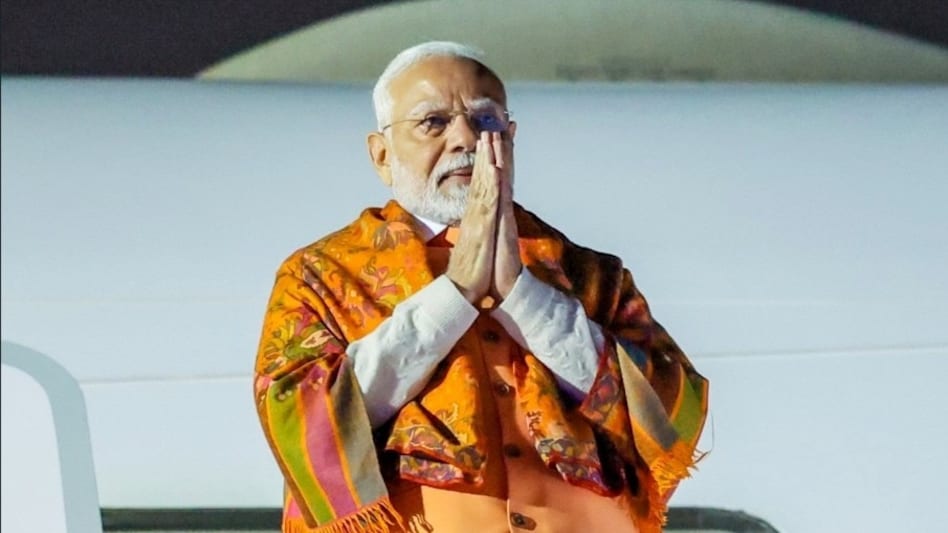 PM Modi worked to make governance more citizen-centric, transparent, and result-oriented.
  NSE empanels Augmont as key partner to promote Electronic Gold Receipts
 Repeated ₹2,000 UPI payments for one purchase? Your bank could flag the pattern: What it means
 US govt vs Anthropic: DC appeals court upholds Pentagon blacklist order. What it means?
 Historic! Home loans in India are now cheaper than the US -- What NRIs must know
 Xi Jinping in US: Beijing, Washington agree to $30 billion reciprocal tariff cut, says report
 R Veeramani Case: Granite Tycoon Faces Widening POCSO Probe In Chennai
 Gen Z And Money: Why Young Investors Want Quick Returns Over Long-Term Wealth Creation
 How Is Alexa+ Different? Will It have Ads Even If You Pay? Exclusive Chat
 Demand Robust Across Segments | Production To Ramp Up, Exports To Expand: Vivek Srivatsa
 GST Council To Meet On October 7: Invoice Matching, ITC & UPI MDR Tax In Focus
 IPO rush: Four IPOs conclude today; check subscription status, other details of issues still open
 Meesho shares slip 7% as Nomura assigns 'reduce' call; here's what the brokerage says
  Sensex, Nifty extend losing streak to seventh week, longest since 2020: What's next?
 Suzlon in bear grip: Oversold signals emerge near 52-week low for the stock
  EIL shares jump 7% to hit record high; stock up nearly 62% in six months: What's driving the rise?
 Government bank jobs barely grew in 5 years even as PSU bank business surged 56%
 Asian Games 2026: India beat Iran 40-34 in thrilling Men’s kabaddi final to retain gold medal
 Who is Preeti Aghalayam? IIT Madras alumna’s journey from student to first woman IIT director
 ₹20,000 salary, two PF calculations: What changes in your September 2026 EPF contribution












