








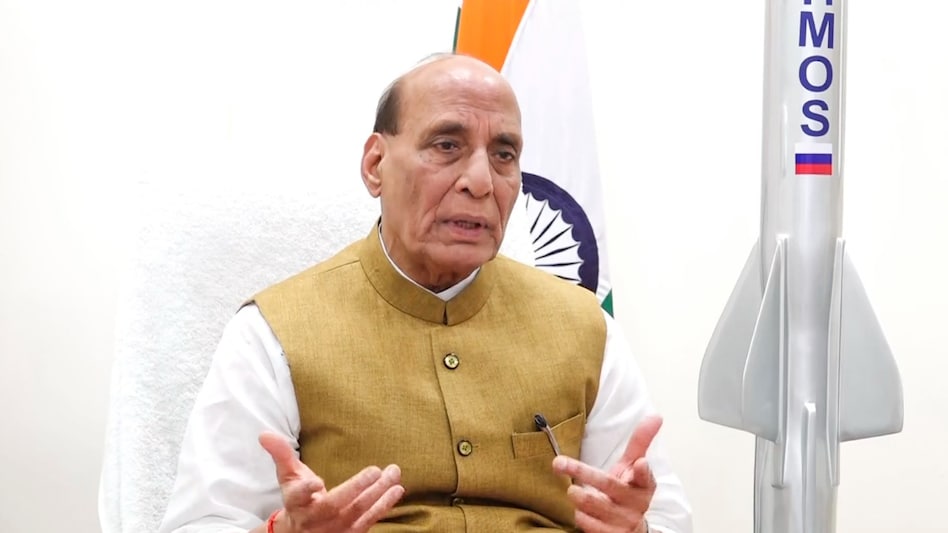
 Defence Minister Rajnath Singh virtually attends the inauguration of BrahMos Aerospace Integration and Testing Facility, in New Delhi, on May 11.
  Defence Minister Rajnath Singh virtually attends the inauguration of BrahMos Aerospace Integration and Testing Facility, in New Delhi, on May 11.
 Indian armed forces struck deep into Pakistani territory under Operation Sindoor, reaching even Rawalpindi — the seat of the Pakistani Army’s headquarters — Defence Minister Rajnath Singh revealed on Sunday. The mission, launched in response to the Pahalgam terror attack, was aimed at dismantling the infrastructure supporting terrorism, he said, adding that those responsible for shattering Indian families “had been punished.”
Virtually addressing an event in Lucknow to inaugurate a BrahMos missile production unit, Defence Minister Rajnath Singh described Operation Sindoor as more than a military campaign — it was, he said, a “symbol of India's political, social and strategic will against terrorism.”
The operation was launched in the early hours of May 7 to target nine terror infrastructures across Pakistan and Pakistan-occupied Kashmir. It served as the overarching command for all subsequent retaliatory actions in response to Pakistani offensives, Singh said.
“The entire country is congratulating the Indian military for the success of the operation,” he noted, crediting it as a clear demonstration of both military might and national resolve.
"We have shown that whenever India takes any action against terrorism, even the land across the border will not be safe for the terrorists and their masters," Singh said. He emphasized that while Indian forces focused strictly on terrorist targets, Pakistan deliberately attacked Indian civilian areas, including religious sites.
"We never targeted their civilians. But Pakistan not only targeted civilian areas of India but also tried to attack temples, gurudwaras and churches," he said.
Singh commended the Indian Army’s conduct during the operation, stating, "The Indian Army has displayed valour and courage as well as restraint and has given a befitting reply by attacking many of Pakistan's military bases."
He highlighted that Indian strikes were not limited to border regions. "We not only took action against the military bases near the border but the threat of Indian forces was felt even in Rawalpindi," he said.
The defence minister underlined the shift in India’s security doctrine post several high-profile terror incidents. “After the Uri incident, our army entered Pakistan and carried out surgical strikes. After the Pulwama attack, we carried out Balakot air strikes. And now the world is seeing how India entered Pakistan and carried out multiple strikes following the Pahalgam attack,” he said.
Singh concluded by reaffirming the government's unwavering stance on national security: “Following the policy of zero tolerance against terrorism, our Prime Minister Narendra Modi has made it clear that this is the new India which will take effective action against terrorism on both sides of the border.”
 Mahindra emerges as South Africa’s third-best volume brand after record 2025 sales
 OpenAI backs Sam Altman’s brain-computer interface startup Merge Labs
 Budget 2026: No printing press yet at new complex, Budget documents to be printed at North Block
 Pakistan’s crypto push: Decoding the USD1 stablecoin deal linked to Donald Trump’s family
 Goldman Sachs shares hit record $961.86 as strong trading and earnings fuel rally: Report
 GST Cut Caused Short-Term Pain, But Used-Car Market Disruption Has Begun: CARS24 CFO
 Is Simple Energy's New Launch Worth A Buy? Let's Test It!
 Chennai Sangamam Lights Up Pongal With Music, Folk Arts And A Grand Celebration Of Tamil Culture
 Sadaf Sayeed On Gold, Silver Rally | What Microfinanciers Expect From Budget 2026
 New CPI, GDP Series To Help RBI Balance Inflation And Growth: RBI GUV Sanjay Malhotra
 Goldman Sachs shares hit record $961.86 as strong trading and earnings fuel rally: Report
 HDFC Life Q3 results: Profit inches up to Rs 421 crore; premium income climbs 9%
 South Indian Bank Q3 earnings: Lender reports highest quarterly profit, NPAs fall
  L&T Tech Q3 results: Net profit rises 2% to Rs 329 crore; sales up 10.2%
 Jio Financial Q3 results: Profit slips nearly 9% to Rs 269 crore; revenue zooms 106%