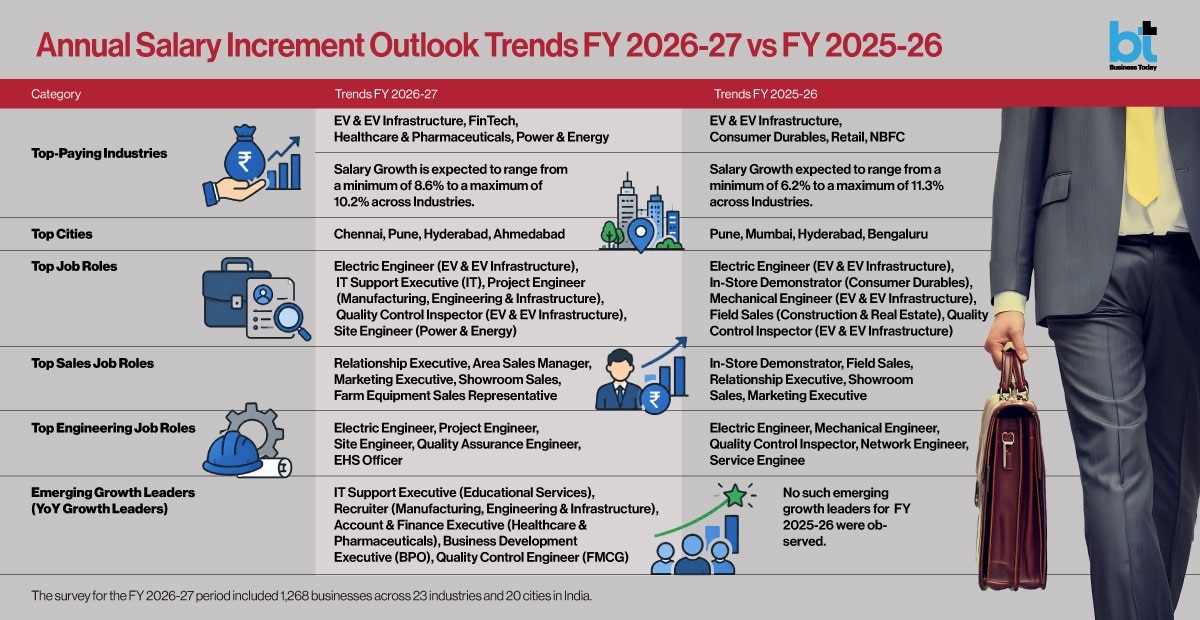
The report, based on inputs from 1,268 businesses across 23 industries and 20 cities, projects overall salary growth of 8.6% to 10.2% across industries, with EV and EV Infrastructure, FinTech, Healthcare and Pharmaceuticals, and Power and Energy leading the charge.
At the city level, Chennai is expected to lead the salary race with projected increments of 9.7%, followed by Pune and Hyderabad at 9.6% each, while Ahmedabad and Visakhapatnam are close behind at 9.5%. Nagpur at 9.4% are also gaining traction supported by manufacturing expansion and industrial corridor development. In contrast, cities including Surat at 8.4% (down from 8.9%), Chandigarh at 8.5% (down from 9.9%), and Lucknow at 8.7% (down from 9.1%) are witnessing lower levels of growth compared to the previous year.
MUST READ | Why fresh graduates are struggling to land their first job
Commenting on the findings, Balasubramanian A, Senior Vice President, TeamLease Services, said India's salary landscape in FY 2026-27 is becoming more differentiated and execution led. “Increment trends are increasingly being shaped by sector-specific growth and specialised skills. At the same time, compensation growth is no longer concentrated only in traditional metro markets. Emerging cities are steadily strengthening their position in the talent economy, supported by industrial expansion, enterprise investments, and evolving business ecosystems."
But amid optimism, a question continues to trouble employees: Do salary hikes really translate into a better quality of life?
Speaking to Business Today, Balasubramanian said that employees often experience inflation very differently from headline economic data.
"The biggest pressure points for the middle class are housing, healthcare and education. These costs often rise much faster than overall inflation. As a result, even when salaries increase, many employees may not feel significantly better off financially," he said.
Why freshers are struggling to command higher salaries
The report highlights a growing trend that is reshaping India's labour market: employers are increasingly rewarding specialised skills over generic qualifications.
Balasubramanian believes this also explains why entry-level salaries in several sectors have remained relatively stagnant despite continued discussions about talent shortages.
DON'T MISS | How corporates are searching for the next leader
"It is not just about employment. It is about employability," he said, pointing out that companies spend significant resources training fresh graduates during their first year of employment.
According to him, internships and practical exposure should be viewed as an essential part of education rather than an optional advantage.
The outcome is a widening divide between graduates who possess industry-relevant skills and those who do not.
Why GCC salaries aren't distorting the market
The rise of Global Capability Centres (GCCs) has sparked concerns that salary growth is becoming concentrated among a small section of highly skilled professionals. But the premium is attached to capability rather than the GCC label itself.
"Compensation has always been linked to skills and business models rather than job titles. GCCs pay more because they require higher-value skills and operate further up the value chain," Balasubramanian said.
The pay transparency
Another shift underway is the growing transparency around salaries.
Employees today have access to salary reports, peer benchmarks, professional networks and online communities, making compensation conversations more informed than ever before.
"The future is less likely to be about secrecy and far more about clearly explaining why people are paid differently," Balasubramanian said.
MUST READ | A day with a CXO: The unexpected lessons MBA students discovered
This increasing transparency is forcing organisations to articulate not just what they pay, but why they pay it.
AI, layoffs and the future of work
The report arrives at a time when concerns around layoffs, restructuring and artificial intelligence continue to dominate workplace conversations.
Yet Balasubramanian remains optimistic. "We are going through a disruptive transition, but technological shifts have historically created more opportunities than they have eliminated," he said.
The real differentiator, he argues, will be adaptability. As AI reshapes work, the labour market is increasingly rewarding continuous learning, digital fluency and the ability to acquire new skills quickly.
For professionals worrying about whether AI will take away jobs, the message is straightforward: the future may belong less to those who hold a degree and more to those who keep learning.
















 Electrical engineers are projected to receive salary increments of 11.2%
 IRDAI’s insurance distribution reforms: What changes for insurers, brokers, customers
 This is not a tax, cess, surcharge...: FM Sitharaman explains what the new UPI MDR really means
 Five-day banking week never up for negotiation, say govt sources
 GLP-1 drugs are under fresh scrutiny over rare condition; here's what's happening
 BT Big Story: The price tag of UPI: Will small shops go back to cash?
 Demand Robust Across Segments | Production To Ramp Up, Exports To Expand: Vivek Srivatsa
 GST Council To Meet On October 7: Invoice Matching, ITC & UPI MDR Tax In Focus
 Tata Chip Plans Stay On Track Despite Boardroom Rift; Dholera Fab Investment Unaffected
 GLP-1 Drugs Face Eye Safety Concerns: Will Fresh Scrutiny Impact India's Growing Market?
 Inside Tata’s Biggest Boardroom Battle: Noel Tata Vs N Chandrasekaran Explained | Hitesh Jain
 IPO rush: Four IPOs conclude today; check subscription status, other details of issues still open
 Meesho shares slip 7% as Nomura assigns 'reduce' call; here's what the brokerage says
  Sensex, Nifty extend losing streak to seventh week, longest since 2020: What's next?
 Suzlon in bear grip: Oversold signals emerge near 52-week low for the stock
  EIL shares jump 7% to hit record high; stock up nearly 62% in six months: What's driving the rise?
 IRDAI’s proposed distribution overhaul: Insurance sector may see major reset; could force distributors rework business models, innovate, say analysts
 Gold imports plunge in India, but gold ETFs surge: What the demand shift means for investors
 Explained: The backlash behind Meta's 'pervert glasses', and its new audio-only fix
 Suzuki bets on compact range extender electric vehicles to catch up in the EV race


