“Retailers only make 18-19% margins. After all the expenses, if they are lucky, they make 2-3%. So, the 0.4% MDR is going to affect them,” says Kumar Rajagopalan, CEO of the Retailers Association of India. “As it is, many of them don’t take credit cards or if they do, they tell customers to pay more. UPI then became their go-to. It changed the way merchants accepted money,” he adds.
GROWING WORRIES
India’s home-grown payments system, Unified Payments Interface (UPI), has grown by leaps and bounds over the past decade and become a default option to pay for everything from a cup of tea to monthly groceries to electricity bill. In August alone, there were 24.51 billion transactions, with their value totalling Rs 29.82 lakh crore. Will MDR change this?
Rajagopalan feels that larger merchants and retailers may not worry too much and absorb the charge, but small merchants will think twice. There is also another concern whether customers, who mostly pay by UPI or other digital methods, will agree to pay a bit more or pay cash or simply move to other retailers.
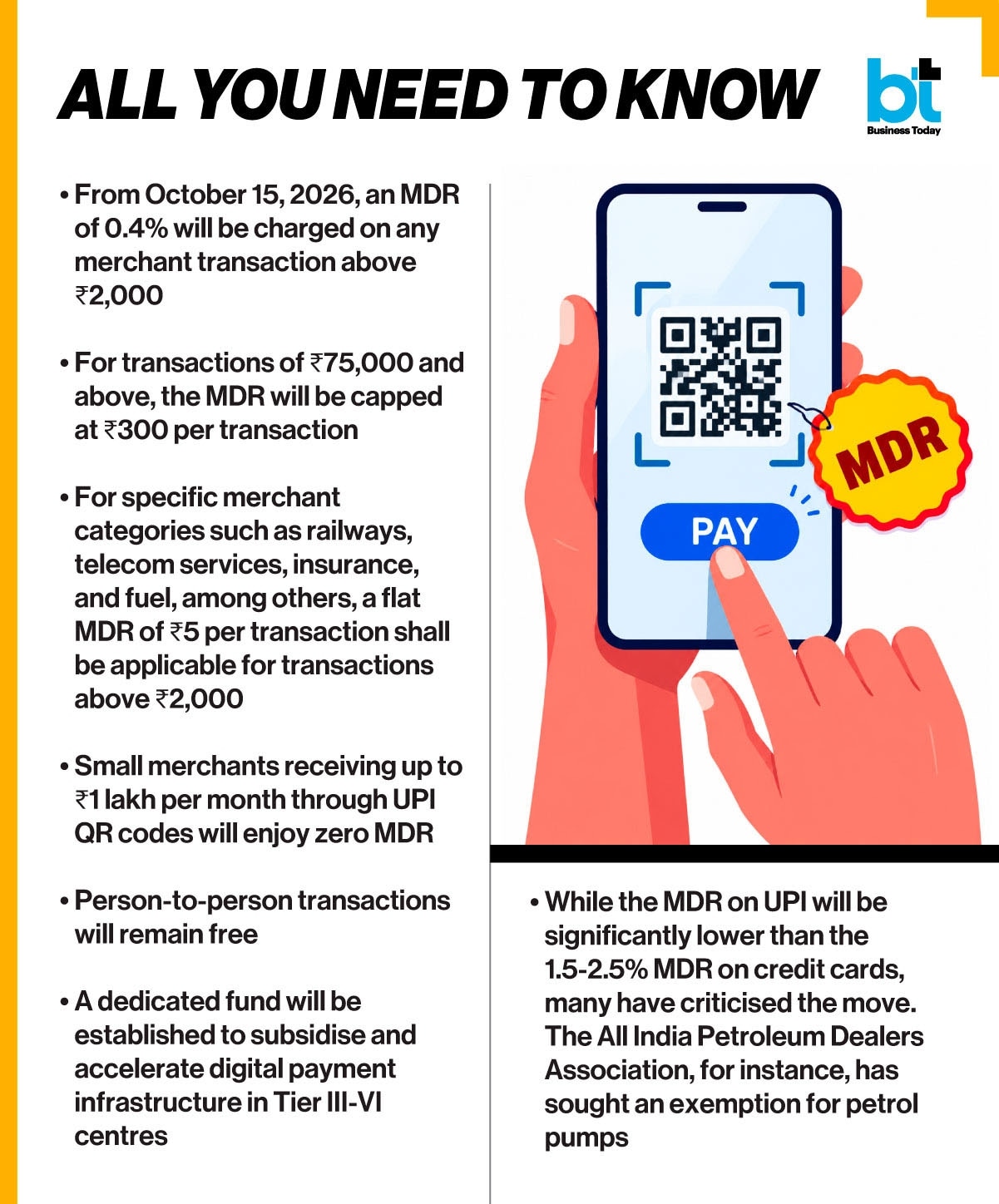
Meanwhile, another issue has cropped up. Small merchants receiving up to Rs 1 lakh a month through UPI will not have to pay the levy, as per the person-to-person-merchant (P2PM) guidelines. But Rajagopalan says this is an extremely low threshold.
Rajiv Kumar, the former Vice-Chairman of Niti Aayog, expresses similar views, stating there was no need to disturb the status quo.
“The local chatwallas, dhabas, vegetable and fruit juice sellers have a daily income of Rs 5,000. That totals more than Rs 1 lakh. So, they will be classified as P2M and charged 0.4%. Who will determine the monthly income of millions of such vendors and yet prevent harassment? Huge incentive to shift back to cash,” Kumar wrote on social media platform X.
MUST READ: MDR on UPI: Will examine concerns raised by stockbrokers, says SEBI chief
The National Payment Corporation of India, the umbrella organisation that operates retail payment and settlement systems across India, has clarified that if monthly sales exceed Rs 1 lakh, the acquiring bank will categorise the merchant under P2M, but MDR will apply on UPI transactions above Rs 2,000 only.
Petroleum dealers recently held discussions with the Ministry of Petroleum and Natural Gas seeking an exemption from the new charges and threatening non-acceptance of UPI from October 15. They later clarified that UPI payments will continue to be accepted.
UPI, launched in 2016, was made free in 2020, as the government looked to aggressively push digital payments. The government had subsidised UPI transactions for years. But with the scale growing significantly, it wants to make the system sustainable. For transactions of Rs 75,000 and above, the MDR will be capped at Rs300 per transaction.
DO READ: UPI MDR GST: NPCI says small merchants and 96% of transactions remain unaffected from October 15
For specific merchant categories, such as railways, telecom services, insurance, and fuel, among others, a flat MDR of Rs5 per transaction shall be applicable for transactions above Rs 2,000. Person-to-person transactions, however, will continue to be free.
The MDR will be shared by the players within the ecosystem, which includes the payment system provider, payment apps, and banks. It is estimated to create a pool of almost Rs 20,000 crore annually.
ARGUMENTS FOR MDR
Backers of MDR say the charge is significantly lower than for other forms of payment like credit cards, where a merchant is charged an MDR of up to 3%. They say the MDR on UPI will open new revenue streams for players in the ecosystem.
“The introduction of MDR is expected to materially improve the monetisation potential of UPI and create a commercial incentive for participants across the ecosystem,” Co-founder and CFO of One MobiKwik Systems, Upasana Taku said recently.
While only 4% of UPI transactions are expected to attract MDR, the eligible transactions could represent 15-20% of UPI GMV (gross merchandise value), as the threshold is linked to transaction value, Taku said in an expert session with broking firm Motilal Oswal.
ALSO READ: Food delivery, quick commerce largely shielded from UPI MDR despite high digital payments
Historically, payment companies have had to absorb significant fixed costs related to onboarding and servicing merchants despite limited direct monetisation from UPI transactions. Taku noted that with MDR, incremental transaction volumes can now contribute directly to revenue, potentially accelerating merchant acquisition and improving the economics of existing merchants.
Furthermore, the MDR should help in strengthening cyber security, fraud prevention, and pushing innovation, experts say.
Anirban Mukherjee, CEO, PayU, concurs. “UPI’s real achievement is that millions of merchants and customers are now part of the digital economy. The next stretch towards 90% digitisation is about bringing merchants and buyers who are still outside the digital economy into the fold,” he says. He adds that achieving this at scale will require a self-sustaining platform that can continue to invest in reliability, security, technology and innovation.
“The return of MDR is an important step in creating that sustainable foundation and enabling UPI to scale further,” he says.
Ranadurjay Talukdar, Partner and Payments Sector Leader, EY India, agrees that for banks and payment providers, this move creates resources for resilience, cybersecurity, innovation and customer service.
“The revised UPI MDR framework represents a shift from subsidising adoption to building sustainable digital infrastructure. Its calibrated design protects consumers, small merchants and over 95% of low-value merchant transactions, while asking larger commercial payments to contribute modestly towards ecosystem costs,” he says.
DON'T MISS: GST on UPI MDR: Government rejects ‘tax on UPI’ rumours, says MDR will be set off through input tax credit
THE NEXT TEST
The finance ministry has stressed that the MDR is borne by the merchant, and consumers will not bear the cost. However, some stakeholders believe that the higher costs may still be passed on through various means.
“Economically, a general price increase, reduced discount, or payment-linked fee can shift MDR onto consumers, even if the invoice does not identify it. At 0.4%, the direct cost is Rs 4 per Rs 1,000, but cumulative costs matter for thin-margin businesses,” says Manoranjan Sharma, Chief Economist, Infomerics Ratings, a credit ratings agency.
A two-tier pricing structure is plausible if merchants preserve a common headline price but vary discounts by payment method, he says. Therefore, monitoring transaction-level pricing will matter more than headline prices when assessing the MDR’s real incidence, adds Sharma.
EY’s Talukdar also believes the key will be transparent sharing of MDR revenues, strict prevention of consumer surcharges, and effective deployment of the proposed fund to deepen acceptance among smaller merchants and underserved markets.
UPI has transformed the way India pays. The question now remains whether putting a price on a part of that ecosystem will strengthen it without weakening the very merchant base that helped make it universal.
For UPI, the challenge will be to ensure that the cost of sustainability does not come at the expense of adoption.
















 UPI, launched in 2016, was made free in 2020, as the government looked to aggressively push digital payments.
 BTTV Exclusive: Ashishkumar Chauhan explains why NSE went public now
 Tata Sons rejects Noel Tata objections over N. Chandrasekaran reappointment
 GST Council to take up proposal of MDR on UPI
 SEBI's settlement rules set for a big revamp; experts call for balance between speed and accountability
  SEBI rewrites PMS rulebook, allows IPO, foreign securities and unlisted debt investments
 Meta’s New Gadgets: Camera-Free Glasses, VR Eyewear And AI Handheld Device Unveiled
  MDR Levy: Will Retail Trading Volumes Take A Hit? | NSE Chairman Srinivas Injeti
 NSE Lists At ₹1,800: Exclusive Post-Listing Interview With India's Largest Exchange
 From Mobile Trading To AI: How NSE Plans To Protect Market Integrity
 NSE On India’s Capital Markets Growth | IPOs, REITs, InvITs And More
 SEBI allows PMS exposure to foreign securities: What products can clients access?
 HSBC plans India equity broking return amid IPO boom, says report
 Insurance commission caps: What happens to your policy when the seller earns less?
 Railway UPS pension calculator: How much can you get after 10, 20 and 25 years?
 This 48-year-old doctor quit her 20-year medical career to open a steamed bun shop, says ‘I just want to live a life I love’
 Financial Horoscope Today, September 25, 2026: Increase in Wealth for Gemini, Know the Condition of All Signs


