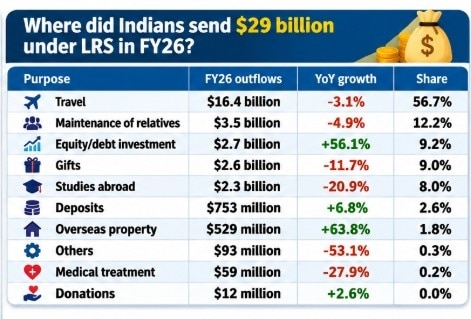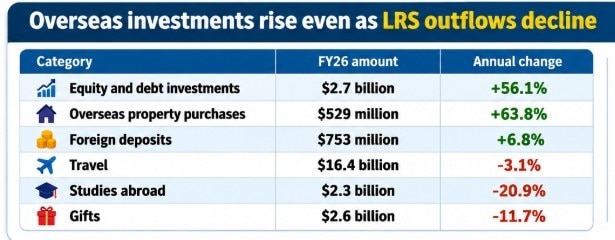



 Travel remains the largest category, accounting for $16.4 billion, or 56.7% of total LRS remittances in FY26.
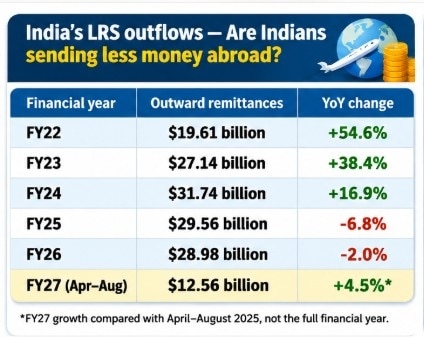
Indians remitted nearly $29 billion overseas under the Reserve Bank of India's Liberalised Remittance Scheme (LRS) in FY26, but concerns that these transfers are putting excessive pressure on India's foreign exchange reserves may be misplaced, according to Deepak Shenoy, founder and CEO of Capitalmind.
Citing RBI data, Shenoy argued that outward remittances have actually declined over the past two years, while a growing portion of the money sent abroad represents investments rather than consumption.

 Myntra, Flipkart lose festive fashion market share as rivals gain ground
 Bharti Airtel overtakes Jio Platforms to become India's second-most valuable listed company after RIL
 Diwali cheer on D-St! Nifty reclaims 25,000 as rally extends to 7th session; investors add over Rs 30 lakh crore
 Diwali 2026 shopping boom: Indians set to spend $16 billion online as festive sales jump 25%
 December deals, CAFE 3 clearance: Better times ahead for car buyers
 "India's First Cathode Material Unit": 12 Electronics Projects Get ₹7,503 Crore Push
 Global Market Bloodbath: U.S. And Asian Stocks Crash, Is India The New Safe Haven For Investors?
 Gold Rush On Dhanteras! Zaveri Bazaar Buyers Defy PM's Appeal Amid Record Prices
 Market Guru | Abhay Agarwal On Samvat 2083: Investment Strategy & Market Outlook
 M&M Q2 Earnings: Auto Business Powers Growth, Farm Segment Faces Pressure | Rajesh Jejurikar

 Zerodha Fund House becomes Zerodha CASE Funds as investor base crosses 12 lakh in three years
 Gold, silver or stocks this Dhanteras? Nifty 500 won 9 years, gold 7 and silver 5 since 2006
 Bharti Airtel shares: Citi remains bullish after strong Q2 despite elevated churn; Rs 299 plan restored
 Vijay Kedia shares formula on how to pick stocks during correction Diwali cheer on D-St! Nifty reclaims 25,000 as rally extends to 7th session; investors add over Rs 30 lakh crore
 Before Ravi Varma: How Kolkata's artists brought Goddess Kali from temples into Indian homes
 Can you convert NSE's Electronic Gold Receipts into jewellery or physical gold? Here's how redemption works
 IPL franchises face a new salary challenge as star players demand ₹40 crore retention deals
 Aadhaar cardholders can update documents for free till June 14, 2027: Steps to follow
 Financial Horoscope Today, November 7, 2026: Capricorn Will Achieve Their Goals, Know the Status of Other Signs