So far, SEBI has not commented on the report.
Currently, LTCG tax of 12.5% applies to equity investments held for more than a year. If equity investments are sold within a year, a short-term capital gains (STCG) tax of 20% applies. Investors also pay securities transaction tax (STT).
Speaking at the Bloomberg New Economy Forum in October, Finance Minister Nirmala Sitharaman said she was open to hearing suggestions on scrapping LTCG tax.
Between April 1 and November 2, 2026, FPIs sold more than Rs 1.59 lakh crore worth of equities in the domestic market. This comes on top of the nearly Rs 1.81 lakh crore they sold in FY26 and Rs 1.27 lakh crore in FY25.
The massive sell-off has been driven by several factors: continued geopolitical uncertainty stemming from the war in West Asia, rising crude oil prices that are pushing up India's import bill, and attractive AI-related investment opportunities in other markets.
The rupee has also depreciated against the US dollar. A weaker rupee erodes dollar-denominated returns for foreign investors holding Indian stocks, while further FPI selling adds to the pressure on the currency.
MUST READ: Goodbye LTCG tax? SBI says government can absorb ₹50,000 crore revenue loss as Budget 2027 hopes rise
Market experts, therefore, believe that scrapping LTCG tax in these circumstances could help make Indian equities more attractive to foreign investors.
“FII selling has reached such a level that it has started impacting India's otherwise good macros. It is impacting the rupee, and also rupee depreciation leads to imported inflation. This is not something, which the Indian economy can afford right now because the poor monsoon this year will aggravate the food inflation further,” V. K. Vijayakumar, chief investment strategist at Geojit Investments, said.
He stressed that there is a case for scrapping LTCG tax not just for foreign investors but also for domestic investors.
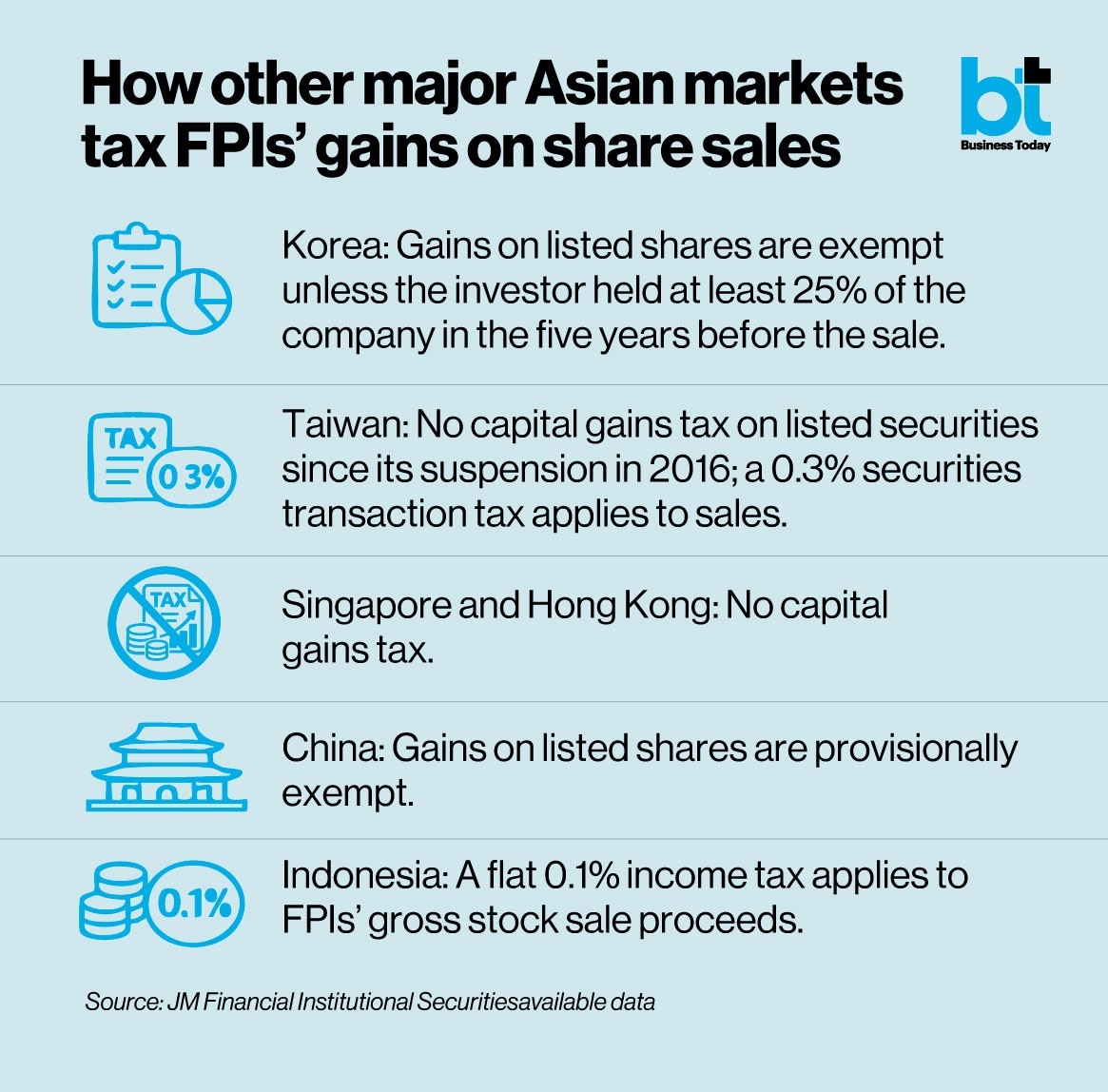
Market analysts also point out that India is an outlier among major Asian markets when it comes to LTCG tax.
According to Venkatesh Balasubramaniam of JM Financial Institutional Securities, Korea exempts gains on listed shares unless an investor held 25% or more of a company in the five years before the sale. Taiwan has no capital gains tax on listed securities and charges a 0.3% transaction tax on sales. Singapore and Hong Kong have no such tax. Even China's gains on listed shares are provisionally exempt, while Indonesia charges a flat 0.1% on gross transaction value, he pointed out.
JM Financial's analysis shows that in 28 of the 201 months (14%), the 12-month Nifty return was positive in rupee terms but zero or negative in US dollar terms. These periods were clustered in 2012–14, 2018–19 and 2022–23, as well as February 2025. This means a foreign investor could be liable to pay tax on a rupee-denominated gain even while incurring a loss in dollar terms.
ALSO READ: Will Budget 2027 roll out red carpet for FPIs? FM Sitharaman says, 'I recognise the voice
Eliminating LTCG would add about 2.2 percentage point to an average year’s dollar return for a foreign investor, comparable to the rupee’s average drag, according to Balasubramaniam.
Abolishing LTCG tax alone may not restart the FPI investment cycle, but it would send a positive signal, analysts note.
“A credible removal or a holding-period reform in the February 2027 Budget would tell allocators that policy is working for them,” Balasubramaniam said.
Nirav Karkera, head of research and funds manager at W by Groww, said lower capital gains taxes would improve post-tax returns, reduce investment friction and make Indian equities more competitive with those of other emerging markets.
He believes FPIs should ideally be taxed on their actual economic gains, rather than on rupee appreciation that may disappear when returns are translated into dollars.
However, he also acknowledged that tax efficiency alone would not be enough to bring foreign capital back to India. Much would depend on corporate earnings growth, equity market valuations and confidence in the rupee, he stressed.
Amid rising oil prices and FPI selling, the rupee hit a low of 96.96 against the dollar in May, prompting the Reserve Bank of India to introduce measures to stabilise the currency. These included a concessional swap window for banks to raise FCNR (B) deposits and a dedicated dollar window for three public sector oil marketing companies. The measures have helped lift the rupee, which traded around 94.90 on Monday, November 2.
ALSO READ: Will Budget 2027 roll out red carpet for FPIs? FM Sitharaman says, 'I recognise the voice
Jefferies analyst Abhinav Sinha said foreign inflows could support the rupee.
Following recent tax relief for foreign investors in government securities (G-Secs), FPI debt inflows picked up to $9 billion in June–July 2026, he noted. An equity LTCG tax cut could similarly improve sentiment and flows, supporting the rupee.
“An out of budget capital-gains tax rate change is feasible via the ordinance route, such as the recent tax relief granted to specific foreign investors in Indian government bonds,” said Sinha.
Another question is how the government would make up for the revenue loss if LTCG tax were abolished.
Jefferies estimates equity LTCG tax collections at Rs 1.3 lakh crore in FY25. Together, equity LTCG tax and STT accounted for 8% of direct tax revenue and 5% of gross tax revenue that year. Given fiscal pressures, the government may need to offset any revenue loss from an LTCG tax cut.
Geojit's Vijayakumar pointed out that the government was already doing well on the indirect tax front, as reflected in the 23% surge in Goods and Services Tax (GST) collections in October 2026. Moreover, the government could consider raising STT to partly offset the revenue loss from scrapping LTCG tax.
Balasubramaniam noted that taxing FPIs on their dollar-denominated gains, or indexing the cost base to account for rupee depreciation, could eliminate instances in which investors owe tax on rupee gains despite making losses in dollar terms. Such measures would also come at a lower fiscal cost than a complete abolition of LTCG tax.
DO READ: BT Explainer: How securities tax policies like LTCG have evolved












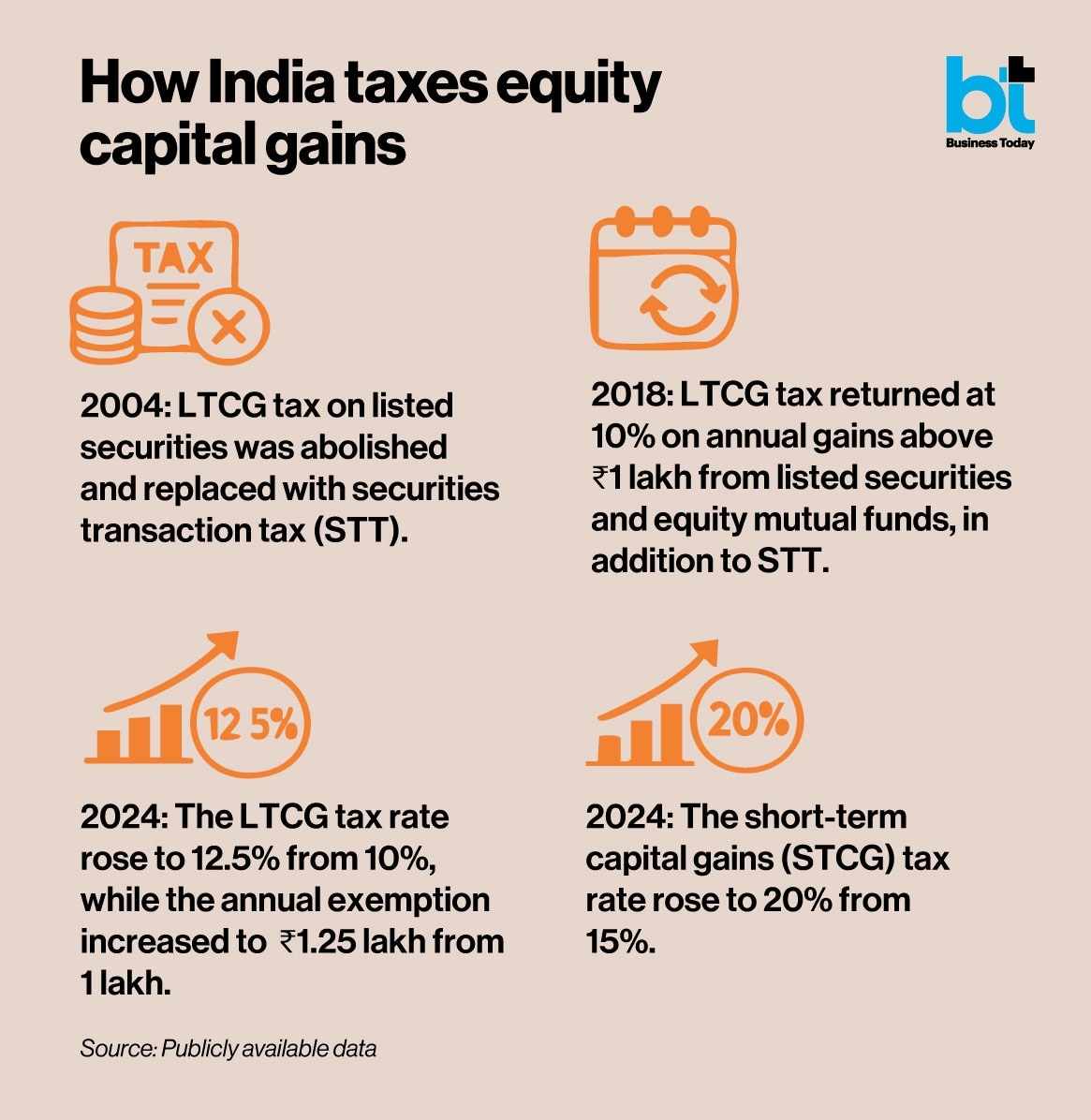



 Currently, LTCG tax of 12.5% applies to equity investments held for more than a year.

 India may soon install 1 lakh rooftop solar systems every 4-5 days, says Pralhad Joshi
 TVS succession: A question of who gets what
 NSE Q2 results: Net profit jumps 23% to ₹2,578 crore, trading volumes lift revenue
 Odisha targets 74% non-fossil energy mix by 2047, bets on floating solar and storage expansion
 India deserves three national carriers, says Adani Airports CEO: Is Adani the answer?
 Is SIF Right For You? Strategy, Risk And Returns Explained
 India's Gold Demand Crashes 29%: Modi's Appeal, High Prices Hit Buying Appetite
 Trump’s Plan B: How White House Could Govern Without Congress | US Midterm Elections
 32,490 Trees At Risk? Maharashtra’s Saidongar Project Sparks Row
 From Wheat And Bajra To Chillies And Tomatoes: A Farmer’s Solar Experiment In Rajasthan

 IPOs delivered 21% average listing gains, but did investors actually make money?
 BLS Polymers, SFC Environmental shares zoom up to 81% in maiden trade
 India is a market for multibagger stocks, says Shankar Sharma; cautions against calling market bottom
 Upcoming IPOs: Over 20 issues may hit market soon after Rs 1.35 lakh crore fundraise in 4 months
 Rupee may slide to 102 against US dollar by December 2027, 106 by 2028: Report
 Want to work in New Zealand? 17 jobs to lose Green List Work to Residence route from March 2027, check the full list
 Himalayas tower over the world: 8 of the world’s 10 tallest mountain ranges are in Asia
 EPFO vs Zerodha withdrawal rules: Where can you get your money faster in an emergency?
 IIT students study Sanskrit and shastras to strengthen reasoning skills, says IISc professor