












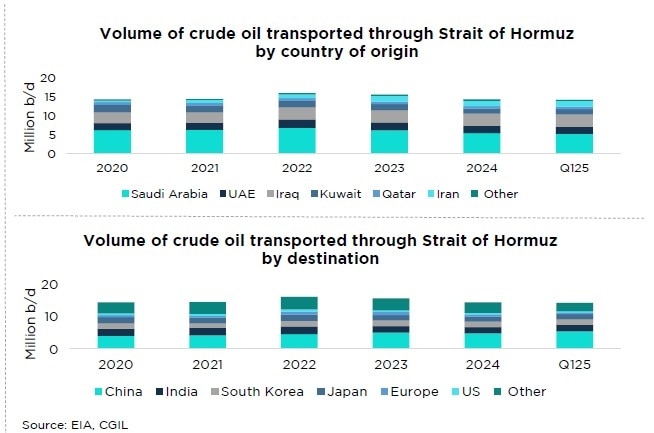



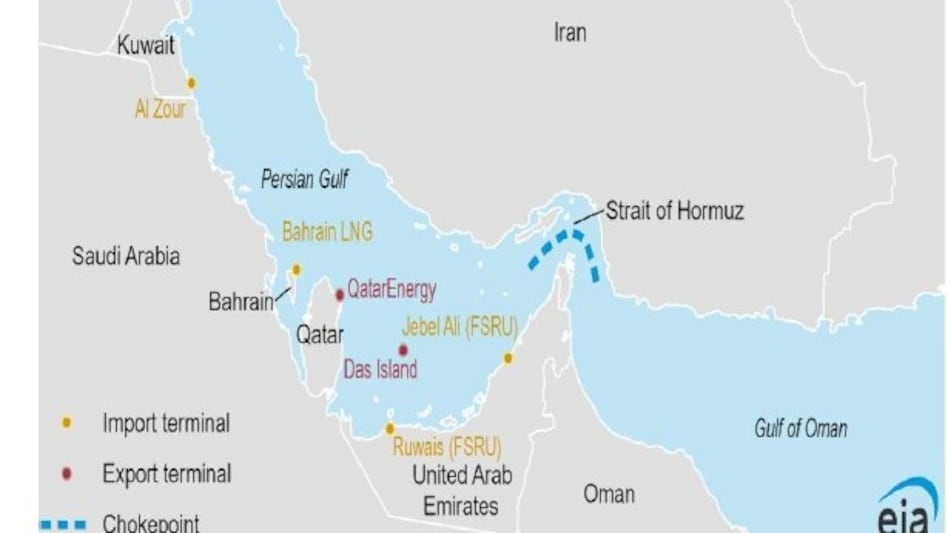
 India’s LNG infrastructure faces uneven Hormuz exposure, with Petronet LNG’s Dahej terminal most vulnerable at ~76%.
India’s natural gas supply chain faces growing vulnerability due to its heavy reliance on liquefied natural gas (LNG) shipments routed through the Strait of Hormuz, a key global energy chokepoint. Multiple research reports by Elara Securities, Crisil Ratings and CareEdge Global highlight that any prolonged disruption in the region could ripple across India’s LNG infrastructure, pipeline networks and energy-intensive industries.
According to a recent note by Elara Securities titled “LNG: Steering through the Hormuz bottleneck”, nearly 69 percent of India’s LNG imports, about 17.5 million tonnes or 63 million metric standard cubic metres per day, originate from Qatar, the UAE and Oman, meaning most shipments transit through or near the Strait of Hormuz. Even after accounting for GAIL’s LNG swap arrangements with the US, the effective exposure of India’s gas system remains around 66 percent, underscoring the structural dependence on Middle Eastern supply routes.

 NSE IPO fully subscribed on Day 2; QIB, NII quotas booked 1.3 times each
 Nestle faces FSSAI crackdown over baby food formula claims. What the regulator found
  STT collections jump 52.9% to Rs 40,214 crore in FY27 so far; key details
 ‘Welcome the decision wholeheartedly’: Shapoorji Pallonji on RBI’s decision on Tata Sons listing; full text
 India’s AI boom gets a massive boost: EQT plans $50 billion push with major Adani data centre bet, says report
 BTTV Exclusive | Jefferies’ Chris Wood On AI, US Bonds, Oil & India’s Market Outlook
 LIVE What’s Hot: Stocks, Gold & Big Money Moves | Daily Markets Show | September 17 | Business Today
 From NPAs To Infrastructure: CEA On How India’s Economy Has Changed Under PM Modi
  “PM Modi Is Architect Of Economic Policy”: CEA V. Anantha Nageswaran On India’s Growth Journey
 iPhone Sale Sparks Overnight Rush As Buyers Queue Across Delhi, Mumbai, Bengaluru
 Jefferies' Christopher Wood sees gold at $10,000 'sooner or later'; likes India's small, midcaps
 NSE IPO: Applying for short-term gains from share sale? Analyst says thisSTT collections jump 52.9% to Rs 40,214 crore in FY27 so far; key details
 Kaynes Technology stock needs breakout confirmation; Moschip preferred semiconductor pick: Analyst NSE IPO fully subscribed on Day 2; QIB, NII quotas booked 1.3 times eachJefferies' Christopher Wood sees gold at $10,000 'sooner or later'; likes India's small, midcapsNSE IPO: Applying for short-term gains from share sale? Analyst says this
 Apple Pay may finally come to India next month; Axis bank tie-up reportedBTTV Exclusive | Jefferies’ Chris Wood On AI, US Bonds, Oil & India’s Market Outlook
 Semicon 2.0 draws investment commitments of ₹1 lakh crore, says IT minister Ashwini Vaishnaw


