


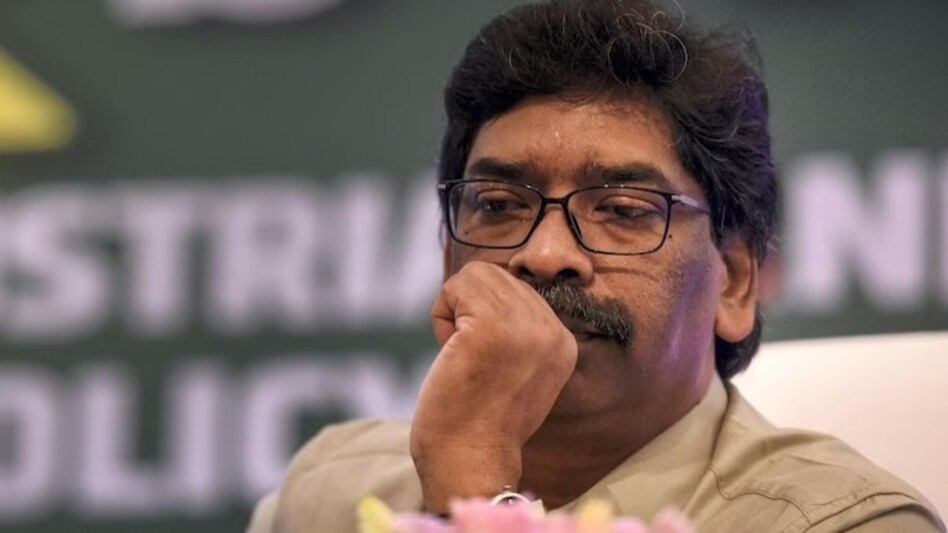
 Hemant Soren has challenged his arrest in the Supreme Court.
Former Jharkhand Chief Minister and Jharkhand Mukti Morcha (JMM) leader, Hemant Soren, has accused the Enforcement Directorate (ED) of orchestrating his arrest as part of a premeditated scheme by the Central government ahead of the upcoming Lok Sabha elections.
Soren, who was compelled to resign as chief minister in anticipation of his arrest, has filed a plea before the Supreme Court, seeking to denounce his arrest as unjustified, arbitrary, and violative of his fundamental rights. The plea, scheduled for hearing on Friday, implores for his immediate release.
 Apple’s growth under CEO Tim Cook: The journey from $350 billion to $5 trillion
 Top 1,000 listed Indian companies see 53% jump in FY25 carbon emissions: IIM-Bangalore study
 How Tim Cook introduced larger iPhone screens and changed Apple’s smartphone strategy
 NSE's ₹30,000 crore IPO: SBI, its investment banking arm to offload 1% stake
 'True founder of Bengaluru's IT hub is Jyoti Basu': Sanjeev Sanyal on Kolkata's lost tech edge
 Why Meta Could Be Fined $1.4 Trillion! Instagram-Facebook Could Change Forever
 Gold Price Outlook: Can Festive & Wedding Demand Push Prices Higher In India?
 Gold Price Rally: Why Gold Surged 16% In August; Key Triggers Behind The Comeback
 Gold Vs Silver Vs Sensex Since 2005: Which Investment Delivered Better Returns?
 “Women’s Reservation Will Be Fulfilled”: Kiren Rijiju On Delimitation And Census
 NSE's ₹30,000 crore IPO: SBI, its investment banking arm to offload 1% stake
 Jio Platforms IPO gets SEBI nod: Rs 27,500 crore debt repayment plan, $100 billion valuation in focus
 Closing Auction Session: Why the system expected to reduce volatility is still seeing occasional wild swings
 RIL-backed penny stock hits 52-week low; firm clarifies on high trading volume
 Happiest Minds shares slip despite IT stocks surge; here's what is weighing on the stock
 ‘My borrowing is ₹0’: Subhash Chandra explains ₹22,000 crore personal guarantee controversyWhy Meta Could Be Fined $1.4 Trillion! Instagram-Facebook Could Change Forever
 1,000 times faster than Hubble: Why NASA’s Roman telescope will map the dark universe Gold Price Outlook: Can Festive & Wedding Demand Push Prices Higher In India?
 Visa-free travel: Uzbekistan unveils 30-day entry for Indians during PM Modi visit












