









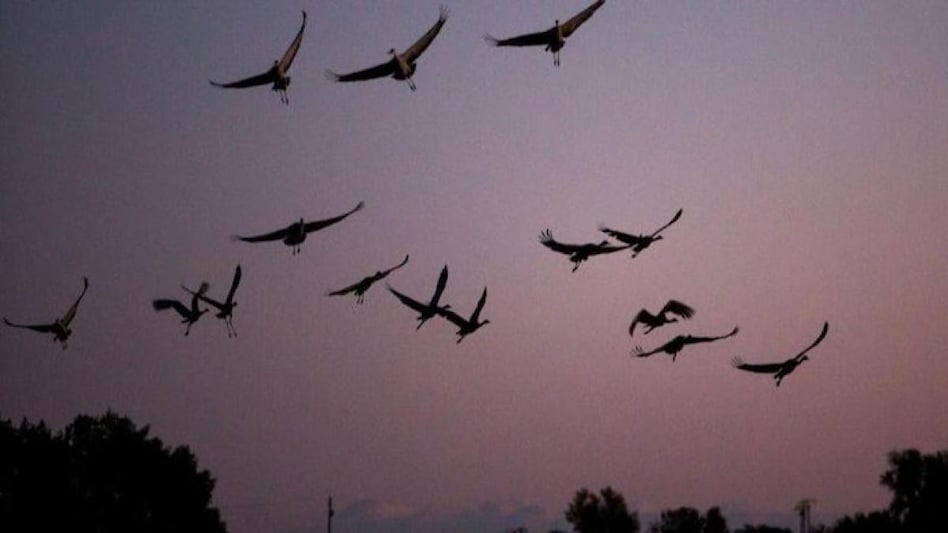
 Just hours after a powerful earthquake struck Turkey and Syria, a video showing strange behaviour by birds surfaced on social media.
  Just hours after a powerful earthquake struck Turkey and Syria, a video showing strange behaviour by birds surfaced on social media.
 Strange behaviour by birds just moments before the massive earthquake in Turkey and Syria has brought the focus back, once again, on the decades-old mystery: 'can animals predict earthquakes?'
Just hours after a powerful earthquake struck Turkey and Syria, a video showing strange behaviour by birds surfaced on social media. The video soon went viral, with some calling it 'nature's early warning system'. The theory that animals can predict earthquakes has gained currency in recent times, though scientifically it has not been proven yet.
But on Monday, former IIT Delhi Director Prof V Ramgopal Rao said there is something the researchers can learn from the animal behavior to be able to develop sensors to predict earthquakes. Apparently, he said, there have been confirmed reports of unusual animal behavior 20 hours before a quake, but the evidence for this phenomenon is largely anecdotal and not scientifically proven.
Rao, who served as IIT Delhi Director from 2016 to 2021, said he saw multiple reports of strange bird behavior the night before the recent earthquake in Turkey and Syria. "With the kind of destruction the earthquakes have been causing lately, I guess there is something we can learn from the bird/animal behavior to be able to develop sensors to #predict earthquakes a few hours before at least," he wrote.
The professor, however, said that earthquakes are relatively rare events, so it can be difficult to obtain a large enough sample size to make statistically significant conclusions about birds, and animal behavior before earthquakes. He said electromagnetic variations have been observed because of earthquakes, but there was no sufficient data to use such variations as precursors.
"The link could be in the recent discoveries that indicate that pigeons use magnetism to find their way home," he said, adding that the researchers have discovered a small spot on the beak of pigeons and some other birds that contains magnetite, which acts as a GPS unit for birds giving it information about its position relative to earth's poles. "Researchers have also found some specialized cells in birds’ eyes that may help them see magnetic fields."
Meanwhile, the US Geological Survey in a post said it can easily explain the cause of unusual animal behavior seconds before humans feel an earthquake. It said very few humans notice the smaller 'P' wave that travels the fastest from the earthquake source and arrives before the larger 'S' wave.
"But many animals with more keen senses are able to feel the P wave seconds before the S wave arrives. As for sensing impending earthquake days or weeks before it occurs, that's a different story," it wrote.
The geological department said there have been anecdotal evidence of animals, fish, birds, reptiles, and insects exhibiting strange behavior anywhere from weeks to seconds before an earthquake.
The USGS also referred to a research paper by American geologist and geophysicist Joseph L Kirschvink, who said it was possible that some animals could sense signals and connect the perception with an impending earthquake.
As per the USGS, the paper says all animals instinctively respond to escape from predators and to preserve their lives. "A wide variety of vertebrates already express "early warning" behaviors that we understand for other types of events, so it’s possible that a seismic-escape response could have evolved from this already-existing genetic predisposal."
"An instinctive response following a P-wave seconds before a larger S wave is not a "huge leap", so to speak, but what about other precursors that may occur days or weeks before an earthquake that we don't yet know about?"
"If in fact there are precursors to a significant earthquake that we have yet to learn about (such as ground tilting, groundwater changes, electrical or magnetic field variations), indeed it’s possible that some animals could sense these signals and connect the perception with an impending earthquake," the paper states, adding that much research still needed to be done on this subject.
 Nothing is better than biofuels for immediate carbon reduction: Hero MotoCorp CEO
 Is AI sustainable? Why the debate goes beyond data centres and energy use
 AI gold rush: How tech boom created a record $20.1 trillion billionaire class
 Monsoon races ahead after Kerala delay: Enters Maharashtra, when will it reach Delhi?
 ‘Global debt has crossed $330 trillion, world moving beyond the dollar’: Kremlin adviser Anton Kobyakov
 #BTSustainabilityAwards LIVE: Grand Award Ceremony & Special Edition Magazine Launch!
 #BTSustainabilityAwards LIVE: Environment Minister Bhupender Yadav On India's Green Future
 #BTSustainabilityAwards LIVE: The Eco Drive - Will Flex-Fuel & EVs Redefine India's Mobility?
 #BTSustainabilityAwards LIVE: The Organic Shift - How Conscious Consumers Reshape The FMCG Market
 #BTSustainabilityAwards LIVE: ESG Over Profits? Redefining Business For Long -Term Value
 Sensex, Nifty outlook for Monday, June 8: GIFT Nifty down 356 pts – What to expect from stock market?
 Titan shares up 20% in a year; still a ‘Buy’? - Check share price target
 Subscribed 127 times, all about CMR Green Technologies IPO latest gmp, allotment status check online, listing date
 US stock market news: Why Nasdaq, S&P 500 witnessed its worst day of year - Factors behind fall
 CMR Green Tech IPO attracts over Rs 56,200 crore bids, subscribed 127 times; check GMP, listing timeline