


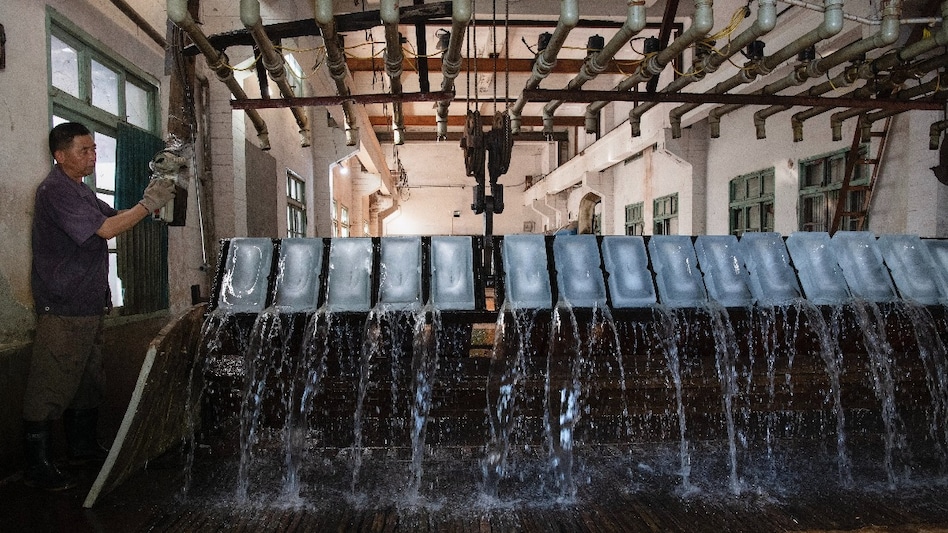
 Workers produce large blocks of ice in the ice production workshop of Xincheng Cold Storage Co. in Jinhua,
As extreme heat worsens across China, cities are rethinking how they keep buildings cool by moving away from individual air conditioners toward shared, city-scale systems known as district cooling. Centralized energy stations produce chilled water and distribute it through underground pipelines to multiple buildings in a closed-loop network, reducing duplicated equipment and improving energy efficiency.
Shenzhen’s Qianhai cooperation zone is a flagship example. Its largest cooling station—the biggest in Asia—already serves roughly 2.75 million square meters of buildings, and planners expect a network of 10 stations to significantly cut energy use and emissions. Once complete, the network is projected to save around 130 million kilowatt-hours of electricity and eliminate roughly 130,000 tonnes of CO₂ annually, according to developers.

 90% EVs exported out of India are from Maruti Suzuki: MD & CEO Hisashi Takeuchi
 India's $30 trillion goal needs 8-10% growth, $400 billion more annual investment: Jayant Sinha
 1.1 billion barrels gone: IMF warns that global oil market is running out of safety cushions
 From Devbhoomi to industrial destination: Uttarakhand’s manufacturing moment
 India’s deep-tech startups face a new test: Crossing the valley of death
 #IndiaAt100 : Adipen Bose Nandhiji On Conscious Capitalism- Can Profit & Purpose Coexist?
 #IndiaAt100 : Hisashi Takeuchi On Driving India’s Manufacturing Revolution
 #IndiaAt100 : Manufacturing For Viksit Bharat | Can Industry Power India’s $30-Trillion Dream?
 #IndiaAt100 : Tarun Garg On Hyundai & India’s Manufacturing Powerhouse Ambition
 #IndiaAt100 : CM Pushkar Singh Dhami On Uttarakhand’s Industrial Growth & India’s Next Leap
 Cupid, NTPC Green, NTPC, Raymond Realty, HAL shares: Key technical levels to watch
 Defence stock with Rs 2,654-crore order book hits record high; here's why
  GACM Technologies: FII holding jumps to 29%; penny stock in focus
 Puravankara shares rise 5% on fresh order win
  20 high-conviction ideas for up to 95% upside | stocks to buy #IndiaAt100 : Adipen Bose Nandhiji On Conscious Capitalism- Can Profit & Purpose Coexist?#IndiaAt100 : Hisashi Takeuchi On Driving India’s Manufacturing Revolution#IndiaAt100 : Manufacturing For Viksit Bharat | Can Industry Power India’s $30-Trillion Dream?#IndiaAt100 : Tarun Garg On Hyundai & India’s Manufacturing Powerhouse Ambition
 Rising demand, Make in India focus driving manufacturing growth in India, but speed bumps need to be addressed, say experts












