









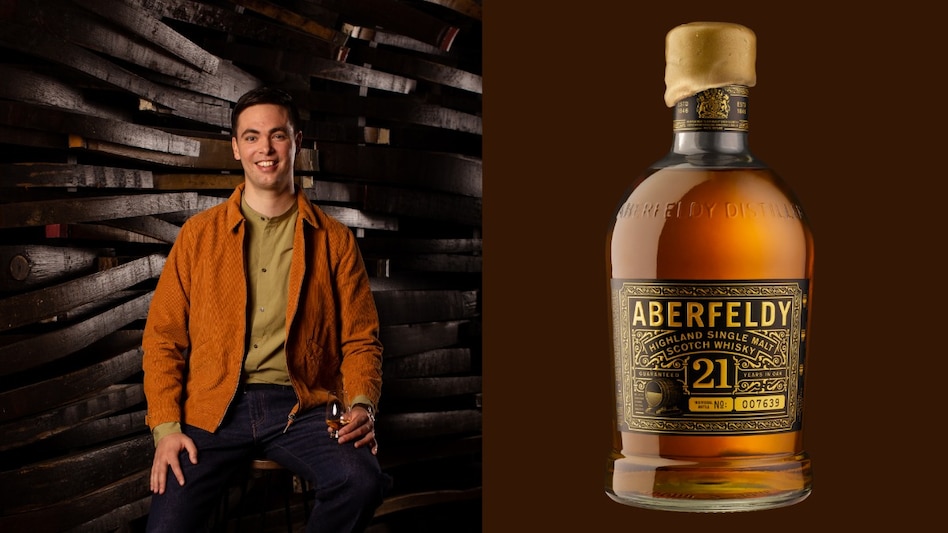
 Matthew Cordiner, Global Whisky Ambassador, Bacardi.
 Matthew Cordiner, Global Whisky Ambassador, Bacardi.
India’s whisky market is evolving rapidly, with new-age drinkers gravitating toward premium single malts and global distilleries sharpening their focus on the country. Aberfeldy, whose core range in Mumbai retails at ₹6,900 for the 12-year-old, ₹12,000 for the 16-year-old, and ₹27,000 for the 21-year-old, is among the brands engaging closely with this shift. During his visit to India, Matthew Cordiner, Global Whisky Ambassador, Bacardi, delved into what’s driving premiumisation, how growing interest in cask finishes and aged expressions is shaping the modern whisky and the increasingly competitive market.
India is now one of the largest and fastest-growing whisky markets in the world. What shifts are you seeing globally and in India, especially with premiumisation?
Matthew: It’s exciting. A new generation is drinking less but drinking better and that’s driving premiumisation worldwide. For us at Aberfeldy, that’s perfect, because we’re a premium whisky brand. We want to continue appealing to long-time Aberfeldy fans and also engage this new generation. You’ll continue seeing limited editions and interesting cask finishes globally, and hopefully more of them in India.
Aberfeldy's Malt Master Stephanie McLeod loves working with wine casks. I’ve just come from InterWhisky in Germany and Amsterdam, where we launched our new 18-year-old finished in Sangiovese casks. Hopefully, India will see more of these in time.
Aberfeldy has long been celebrated as the “Golden Dram” of the Highlands. How do you see Aberfeldy retaining its distinctive edge in an increasingly competitive Indian market?
Matthew: The story of Aberfeldy has always been about detail. We’re a historic distillery, founded in 1898. Our founder, John Alexander Dewar, the son of John Dewar, believed that “gold is in the detail.” He was meticulous, and that philosophy continues today under our Malt Master Stephanie McLeod.
Stephanie is now a six-time winner of “Best Whisky Maker in the World” at the International Whisky Competition. I know I’m biased, but we genuinely have one of the best whisky makers leading us. She carries forward the same vision of excellence that our founder began. That’s how we hope to continue building our success in India.
How would you describe Aberfeldy’s identity to a single malt enthusiast in India?
Matthew: For me, Aberfeldy is the perfect all-rounder. It’s complex yet incredibly easy to enjoy. If friends come over, whether they are new to whisky or seasoned connoisseurs, I know Aberfeldy will work for everyone.
The honeyed sweetness gives it a very enjoyable flavour profile, making it ideal for beginners. At the same time, the depth and complexity, coming from Stephanie’s dynamic use of casks, first-fill ex-bourbon, first-fill ex-sherry, refilling and re-charring, also satisfies experts. So it’s this combination that hits the right balance.
What flavours come from these different cask types?
Matthew: Our new-make spirit already has sweet, floral, fruity notes. After distillation, it’s moved into oak casks. Legally, Scotch must mature for at least three years in Scotland, and that’s where flavour develops.
American ex-bourbon casks bring light, sweet vanilla notes; sherry casks from Jerez in Spain add rich, dark fruit and spice. Refill casks mellow the flavours to maintain the distillery character. Re-charred casks introduce spicy, woody complexity. Each plays a role in creating Aberfeldy’s signature profile.
Which Aberfeldy expression is most popular in India?
Matthew: I’m still learning, but I had a great session with 40 of Delhi’s best bartenders earlier. They said the 12-year-old is a staple you should have in any good bar in the city or at home. They also loved the 21-year-old. Its profile comes from not just the four different casks but its time in wood so you get beautiful toasted coconut notes from oak lactones that only develop over long ageing. It’s the icing on the cake of Aberfeldy’s range.
Speaking of age, do you see Aberfeldy as an investment-worthy whisky as it matures?
Matthew: Whisky is meant to be drunk, but I understand collectors. We’re in a golden age of whisky as older expressions are appearing more than ever. We just introduced a 25-year-old into our core range for the first time.
We also recently released a 40-year-old Aberfeldy. Only about 200 bottles were produced, because of the angel’s share there was about 2% evaporation yearly. By 40 years, what’s left is incredibly special as you will find the perfect balance between the distillery character, and the light, sweet honeyed note, and the soft tropical fruits that the bourbon cask starts to offer. These are whisky tasting notes that can be achieved only with time.
Many Indian single malts—Amrut, Paul John, Godawan, Indri and newer distilleries—are gaining global recognition. India’s climate also matures whisky much faster. How does Aberfeldy view this?
Matthew: I see it as adding more to the whisky world. The industry is very friendly, there’s room for all of us. Scotch will always have its own identity due to climate and tradition. But what’s happening in India is exciting—flavours emerging here are ones we could never achieve in Scotland.
At whisky festivals around the world, I meet Indian master distillers. We share, compare, and celebrate each other’s work. It’s healthy competition, but ultimately a community.
Indian whisky drinkers have evolved—how is Aberfeldy approaching this changing market?
Matthew: Premiumisation is not just about price; it’s about flavour expectations. Aberfeldy caters to that through our 12-, 16-, 21-, and 25-year expressions.
We hope to introduce more limited editions here as the market matures, matching the evolving palate.
With sustainability now a key pillar in the global spirits industry, what steps is Aberfeldy taking to ensure responsible production?
Matthew: Sustainability is a key priority. In 2014, we moved from heavy fuel oil to a biomass boiler. The distillery now runs on waste wood shavings, from sustainable forestry operations, compressed into biofuel. Aberfeldy was among the earliest to use such a biomass boiler and this change alone reduced our carbon footprint by 90%.
We’ve also optimised water usage, installing a Coriolis meter system to regulate cold water flow. Traditionally, water ran constantly in shell-and-tube condensers; now it adjusts based on spirit flow, significantly reducing water waste.
Packaging is evolving too—we’re moving away from tins and unnecessary materials while balancing gifting expectations as premiumisation in packaging still continues with glass as a key material.
 India may cut bond taxes, ease investment rules to attract foreign capital: Report
 ₹10,000-crore support for aviation fuel: Will airfares stabilise after govt help?
 It's DK Shivakumar's Sarkara in Karnataka! Siddaramaiah's son, Priyank Kharge among 13 ministers sworn in
 'Fake, incorrect': Govt dismisses report of RBI selling $12 billion gold to save forex reserves
 21 dead in Malviya Nagar hotel fire: Flourish Stay hotel licensed only for 6 rooms but ran 25
 Market Masters With Aniruddha Sarkar | Top Stock Ideas, Market Outlook & Investment Strategy
 The Retirement Strategy: NPS, SWP, Mutual Funds, Insurance & Passive Income Explained
 What’s Hot: Stocks, Gold & Big Money Moves | Daily Market Show | Business Today TV
 Maruti's Flex-Fuel Car Launch: Ethanol Industry On Fuel Pricing, Mileage & Demand
 Daily Calls LIVE: Ask Your STOCK MARKET TODAY QUERIES | Market Update LIVE | Share Market News Today
 Ola share price surged 10% amid heavy volumes; key details
 BT Closing Bell | Sensex recovers 850 pts from day's low on report of tax cut on foreign bonds
 IndiGo, SpiceJet, Taneja Aerospace, other aviation stocks jump up to 5%; here's why
 Reliance Jio IPO in focus ahead of AGM: What YES Securities said on valuations, growth & more
 IFCI shares hit fresh 52-week high, surge 22% in two days; is there more upside ahead?