“Over the next five years, we see the NSE evolving from being primarily identified as an equity and derivatives exchange into a genuine one-stop shop with deep liquidity across multiple asset classes,” Chauhan says in an interview with Business Today.
His relaxed demeanour belies the scale of the ambition behind that vision.
NEW STRATEGY
The NSE’s next phase of growth will be driven by a combination of new products, newer market segments, technology, and deeper participation across the financial ecosystem.
“Commodity and energy markets are certainly an important part of the NSE’s growth opportunity. The recent regulatory decision to allow FPIs (foreign portfolio investors) to participate in physically settled non-agricultural commodity derivatives can also help broaden participation in the commodity ecosystem,” says Chauhan.
MUST READ: NSE shares climb for second straight day; is the stock a long-term 'Buy'?
The NSE commenced operations in 1994, ushering in a new era of electronic screen-based trading of securities, while settlement in dematerialised securities followed in 1996. Derivatives trading began in 2000.
The rapid economic growth seen over the past 30 years has led to multi-fold growth for NSE as hundreds of companies tapped the stock market. That, in turn, has brought in large institutional investors as well as millions of retail investors into the ecosystem.
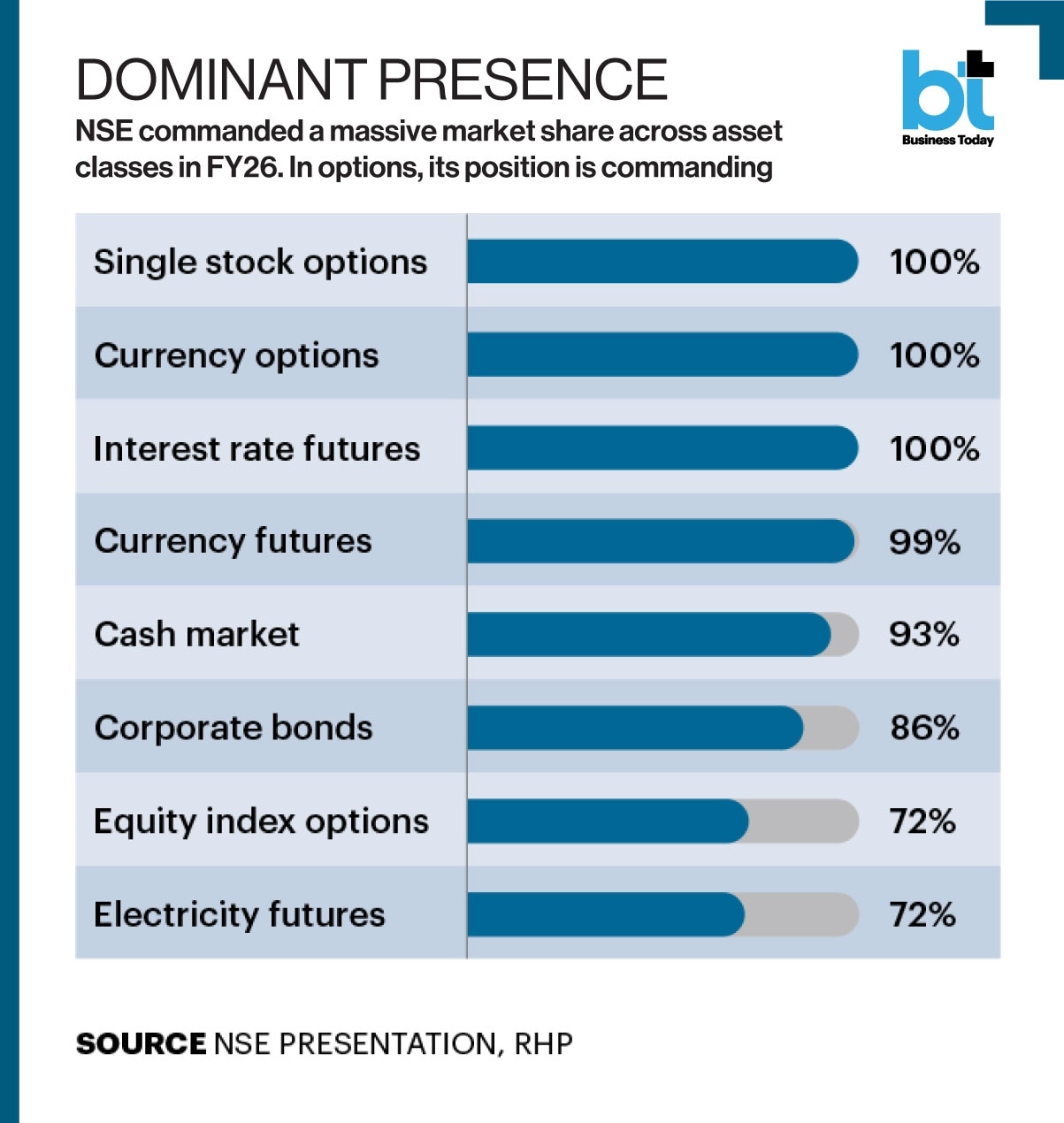
Chauhan points out that the NSE’s premium turnover in the WTI (West Texas Intermediate) Crude Oil contract has surged from Rs 875 crore in January 2026 to about Rs 8,200 crore in September 2026. Similarly, in electricity futures, it now has more than 72% market share.
Analysts from PL Capital say the NSE has built a “holistic ecosystem through key market institutions.” NSE Clearing, for instance, is the largest clearing corporation in India in terms of cleared value, they say. Separately, NSE Indices had 425 indices, spanning sectors, themes and strategies, as of March 2026, they said.
NSE IX, the international exchange in Gujarat’s GIFT International Financial Services Centre, got the global access provider licence earlier this year, enabling it to offer an avenue for Indians to invest in global stock markets.
Last year, transaction charges driven by trading activity made up a large portion of the NSE’s revenue. Officials say this should come down with new revenue lines such as data and connectivity, and indices growing at a fast pace.
“If you look at the revenue composition, 80% volumes come from trading activity, 20% from related activities. Moving forward, we need to diversify the revenue stream,” says Srinivas Injeti, Chairman, NSE, adding the organisation can also monetise data within what is permissible under the regulatory framework. “So, many other products could also be developed,” says Srinivas.
ALSO READ: NSE shares in focus after SEBI nod for corporate bond index futures
ROBUST NUMBERS
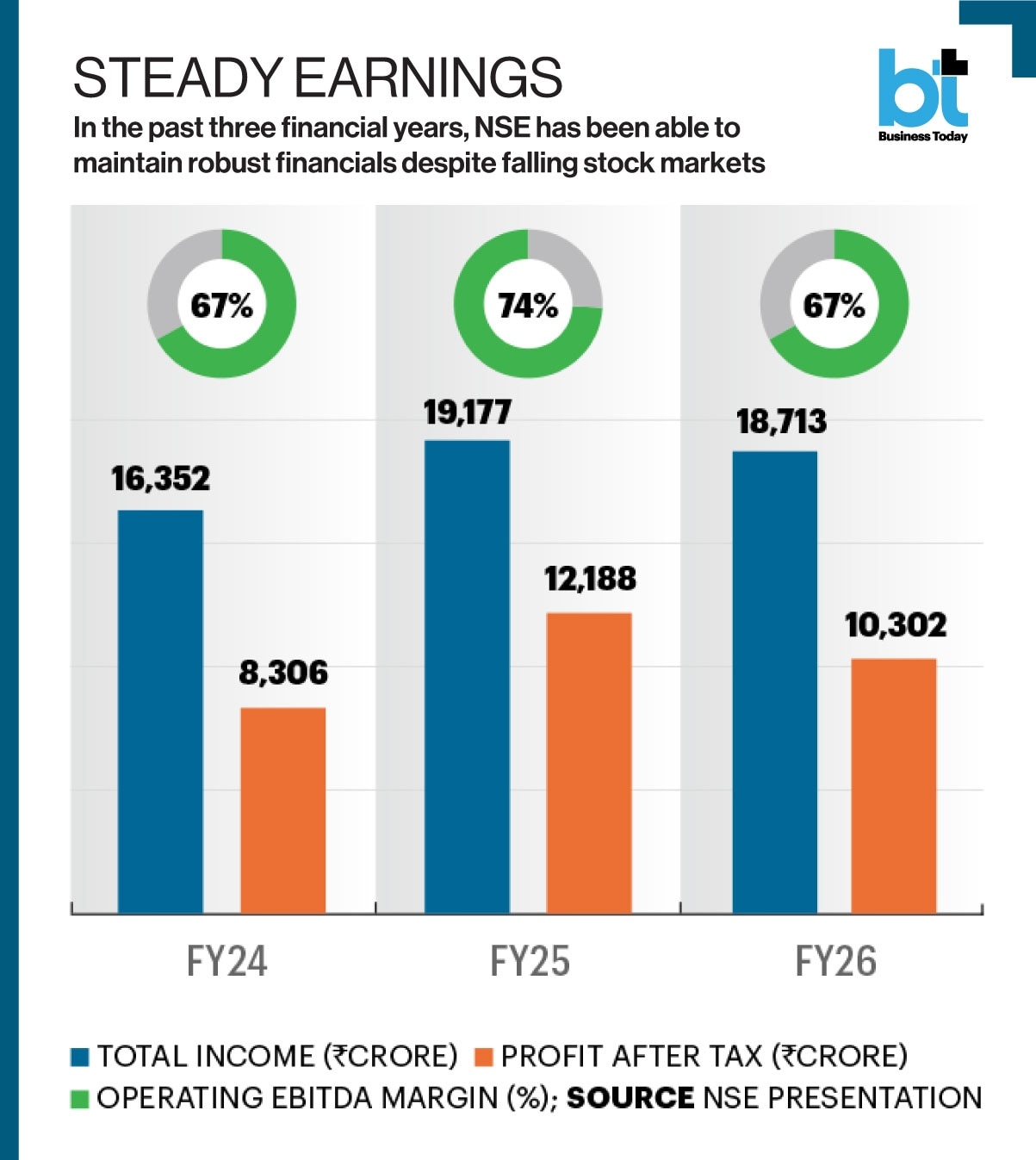
The NSE’s total income rose from Rs 16,352 crore in FY24 to Rs 18,713 crore in FY26. According to Srinivas, the company’s economies of scale mean that many of its new product launches may not require major additional costs, given that it has the technology and manpower in place.
In the cash market, the NSE had a market share of 93% as of March 2026, based on turnover. In equity futures, its share was 99.79%; in currency futures and interest rate futures, it was 100%. In the equity options segment, its market share last year was 74.71%, based on the premium turnover.
“Equity as an asset class remains hugely underpenetrated in India, so the runway is long. As more investors enter the market and more companies tap the capital market, the exchange will benefit. Derivatives will remain at least half the business. But they will diversify, and given that the business is generating a lot of cash, they will not require any major debt to expand,” says
Avinash Gorakshakar, a Sebi-registered research analyst and founder of Avinash Mentor Research.
The NSE’s key strength is not just the market share but the liquidity advantage built over time. “Its unique investor base has grown at 26% CAGR to 132 million. More traders bring more liquidity, which attracts more traders. In simple terms, the NSE offers exposure to India’s growing participation in financial markets without having to pick which broker or platform will emerge as the winner,” says Maahir Mani, research analyst at broking firm Deven Choksey.
These strengths are reflected in the NSE’s earnings. In FY26, it reported a net profit of Rs 10,302 crore, up from Rs 8,306 crore in FY24. In recent years, however, as the government and regulators have moved to curb derivatives activity, the exchange has felt the impact. In FY26, its net profit declined 15.4% from FY25, while total income fell 2.4%. In addition to the curbs in futures and options (F&O), the broader volatility in the stock market due to geopolitical and trade tariff-related tensions also dented investor activity and had a bearing on earnings.
THE DIVERSITY STORY
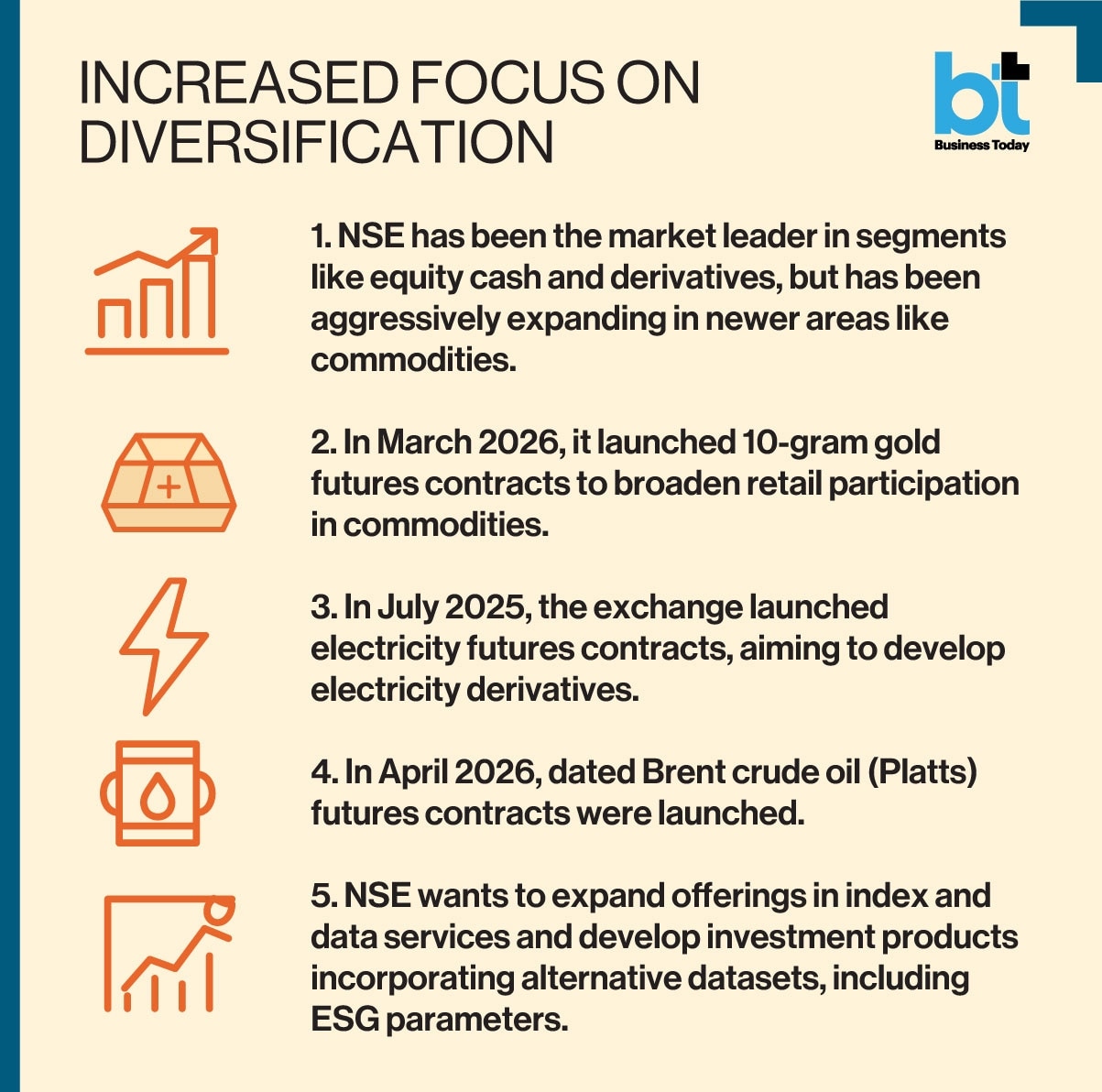
Another reason the NSE is diversifying its product basket is the uncertain global environment. In 2025, the exchange launched its electricity futures contracts. These are exchange-traded, standardised, and cash-settled contracts that allow market participants to secure pricing for 28/30/31 days of round-the-clock electricity delivery, up to three months ahead. These contracts operate alongside the physical electricity market, providing a complementary financial instrument rather than being part of the physical trading or delivery process.
In March 2026, the exchange introduced 10-gram gold futures contracts, a move that could help investors trade in small quantities and drive retail participation. In May, it announced the launch of electronic gold receipts, essentially gold held in an electronic dematerialised form.
In April, it introduced dated Brent Crude oil futures contracts. These are based on the physical Platts dated Brent crude oil benchmark. Chauhan says the steps taken by Sebi to curb retail activity in the derivatives market were in the interest of investors. From the exchange’s perspective, the right thing to do was to diversify.
ALSO READ: NSE regaining market share in equity options, commodities pick up: Ashish Chauhan
“We need to find ways to ensure that we not only do not depend on a few products but also expand our products,” he says.
Sebi has mandated exchanges to offer weekly index derivatives on only one benchmark index each, instead of weekly expiries.
The NSE has been among the most impacted, say analysts.
“The NSE had five weekly expiries—Nifty 50, Bank Nifty, Nifty Financial Services, Nifty Midcap Select, and Nifty Next 50. Following the new guidelines, it retained Nifty as its weekly expiry product, while shifting the remaining indices to a monthly cycle. Consequently, NSE index option premium market share moderated from 87% in November 2024 to 72% in March 2026,” say analysts at PL Capital.
ALSO READ: Sensex, Nifty resume fall after one-day pause; what next for markets?
ENSURING EFFICIENCY
Chauhan says contrary to the exchange’s expectation that volumes and revenues will drop by half, last financial year, the dip was only 3%. This, Chauhan says, shows that diversification is working. More is in the pipeline, he adds.
“On a scale of three years, we have been able to reduce dependence on weekly options to 40-42%. We are now in the process of launching a coal spot exchange with some industry leaders. We also will have derivatives on top of that later,” says Chauhan.
In April this year, the NSE got the nod from Sebi to invest in the proposed National Coal Exchange of India. The exchange is intended to facilitate electronic spot trading of coal through standardised contracts, enabling transparent price discovery and defined settlement mechanisms for market participants, including producers, consumers and traders.
On September 30, the NSE also received a no-objection certificate from the market regulator for proposed introduction of futures contracts on a corporate bond index. Corporate bond index futures are expected to complement the growing corporate bond market.
“India’s capital markets are no longer merely reflecting economic growth. They are actively shaping it by channelling savings into productive investment, supporting entrepreneurship, fostering innovation and enabling efficient capital allocation,” says Chauhan.
ROAD AHEAD
With increased regulations, the NSE is expected to face more challenges. According to market expert Sudip Bandyopadhyay, it is expected to lose market share as competition increases. However, he also notes that the overall market size is increasing too, and that will benefit the NSE over the longer term. “Financialisation of savings is happening and will remain a trend. The wealth effect will benefit capital market players over the long term. The pie is increasing, and newer revenue streams are also emerging for NSE.”
As Chauhan sums it up, going ahead, the NSE’s growth will be closely linked to the growth of India, and as the economy becomes more formalised, the opportunity for market infrastructure will expand with it.
DO READ: IDBI Bank shares jump 13%, CSB Bank also gains 6% after Fairfax approval; here's why
















 NSE IX, based in Gujarat’s GIFT IFSC, secured a global access provider licence earlier this year, enabling Indians to invest in global stock markets.
 Jio Platforms IPO: Price band announced at Rs 1,065-1,119; set to become India's biggest public issue
 Jio Platforms files RHP for IPO of up to 27 crore shares; issue to open on October 21
 IDBI Bank stake sale is the largest FDI deal till date; Centre, LIC to continue to remain invested
 'My satellites have been hovering for 5 years, I'm ahead of Musk in the queue,' says Sunil Bharti Mittal
 Henley Passport Index 2026: Indian passport climbs to 84th rank, visa-free countries falls to 55
 IMC 2026: The Biggest Tech Innovations You Need To See!
 What Is A Specialized Investment Fund (SIF)? SIF Vs Mutual Funds Explained
 This Week In Cinema: Jailer 2, Ranabaali, Prahaar, Nayyi Navelli & Street Fighter Hit Theatres
 India Inflation Shock: WPI Hits 11.39%, CPI At 5.54% As Crude Oil Touches $107 A Barrel
 Cabinet Approves IDBI Bank Stake Sale to Fairfax: Is the Stock Still a Buy?
 LTCG tax rollback: What investors want from Budget 2027 and will the government deliver?
 Tata Tech Q2 profit rises 4% to Rs 171 crore; revenue jumps 28%
 Hyundai Motor India to invest up to Rs 11,000 crore in Pune plant
  Can India build its next CEOs beyond English?
 No-cost EMI vs upfront payment: When does buying on instalments make sense?
 How a younger faculty is beginning to address the issue of brain drain
 The AI boom is hiding a bigger technology divide: Who profits as device sales fall?
 From 'Kashmir Saffron' to 'Mithila Makhana': 15 GI-tagged food ingredients for your festive kitchen