









 Stock market today: The current phase resembles past trough periods, where valuation compression and capital outflows preceded renewed investor interest.
  Stock market today: The current phase resembles past trough periods, where valuation compression and capital outflows preceded renewed investor interest.
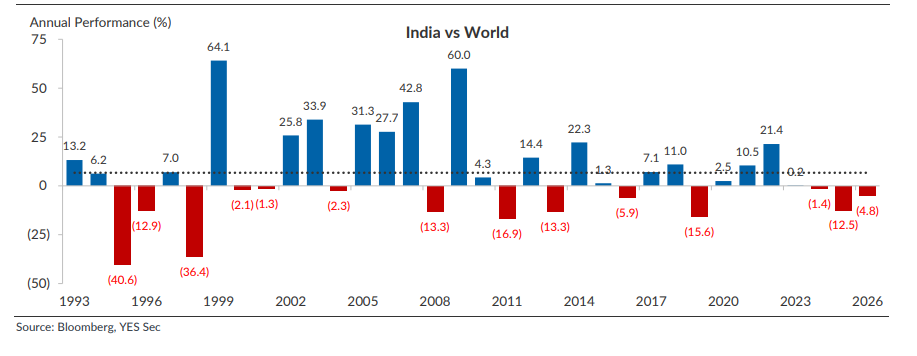
 India’s relative underperformance phases have not lasted beyond two years historically, even as calendar year 2026 marked the third consecutive year of underperformance. The odds are in favour of a reversal, YES Securities in its latest strategy note said.
Long-term comparisons of India versus global equity returns showed that periods of underperformance tended to be cyclical rather than structural. Since the 1990s, phases of lagging returns were typically followed by sharp rebounds, often when macro conditions, earnings cycles, or liquidity trends shifted.
“The current phase resembles past trough periods, where valuation compression and capital outflows preceded renewed investor interest. This historical pattern strengthens the case that India’s current lag may reflect cyclical positioning rather than deterioration in fundamentals,” YES Securities said.
The domestic brokerage said the current weakness in Indian market reflects valuation compression, reduced index
weights, and shifting global capital flows rather than structural deterioration. Valuation premiums have moderated toward long-term averages, lowering risk and improving long-term attractiveness, it said.
India’s share in global market capitalisation and EM indices has declined, while underlying fundamentals profitability, growth potential, and corporate strength, remained robust, YES Securities said.
"A key near-term constraint is that India’s short term forward earnings growth lags the broader emerging-market surge, which may delay recovery. Overall, the market appears to be in a consolidation phase rather than a long-term downtrend, with potential upside if earnings momentum improves or global capital rotates back," it said.
India has traditionally traded at a premium valuation relative to both emerging markets (EM) and the global average. But the premium has moderated recently toward historical averages. The India-vs-EM forward P/E
spread and India-vs-World spread have both declined from elevated levels seen in 2023-2024, reflecting partial mean reversion.
"This moderation suggests that valuation risk has reduced, making Indian equities less stretched than during previous peaks. From a portfolio allocation perspective, this normalization can improve the risk-reward balance for long-term investors," YES Securities said.
YES Securities said comparative analysis of expected earnings growth versus return on equity shows that India remains among the global leaders in profitability and growth potential, alongside markets like the United States and Korea. This positioning indicates that underlying corporate fundamentals remain robust, suggesting the recent equity weakness is more likely driven by valuation compression and capital flow dynamics than by deterioration in earnings quality or economic prospects, it said.
 LPG cylinder gets costlier again: Cooking gas price hiked by Rs 29
 Trump's AI adviser Sriram Krishnan to leave White House, hints at new mission
 Engineer started with a Rs 6,000 salary. Raids now uncover Rs 2 crore cash, 341 gm gold, 14 plots
 Nothing is better than biofuels for immediate carbon reduction: Hero MotoCorp CEO
 Is AI sustainable? Why the debate goes beyond data centres and energy use
 #BTSustainabilityAwards LIVE: Grand Award Ceremony & Special Edition Magazine Launch!
 #BTSustainabilityAwards LIVE: Environment Minister Bhupender Yadav On India's Green Future
 #BTSustainabilityAwards LIVE: The Eco Drive - Will Flex-Fuel & EVs Redefine India's Mobility?
 #BTSustainabilityAwards LIVE: The Organic Shift - How Conscious Consumers Reshape The FMCG Market
 #BTSustainabilityAwards LIVE: ESG Over Profits? Redefining Business For Long -Term Value
 Sensex, Nifty outlook for Monday, June 8: GIFT Nifty down 356 pts – What to expect from stock market?
 Titan shares up 20% in a year; still a ‘Buy’? - Check share price target
 Subscribed 127 times, all about CMR Green Technologies IPO latest gmp, allotment status check online, listing date
 US stock market news: Why Nasdaq, S&P 500 witnessed its worst day of year - Factors behind fall
 CMR Green Tech IPO attracts over Rs 56,200 crore bids, subscribed 127 times; check GMP, listing timeline