












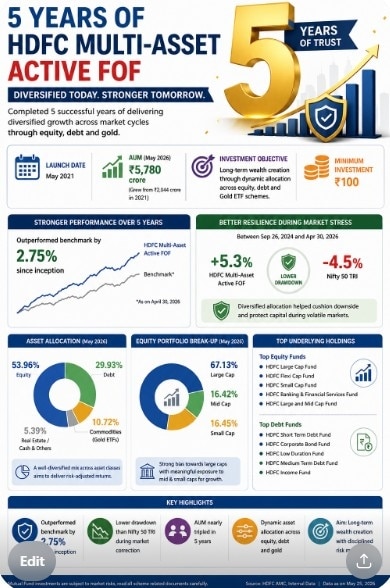



 Launched in May 2021, the fund follows a fund-of-funds (FOF) structure and allocates money across equity-oriented schemes, debt-oriented schemes and Gold ETFs.
As market volatility, geopolitical uncertainties and changing interest-rate environments continue to test investor confidence, diversified investing strategies have gained greater attention. Investors increasingly seek products that can balance long-term wealth creation with downside management rather than relying solely on a single asset class. Against this backdrop, HDFC Multi-Asset Active FOF recently completed five years since launch, offering a useful case study on how a diversified strategy has navigated different market cycles.
Launched in May 2021, the fund follows a fund-of-funds (FOF) structure and allocates money across equity-oriented schemes, debt-oriented schemes and Gold ETFs. The strategy is designed to create long-term wealth while using asset allocation to manage changing market conditions. By spreading exposure across multiple asset classes, the fund seeks to reduce dependence on any one segment of the market.

 India faces fertilizer squeeze as rising costs force govt to rethink urea policy
 Meet Deepak Mahaske, BJP's new Social Media Convenor
 BSE, L&T, Bharat Forge, Navin Fluorine, Sundram Fasteners shares: Expert weighs in
 BJP chief Nitin Nabin names new team; Piyush Goyal gets treasurer post, Smriti Irani made general secretary
 Should You Buy an iPhone 17 Now or Wait for iPhone 18? Here's What You Need to Know
 Mahindra BE 6 Sport Teq Launched At ₹11.45 Lakh With BaaS | New Tech, Gemini AI & More
 The week's Tech News By AI Sana | Tech Gear EP 14
 Mahindra BE 6 Sport Teq Design Decoded | Pratap Bose Reveals What’s New
 Mahindra Eyes More SUV Market Share, Says India Ready For Pickup Trucks
 Vande Mataram: Why BJP Is Targeting Sonia Gandhi & Rahul Gandhi Over Full National Song
 Cupid promoter Aditya Kumar Halwasiya increases stake; multibagger stock slips 8%
 NMDC shares: Nuvama upgrades stock to 'Buy' despite Q1 EBITDA miss; check target price
 Avtar Steel files draft IPO papers with Sebi to raise Rs 585 crore through fresh issue
 Polycab shares may offer more returns despite stellar sectoral rally: SBI Securities
 BEL, L&T among SBI Securities top capital goods bets after Q1 earnings
 ‘Mockery of the entire system’: NCLT questions SpiceJet’s last-minute ₹4.78 crore payment to one creditor, gives 2 days to clear others’ dues
 ‘Will bomb the shit...’: Trump escalates Iran war rhetoric, threatens Oman over Strait of Hormuz talks
 Ocean sentinels: India inks ₹1,943-crore lease for two MQ-9B Sea Guardian dronesCupid promoter Aditya Kumar Halwasiya increases stake; multibagger stock slips 8%
 'Deepak Mhaskey will take over...': Amit Malviya's first reaction after BJP replaces him as social media head


