












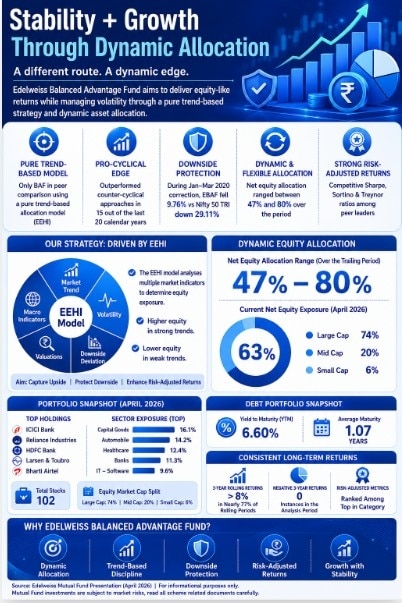



 Most Balanced Advantage Funds rely on valuation-led or hybrid models, while EBAF uses a pure trend-based strategy powered by its proprietary Edelweiss Equity Health Index.
Amid elevated market volatility, geopolitical uncertainty and fluctuating valuations, investors are increasingly looking for products that can strike a balance between growth opportunities and downside protection. Balanced Advantage Funds (BAFs), which dynamically shift allocations across equity and debt, have emerged as one such category. Among them, Edelweiss Balanced Advantage Fund (EBAF) is positioning itself through a differentiated trend-led framework rather than a conventional valuation-based approach.
The fund aims to deliver equity-linked returns while reducing portfolio volatility through active allocation across equity, fixed income and arbitrage strategies. Its broader objective is to participate in market upside while attempting to protect investors during periods of correction and uncertainty.

 CJP protest: Supreme Court to hold special Sunday hearing on contempt plea against Home Secretary, DMRC
 West Asia tensions: Riyadh airport hit again in fresh assault, multiple injured; flights diverted
 Delhi protest: Police release all detained except CJP leaders; key faces detained & released
 Mahindra & Mahindra announces sale of 51% stake in Novavayu Aerospace to Embraer
 Delhi CJP protest: '₹1.5 lakh loss per shop in a day', says Khan Market traders body
 REIT Returns Explained: Income, Capital Gains & Risks Investors Need To Know
 REIT Risks Explained: Key Factors Investors Must Check Before Investing In Commercial Real Estate
 Will IRDAI’s Broker Commission Crackdown Make Insurance Cheaper For Consumers?
 5 Reason Why Cheap Premium Insurance May Not Be The Best Choice
 Health & Life Insurance: How Much Cover Do You Really Need? Expert Explains
 Market on the back foot, opportunities ahead: where should investors put their money?
 Poonawalla Fincorp Q2 earnings: Net profit zooms 405%, NII at Rs 1,589 crore
  Vedanta, TCS shares to turn ex-dividend; Ola rights issue; 2 stock splits next week
 IPO rush: Rs 50,000 crore worth IPOs to hit Street by Diwali; Jio, Avada to lead fundraise
 Adani Ports, GMR Airports rise up to 5% amid block deal reports; check details
  Canada asylum alert: What unfinished claims must do before November 3
 Infosys co-founder and technology leader Kris Gopalakrishnan’s advice to leaders
 'The Truman Show' star Jim Carrey ties knot third time with girlfriend Min Ah in private ceremony
 India's gender commute gap: Why fewer working women travel beyond 1 km
 Form 121 does not make your EPF withdrawal tax-free: 5 things to check


