












 For many affluent Indian families, residence-by-investment programmes offer access to international education, easier travel and the possibility of relocating for business or lifestyle reasons.
Interest among wealthy Indians in global residency and second citizenship programmes remains robust, even as countries tighten regulations and raise investment thresholds.
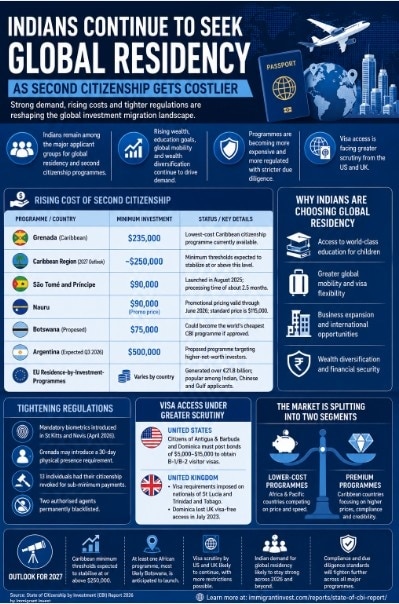
According to the State of Citizenship by Investment (CBI) Report 2026 released by Malta-based advisory firm Immigrant Invest, India continues to be one of the major source markets for European residence-by-investment programmes, alongside China and Gulf countries. The report notes that demand for overseas residency and citizenship is increasingly being driven by factors such as global mobility, education opportunities, business expansion and wealth diversification.
European dreams
European investment migration programmes have collectively generated more than €21.8 billion for participating countries, underlining the continued appeal of residency routes despite mounting political scrutiny across the region.
For many affluent Indian families, residence-by-investment programmes offer access to international education, easier travel and the possibility of relocating for business or lifestyle reasons. European destinations have remained particularly attractive because they provide residency rights without necessarily requiring applicants to renounce their Indian citizenship.
The report indicates that demand for these programmes remains strong heading into 2027, despite a changing regulatory landscape.
Cost of second citizenship
At the same time, citizenship-by-investment programmes are becoming significantly more expensive.
For years, Caribbean countries offered some of the most affordable pathways to acquiring a second passport, with entry thresholds once falling below $100,000. That era has effectively ended.
Grenada now offers the lowest entry point among Caribbean programmes at $235,000, and minimum thresholds across the region are expected to stabilize around $250,000 by 2027.
The higher price points reflect efforts by governments to reposition their programmes as premium offerings and address concerns raised by international regulators, particularly the European Union.
Compliance rules
Alongside rising costs, governments are introducing stricter due diligence requirements.
St Kitts and Nevis implemented mandatory biometric measures in April 2026, while Grenada is considering a 30-day physical presence requirement. Authorities have also taken action against irregularities, with 13 individuals losing their citizenship over sub-minimum payments and two authorised agents being permanently blacklisted.
The report suggests that enhanced compliance and anti-money laundering standards are likely to become the norm across established programmes.
MUST READ: Are Indian equities replacing real estate as the top wealth choice for Gulf NRIs now?
Visa access
Another challenge for prospective applicants is the increasing scrutiny from major economies.
The United States now requires citizens of Antigua and Barbuda and Dominica to post bonds ranging from $5,000 to $15,000 to obtain B-1/B-2 visitor visas. The United Kingdom has introduced visa requirements for nationals of St Lucia and Trinidad and Tobago, while Dominica lost visa-free access to the UK in 2023.
These developments indicate that visa-free travel benefits associated with some citizenship programmes can no longer be treated as permanent or guaranteed.
New competitors emerge
As Caribbean programmes become more expensive, lower-cost alternatives are beginning to emerge.
São Tomé and Príncipe launched a citizenship programme in 2025 with investment requirements starting at $90,000, while Nauru is offering promotional pricing of $90,000 through June 2026. Botswana is also considering a programme with a proposed minimum investment of $75,000, potentially making it the most affordable option globally.
According to the report, the investment migration market is increasingly splitting into two segments: lower-cost programmes in Africa and the Pacific competing on price and speed, and premium Caribbean programmes focusing on stronger compliance and international credibility.
For Indian investors, the trend suggests that while global residency and second citizenship opportunities remain attractive, they are becoming more expensive, more regulated and increasingly subject to evolving geopolitical considerations.

 Crude oil, electronics and gems and jewellery top three imports adding to trade deficit
 What's driving the rapid growth and interest in India's gold loan market
 How REITs are becoming a rewarding investment proposition
 Banks set for Q1 credit boost, but margin pressure may spoil the party
 Sir Sam Neill, who made Jurassic Park's Dr Alan Grant unforgettable, dies at 78
 Indian I.T. Stocks Face AI Disruption: Why Growth, Margins And PE Multiples May Fall
 The AI Cost Illusion Explained | Instagram New Updates & GoPro Mission 1 Pro First Look | Tech Today
 IT Stocks Rally After TCS Q1 Results: Nifty IT Surges, ICICI Direct Shares Outlook
 India’s Astra Mk2 Missile Production May Open To Private Firms | Defence Policy Shift Explained
 AI Sector Boom: Pankaj Pandey Reveals The Best Sectors To Invest In India's Data Centre Growth
 HCLTech Q1 FY27: Profit rises 20% YoY to Rs 4,624 crore; announces Rs 12/share interim dividend
 Vedanta, demerged stocks: What should investors do? Centrum's Nilesh Jain shares his view
 Reliance Power, BLS International, Bajaj Healthcare: Analyst decodes trading strategy
  Sensex, Nifty end marginally higher after volatile session; what should investors watch now?
 Rs 1,616 to Rs 18,141 in five years: Now, this defence stock set to nearly halve, says Kotak