


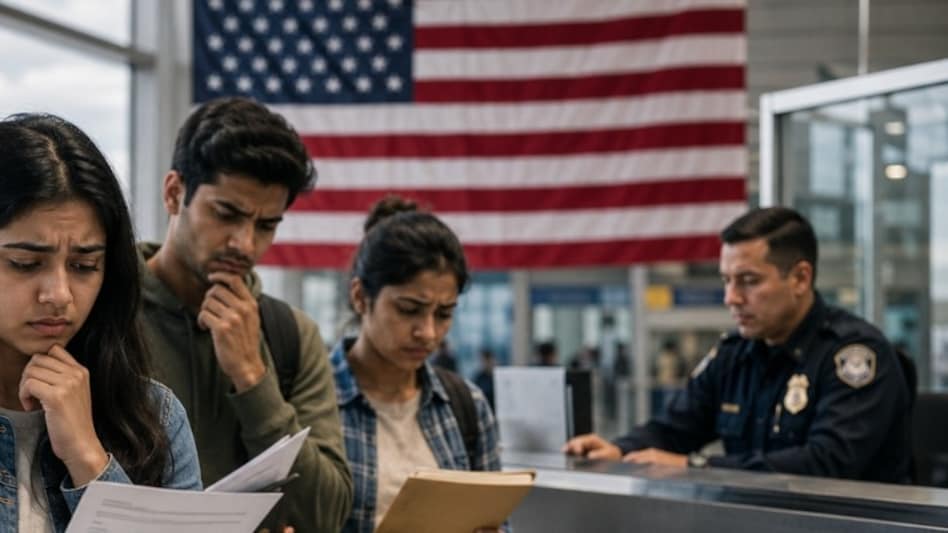
 PhDs take 5.7 years, cap is 4: Indian diaspora group flags flaw in new US student visa rule
Days after the United States announced a four-year cap on visa stays for international students and exchange visitors, an Indian diaspora advocacy group has stepped forward to demand Congress and the US Citizenship and Immigration Services halt the rollout before it takes effect in mid-September.
The Foundation for India and Indian Diaspora Studies, known as FIIDS, warned that the new rule would disrupt ongoing degrees, damage US research and innovation, and hand America's global talent edge to competing nations.
"This is a self-inflicted wound on US competitiveness," said Khanderao Kand, chief of Policy and Strategy at FIIDS. "A four-year cap misaligns with how modern degrees actually work — median time to a bachelor's is about 52 months and to a PhD about 5.7 years — while USCIS is already sitting on more than 11 million cases with roughly year-long processing times. Students will be forced out mid-program or mid-research, labs will lose critical talent, and America will hand its innovation pipeline to competitors."
The economic stakes
FIIDS cited data showing that international student enrolment had already fallen 17% in Fall 2025, the steepest decline since the pandemic, with 96% of institutions attributing the drop to visa concerns. Total international enrolment currently stands at close to 1.2 million students, contributing approximately USD 55 billion annually to the US economy. The National Association of Foreign Student Affairs has estimated that the 17% decline in new enrolments alone has resulted in more than USD 1.1 billion in lost revenue and nearly 23,000 fewer jobs.
What FIIDS is asking for
The group made specific demands of both Congress and the USCIS. On the legislative side, it urged Congress to introduce and support legislation that would restore the duration of stay for F-1 and J-1 visas, or create statutory exemptions for graduate STEM programmes with median completion times exceeding 48 months, with extensions capped at 64 months. It also called for Optional Practical Training and STEM OPT to be excluded from the four-year count, and for the 60-day post-completion grace period to be restored.
On the administrative side, FIIDS asked USCIS to issue relief before the mid-September effective date, including automatic extensions for students in good standing enrolled in programmes whose nationally reported median completion times exceed 48 months.
"If the goal is integrity, do it without blowing up degree pathways that power American labs and startups," Kand said.
The group's appeal reflects broader anxiety within the Indian student and diaspora community in the US, where Indian nationals account for the second-largest international student population and a significant share of STEM graduate enrolment at American universities.
(With inputs from PTI)

 CJP’s ‘Chalo Sansad’ march: Anti-riot vehicles, 5,000 personnel deployed; traffic advisory in Delhi
 Sonam Wangchuk to end hunger strike today? 59-year-old activist lists 3 conditions from hospital bed
 RIL share price targets: What JPMorgan, Goldman Sachs, Citi, Jefferies, CLSA say
 ₹10 lakh invested, ₹12 lakh withdrawn, still ₹1 crore left: How SWPs created wealth over 20 years
 FD vs bond investment: Which fixed-income investment offers better post-tax returns for investors?
 U.S.-Iran War’s 3 Phases Explained: From Khamenei’s Killing To Battle For Strait Of Hormuz
 China’s Helium Export Ban Triggers Global Tech Alarm As Hormuz Crisis Chokes Critical Supply
 CEAT Stock Impact: Why The Company Took A ₹50 Crore Forex Loss | CFO Breaks It Down
 Caliber Mining IPO Opens: Should You Subscribe? Price Band, GMP & Key Risks Explained
 Trump Threatens Iran’s “Pickaxe Mountain”: Why This Nuclear-Linked Bunker Is Hard To Hit
 Lohia Corp IPO opens on July 23; check price band, issue size & more details
 HDFC Bank shares fall 5% after Q1 NIM miss: Targets by UBS, Bernstein, Citi, Jefferies and others
 Cipla receives one USFDA observation for US subsidiary, stock in focus today
  TechM, GSK Pharma, India Cements: Top stock picks for decent gains; check price targets
 Tata Power's order book swells as firm wins Rs 351.3 crore LoA from SECI









