












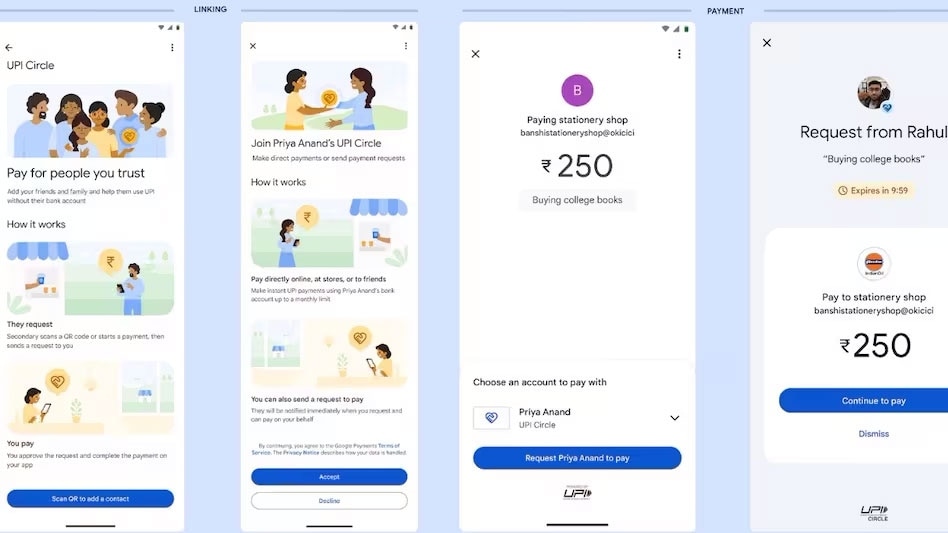



 UPI Circle allows users to authorize payments without sharing their UPI PIN, bank details, or passwords, while retaining control through spending limits and approval settings.
India's digital payments ecosystem continues to evolve, and a new feature called UPI Circle is emerging as a solution for families that want to give children and teenagers access to digital payments without compromising security.
With UPI now used for everything from grocery purchases and food delivery to transport and online shopping, many parents face a common dilemma: how to provide spending money to teenagers without sharing bank account credentials or repeatedly transferring funds. UPI Circle aims to address that challenge by allowing supervised digital payments under parental control.
FAQs
What is UPI Circle and how does it help families?
UPI Circle is a delegated payments feature introduced by NPCI that lets a primary UPI user allow a trusted family member, such as a teenager, spouse or parent, to make payments on their behalf. It helps families give controlled access to digital payments without sharing UPI PINs, passwords or bank account details.
How does UPI Circle work for teenagers?
UPI Circle allows parents or guardians to authorise a teenager as a secondary user for digital payments. The teen can make purchases for daily needs such as food, transport, shopping or subscriptions, while the parent sets spending limits, monitors transactions and keeps overall control.
What are the payment approval modes available in UPI Circle?
UPI Circle offers two approval modes. In manual approval mode, every payment started by the secondary user must be approved by the primary account holder. In automatic approval mode, transactions go through instantly as long as they stay within the spending limit set by the parent or guardian.
Why is UPI Circle useful for parents managing pocket money?
UPI Circle gives parents a safer and more convenient way to manage pocket money digitally. Instead of repeatedly transferring funds or sharing access to payment apps, they can set monthly or per-transaction limits, track spending in real time, approve or reject payments and revoke access whenever needed.
Which apps and platforms are using the UPI Circle model in India?
Paytm has launched Pocket Money based on NPCI's UPI Circle framework to support supervised payments for teenagers. The wider teen finance space in India also includes firms such as FamApp, Junio, Walrus and Akudo, which offer products focused on supervised spending, budgeting and financial awareness for younger users.

 Bessent's big reveal: 'I asked Europe to impose secondary tariffs on India, but they refused'
 'Close your borders before it's too late': Trump sounds alarm as France erupts in violence
 New Noida to become UP's next manufacturing hub: Land acquisition begins in 37 villages
 'Deport those who refuse to integrate': Milind Deora's warning as France burns
 Firing at Tiger Shroff's car in Mumbai's Juhu; Lawrence Bishnoi gang claims responsibility
 Gold Vs Silver: Which Could Deliver Better Returns Over The Next 3–5 Years? Expert Shares Targets
 Gold, Silver ETF Purchases Halted: Why Mutual Funds Have Restricted Fresh Investments Before Diwali
 SIR Explained: Forms 6, 7 And 8—What Voters Must Know | Akshita Nandagopal Explains
 Gold Investment Options: ETFs, EGR And MCX Explained | How To Invest In Gold Beyond Physical Buying
 Redmi Note 17 Pro Max Review , Vivo V80, Vivo Vision | Tech Gear EP 20 | Business Today
 Markets Next Week: Jio Platforms IPO, high crude oil prices and Q2 earnings in focus
 10 investing mistakes retail investors should avoid, from overpaying to panic selling
 YES Bank Q2 profit rises 65% to Rs 1,080 cr; proforma impact of restatement of AT-I bonds revealed
 ICICI Bank Q2 results: Net profit jumps 20% to Rs 14,843 crore; NIM contracts
 IDBI Bank Q2 net profit falls 39% to Rs 2,205 crore on year-ago's one-off gain
  Delhi Metro to London Underground: Here are the world’s top 18 metro systems. Check the full listBessent's big reveal: 'I asked Europe to impose secondary tariffs on India, but they refused'Firing at Tiger Shroff's car in Mumbai's Juhu; Lawrence Bishnoi gang claims responsibility
 'Take shelter, don't film attacks': India's fresh advisory for citizens in Saudi Arabia amid rising tensions'Close your borders before it's too late': Trump sounds alarm as France erupts in violence


