















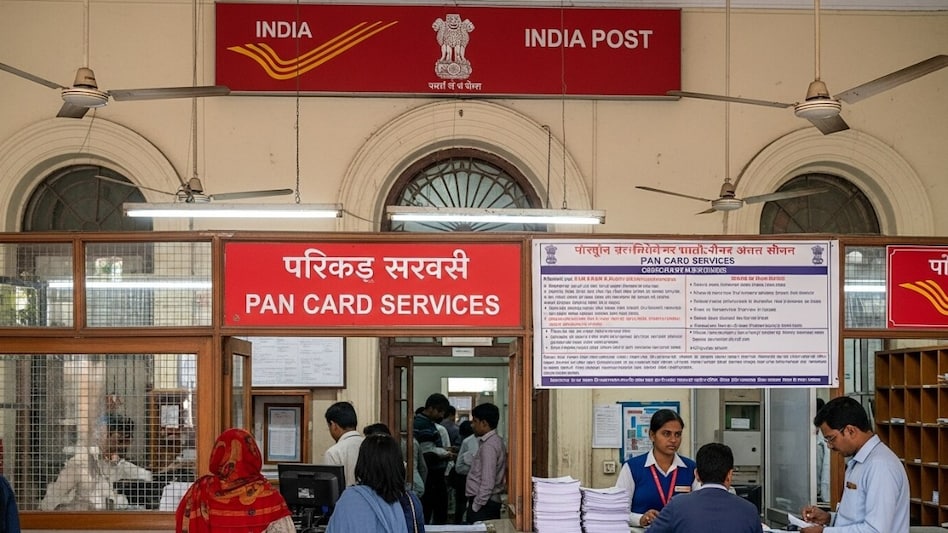
 The revised rules are expected to impact millions of depositors who use post office-backed savings products such as NSC, SCSS, MIS, recurring deposits and TDs.
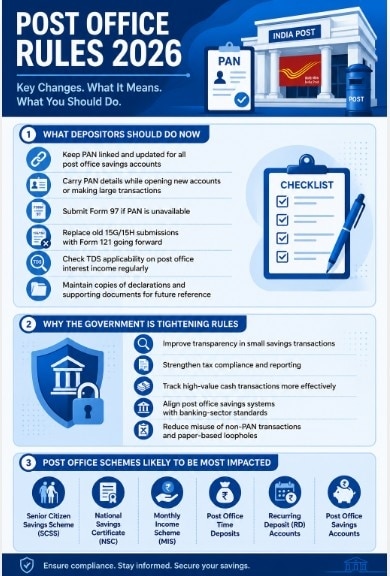
India’s vast post office savings network is coming under tighter tax scrutiny as the government introduces stricter compliance norms under the Income-tax Rules, 2026. In a major change for depositors, quoting Permanent Account Number (PAN) has now become mandatory for several post office financial transactions, including account openings, deposits, withdrawals and investments in savings schemes.
The move is part of the government’s broader push to improve financial transparency, strengthen audit trails and bring traditional small savings channels more firmly into the formal tax reporting system.
The revised rules are expected to impact millions of depositors who use post office-backed savings products such as National Savings Certificates (NSC), Senior Citizen Savings Scheme (SCSS), Monthly Income Scheme (MIS), recurring deposits and Post Office Time Deposits.

 90% EVs exported out of India are from Maruti Suzuki: MD & CEO Hisashi Takeuchi
 India's $30 trillion goal needs 8-10% growth, $400 billion more annual investment: Jayant Sinha
 1.1 billion barrels gone: IMF warns that global oil market is running out of safety cushions
 From Devbhoomi to industrial destination: Uttarakhand’s manufacturing moment
 India’s deep-tech startups face a new test: Crossing the valley of death
 #IndiaAt100 : Adipen Bose Nandhiji On Conscious Capitalism- Can Profit & Purpose Coexist?
 #IndiaAt100 : Hisashi Takeuchi On Driving India’s Manufacturing Revolution
 #IndiaAt100 : Manufacturing For Viksit Bharat | Can Industry Power India’s $30-Trillion Dream?
 #IndiaAt100 : Tarun Garg On Hyundai & India’s Manufacturing Powerhouse Ambition
 #IndiaAt100 : CM Pushkar Singh Dhami On Uttarakhand’s Industrial Growth & India’s Next Leap
 Cupid, NTPC Green, NTPC, Raymond Realty, HAL shares: Key technical levels to watch
 Defence stock with Rs 2,654-crore order book hits record high; here's why
  GACM Technologies: FII holding jumps to 29%; penny stock in focus
 Puravankara shares rise 5% on fresh order win
  20 high-conviction ideas for up to 95% upside | stocks to buy
  NHAI’s ₹350 monthly toll pass now available: who can apply? Check eligibility and benefits
 90 million litres of glacier water every day: How Ladakh is reviving 1,000 acres of farmland#IndiaAt100 : Adipen Bose Nandhiji On Conscious Capitalism- Can Profit & Purpose Coexist?#IndiaAt100 : Hisashi Takeuchi On Driving India’s Manufacturing Revolution#IndiaAt100 : Manufacturing For Viksit Bharat | Can Industry Power India’s $30-Trillion Dream?


