












 The Public Provident Fund (PPF) is a government-backed long-term savings scheme that offers stable returns with high tax efficiency.
PPF investment: For investors relying on the Public Provident Fund (PPF) for long-term, tax-efficient wealth creation, the timing of deposits is just as important as the amount invested. A simple rule, depositing money before the 5th of every month, can significantly enhance returns over time.
Key rule
PPF interest is calculated on the lowest balance between the 5th and the end of every month. This makes the first five days of each month critical for investors.
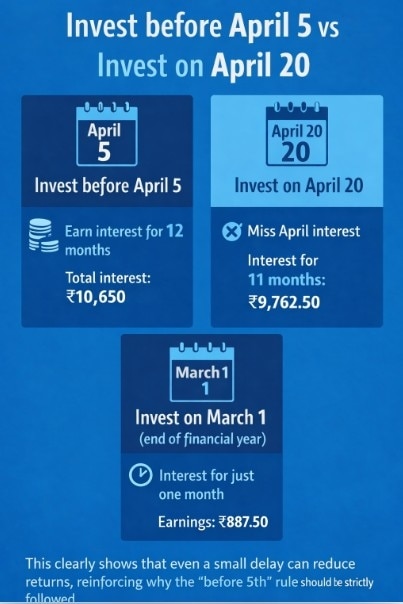
If you deposit by April 5, your full amount starts earning interest from April itself. But if you miss this date, even by one day, your money starts earning from the next month. That means you lose one full month of interest every year.
This rule applies not just in April, but every month throughout the financial year—making disciplined timing essential.
How monthly interest calculation impacts you
Although PPF interest is credited annually on March 31, it is calculated monthly, based on balances maintained within the defined window.
Deposit on or before the 5th → Earn interest for that month
Deposit after the 5th → No interest for that month
Over a 15-year investment horizon, repeatedly missing this deadline can lead to a noticeable reduction in corpus.
Cost of delayed investment
Consider an annual PPF investment of ₹1.5 lakh at the current interest rate of 7.1%:
How to maximise returns
Investors can optimise PPF returns through two approaches:
1. Lump Sum Investment
Deposit the full ₹1.5 lakh before April 5 to ensure your entire investment earns interest for the full year.
2. Monthly Contributions
If investing in instalments, ensure each deposit is made before the 5th of every month. This ensures consistent interest accrual and avoids losing monthly earnings.
PPF and tax efficiency
PPF continues to be one of India’s most reliable long-term investment options, offering:
This means:
Investments qualify for Section 80C deductions (old tax regime)
Interest earned is tax-free
Maturity proceeds are fully exempt
Even under the new tax regime, where deductions are not available, PPF remains attractive due to its completely tax-free returns.
ALSO READ: Your wallet from April 1: Money rule changes you can’t afford to ignore
Liquidity features
Despite the long lock-in, PPF provides limited flexibility:
Loans available between the 3rd and 6th year
Partial withdrawals allowed from the 7th year onwards
Accounts can be opened with post offices and major banks, making it widely accessible.
Interest rates stay unchanged
The government has kept PPF interest rates unchanged at 7.1% for the eighth consecutive quarter (April–June 2026), reinforcing its role as a stable, low-risk investment avenue.
ALSO READ: Income Tax 2026: What deductions you lose under new tax regime from April 1
PPF investment
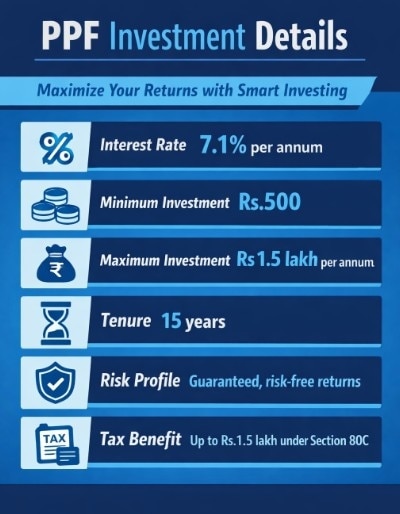
The Public Provident Fund (PPF) is a government-backed long-term savings scheme that offers stable returns with high tax efficiency. It currently provides 7.1% annual interest (Q1 FY2026), compounded yearly, and is well-suited for retirement planning due to its 15-year lock-in and EEE (Exempt-Exempt-Exempt) status—ensuring that investments, interest earned, and maturity proceeds remain tax-free.
Investors can contribute between ₹500 and ₹1.5 lakh annually, with deposits qualifying for deduction under Section 80C (old tax regime). The scheme also offers limited liquidity, including loan facilities between the 3rd and 6th year and partial withdrawals from the 7th year onwards.

 Third round of talks: CJP ends 49-day-long protest, says govt accepted 'key demands'
 Dharmendra Pradhan resigns, says decision taken to protect students' future amid NEET row
 All about Dharmendra Pradhan's educational qualification, wealth, assets and more
 India's first REIT mutual fund is here. Can it change how Indians invest in real estate?
  1997 paper leak protest to Education Minister: The extraordinary political journey of Dharmendra Pradhan
 FDs vs Markets: Where Should You Keep Your Short-Term Money?
 Why Term Insurance Is Essential for Every Earning Member | Sum Assured & Coverage Explained
 Pakistan's Alleged Terror-Politics Nexus: Lashkar Links Spark Questions Over Fazlur Rehman
 Think Life Insurance Is Optional? Here's Why Every Indian Family Needs It Today
 FD Vs Arbitrage Fund: Which Is Better For High Taxpayers?
 Adani Power: 45 GW target, Rs 2 lakh crore capex plan among conference call highlights
  ITC Hotels, Chalet, Ventive, IHCL, SAMHI: Hotel stocks to buy despite travel disruptions
 ITC shares: Rs 307 a key short-term level to watch; here's target price
 Mphasis shares: FY27 guidance maintained; brokerages keep 'Buy' after Q1; check target price
 Should you buy every IPO? Research suggests patience may be the smarter strategy
 Houthis target Saudi Aramco sites in Jizan and Yanbu as Red Sea tensions take a new turn
  Lifestyle inflation, delayed investing, high-interest debt: 3 biggest money mistakes young professionals makeThird round of talks: CJP ends 49-day-long protest, says govt accepted 'key demands'FDs vs Markets: Where Should You Keep Your Short-Term Money?
 ED targets gangster Atiq Ahmed’s Noida syndicate as henchmen push secret sale of benami assets