












 Over the past year, the RBI has followed an easing trajectory, cutting the repo rate by a cumulative 125 basis points.
RBI repo rate 2026: As the Reserve Bank of India (RBI) prepares to announce its latest monetary policy decision, fixed deposit (FD) investors are closely watching the interplay between interest rates, inflation, and rising geopolitical risks -- particularly escalating tensions involving Iran.
The macroeconomic environment has shifted meaningfully in recent months. Heightened tensions in West Asia have triggered a rise in crude oil prices and raised concerns over supply disruptions. For India, a major oil importer, this has direct inflationary implications. Higher fuel and commodity costs tend to push up input prices across sectors, eventually feeding into retail inflation.
This evolving inflation trajectory is critical because it directly influences the RBI’s policy stance—and by extension, FD returns. While global conflicts may appear distant, their economic impact is transmitted through inflation and interest rate cycles, affecting domestic savings instruments like fixed deposits.
RBI rate cycle and FDs
Over the past year, the RBI has followed an easing trajectory, cutting the repo rate by a cumulative 125 basis points—from 6.25% in February 2025 to 5.25% by December 2025. The central bank has since maintained the rate at 5.25% in its latest policy reviews, signalling a pause after aggressive easing.
This rate-cut cycle led banks to gradually reduce FD interest rates, aligning deposit pricing with lower borrowing costs, easing inflation, and softer government bond yields. However, the current global backdrop complicates this trend.
If geopolitical tensions—such as the Iran-linked conflict—continue to push inflation higher, the RBI may be forced to reassess its accommodative stance. Any shift towards tightening or even a prolonged pause could stabilise or push FD rates higher in the coming quarters.
ALSO READ: Is lab-grown gold the future or just a costly experiment?
Where FD rates stand today
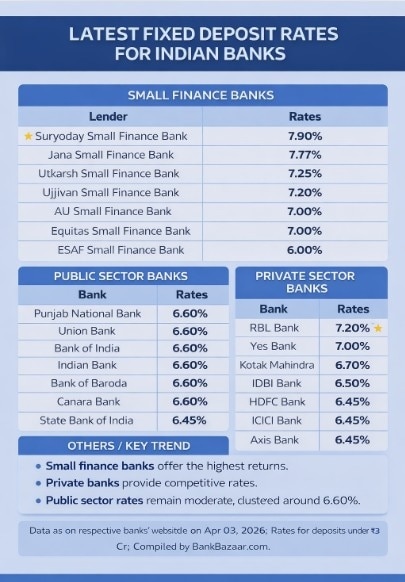
Fixed deposit (FD) rates across bank categories show a clear hierarchy, balancing return, safety, and risk. Public sector banks (PSBs) continue to offer relatively stable and clustered rates, with most large lenders such as Punjab National Bank, Bank of Baroda, Union Bank, and Canara Bank offering around 6.60%, while SBI remains slightly lower at 6.45%. This segment appeals to conservative investors prioritising capital safety and predictable returns.
Private sector banks offer moderately higher and more competitive rates. RBL Bank leads at 7.20%, followed by Yes Bank at 7.00%, while Kotak Mahindra Bank offers 6.70%. Large players like HDFC Bank, ICICI Bank, and Axis Bank remain in the 6.45%–6.50% range, providing a balance between returns and credibility.
Small finance banks offer the highest yields, led by Suryoday at 7.90%, Jana at 7.77%, and Ujjivan at 7.20%. However, these higher returns come with relatively higher perceived risk.
Outlook
Despite global uncertainties, FD rates are expected to remain broadly stable in the near term. Tight liquidity conditions and strong credit demand are supporting deposit rates, even as the RBI maintains a wait-and-watch approach.
ALSO READ: Investment 2026: Gold’s low correlation With equities makes it a strong diversifier: Report
However, the trajectory from here hinges on inflation. If crude oil prices remain elevated due to prolonged geopolitical tensions, upward pressure on inflation could emerge. This would increase the probability of a policy shift, potentially leading to higher FD rates.
For investors, the current phase presents a tactical opportunity -- locking in FD rates now could be beneficial, especially if rates stabilise before any future adjustments. At the same time, monitoring RBI signals and global developments remains essential, as the interest rate cycle appears to be entering a more uncertain and data-dependent phase.

 'Will discharge my responsibilities with complete humility': Pralhad Joshi after being appointed Education Minister
 From NEET protests to politics? What CJP's Saurav Das and Ashutosh Ranka have now revealed
 From a BA graduate to a five-time MP and Cabinet veteran: What did new Education Minister Pralhad Joshi study?
 Large office spaces remain in demand as India's leasing touches 48 million sq ft in H1 2026, says report
 Gold, silver prices today (July 26): Check latest rates in Delhi, Mumbai, Kolkata, other cities
 FDs vs Markets: Where Should You Keep Your Short-Term Money?
 Why Term Insurance Is Essential for Every Earning Member | Sum Assured & Coverage Explained
 Pakistan's Alleged Terror-Politics Nexus: Lashkar Links Spark Questions Over Fazlur Rehman
 Think Life Insurance Is Optional? Here's Why Every Indian Family Needs It Today
 FD Vs Arbitrage Fund: Which Is Better For High Taxpayers?
 TRIL shares: Should you average the falling stock? Here's 'fixed and final' stop loss
 Adani Power: 45 GW target, Rs 2 lakh crore capex plan among conference call highlights
  ITC Hotels, Chalet, Ventive, IHCL, SAMHI: Hotel stocks to buy despite travel disruptions
 ITC shares: Rs 307 a key short-term level to watch; here's target price
 Mphasis shares: FY27 guidance maintained; brokerages keep 'Buy' after Q1; check target price
 'You don't perform, you don't exist': TV Mohandas Pai recalls working under Narayana Murthy, calls him the best boss he ever hadTRIL shares: Should you average the falling stock? Here's 'fixed and final' stop loss
 'Jana Nayagan' box office collection day 3: Vijay's last film nears ₹200 crore worldwide, tops 'Theri'From a BA graduate to a five-time MP and Cabinet veteran: What did new Education Minister Pralhad Joshi study?From NEET protests to politics? What CJP's Saurav Das and Ashutosh Ranka have now revealed