












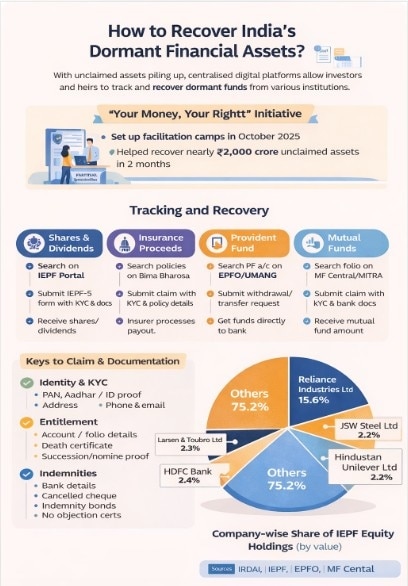



 While the top five companies account for a significant share, the remaining 75.2% of holdings is spread across hundreds of firms, indicating a long tail of smaller, fragmented investments.
Reliance Industries alone accounts for 15.6% of the total unclaimed equity holdings by value in the Investor Education and Protection Fund (IEPF), highlighting a sharp concentration of dormant wealth in India’s largest listed company.
According to a study by 1 Finance Magazine – a personal finance advisory firm, a significant portion of India’s unclaimed financial wealth is now concentrated in equities, with the Investor Education and Protection Fund Authority (IEPFA) holding shares worth nearly ₹89,004 crore across 1,671 listed companies as of November 2025. What stands out is the high concentration of value in a handful of blue-chip stocks, underscoring both the scale and skew of unclaimed investor wealth.

 'AI models cannot be trusted': Microsoft warns of insider threats, expands Project Perception
 China announces export controls on tunnel boring machines. Challenge for India's infra push?
 Ferrari expects FTA to boost demand in India; plans new dealerships in Ahmedabad and Chennai by year-end
 Houthi attacks disrupt Saudi aviation: Riyadh airport restricts flights indefinitely
 Fewer seats, higher fares: Why flying home this festive season costs more
 SIP to SWP: How to Withdraw Money From Mutual Funds After Building a Corpus
 PNB Reports Strong Q2FY27 Results; MD & CEO Ashok Chandra On Earnings And Growth Outlook
 Market Commentary | Axis, HDFC Bank & IT Stocks Bleed! Vaishali Parekh On Key Support Levels
 Cricket Diplomacy To Zero Tariffs: Why The India-New Zealand FTA Is A Total Win-Win
 How Many Mutual Funds Should You Hold? Expert Explains Portfolio Diversification And Fund Overlap
 Jio IPO draws 30 times anchor demand, brokerages see more upside in digital business
 Indian stock market outlook: Nikunj Saraf prefers large-caps, cautions against small-caps
 Hindustan Zinc Q2 earnings: Net profit zooms 149%, revenue at Rs 15,093 crore
  Muhurat Trading 2026: NSE, BSE announce Diwali timings; check full schedule
 ICICI Bank shares close lower after Q2 earnings; 3 brokerages remain bullishSIP to SWP: How to Withdraw Money From Mutual Funds After Building a Corpus
 Apple announces 'Pro and Tell' event for next week: OLED MacBook Pro and other devices expected
 Apple HomeView may get a 360-degree robotic arm and 9-inch display: What it means for smart homesJio IPO draws 30 times anchor demand, brokerages see more upside in digital business
 Saudi Arabia postpones in-person 'Davos in the desert' event amid Houthi attacks


