


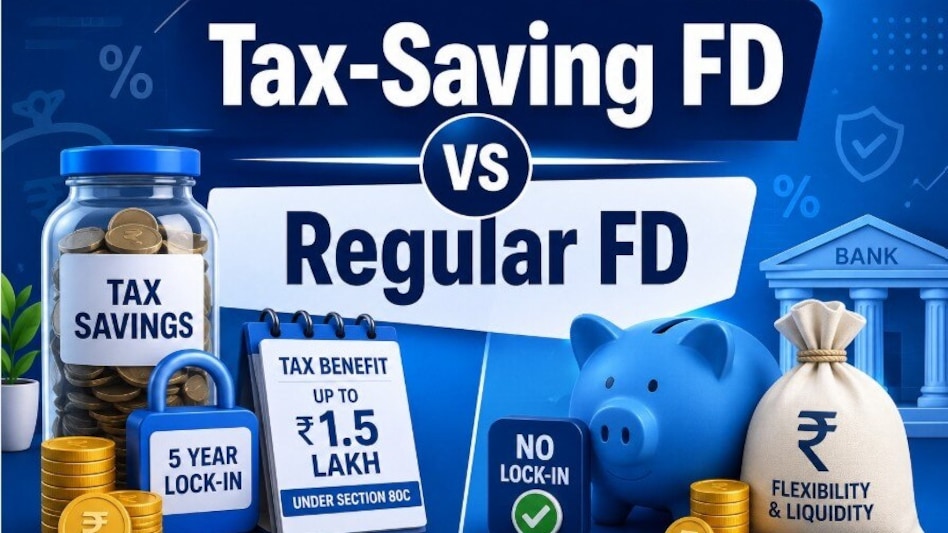
 Tax-saving FDs come with a mandatory five-year lock-in period, during which investors cannot withdraw their money prematurely or avail loans or overdraft facilities against the deposit.
Tax-saving fixed deposits (FDs) continue to be a popular choice among conservative investors looking to save income tax while earning guaranteed returns. Eligible under Section 80C of the Income Tax Act, 1961, these deposits allow taxpayers to claim deductions of up to ₹1.5 lakh in a financial year, while offering fixed returns that are insulated from market volatility.
However, unlike regular fixed deposits, tax-saving FDs come with a mandatory five-year lock-in period, during which investors cannot withdraw their money prematurely or avail loans or overdraft facilities against the deposit. While the principal qualifies for tax deduction, the interest earned is taxable and subject to tax deducted at source (TDS), wherever applicable.

 Parth Jindal takes charge as Chairman at JSW MG Motor India to drive green mobility
 HDFC Bank leadership: Ex-SBI chairman Dinesh Khara being considered for MD, CEO role, says report
 John Ternus’ biggest challenge as Apple CEO: Reshaping a decades-old leadership team
 RIL, Adani Energy, SBI Cards, Laurus Labs: MSCI rebalancing to drive market volatility today
  ISRO’s ‘Bahubali’ gathers industry bigwigs: L&T, Adani, JSW eye rocket technology
  Debt Funds Explained: Who Should Invest & How Much Debt Should Be In Your Portfolio?
 FD Or Debt Fund: Which Can Offer Better Returns, Tax Benefits & Liquidity?
 Why Meta Could Be Fined $1.4 Trillion! Instagram-Facebook Could Change Forever
 Gold Price Outlook: Can Festive & Wedding Demand Push Prices Higher In India?
 Gold Price Rally: Why Gold Surged 16% In August; Key Triggers Behind The Comeback
 Aadhar Housing, Aavas Financiers, Home First, India Shelter shares: Check target prices
 Manipal, VBL, Urban Co, AEL, Lenskart among stocks with fresh brokerage interest for upto 62% rise
 Ather Energy shares: Can this stock double after 423% return over IPO price? Targets
 ZEE Entertainment shares tumble 14%, take losing run to 4th session; key detailsRIL, Adani Energy, SBI Cards, Laurus Labs: MSCI rebalancing to drive market volatility today Aadhar Housing, Aavas Financiers, Home First, India Shelter shares: Check target prices
 Subhash Chandra debt resolution: Lenders challenge NCLT approval for ₹6.5-crore plan in NCLAT
 Nepal flash flood death toll climbs to 903, over 4,200 people still missing
 Overlapping 39 stocks: How Rajeev Thakkar’s two PPFAS equity schemes stand apart Manipal, VBL, Urban Co, AEL, Lenskart among stocks with fresh brokerage interest for upto 62% rise












