












 The 8th Pay Commission, constituted with an 18-month timeline, is likely to submit its report by mid-2027.
As deliberations around the 8th Pay Commission gather pace, multiple employee bodies have submitted detailed recommendations seeking a significant overhaul in salaries, allowances, and service conditions for central government employees and teachers. The proposals, if accepted, could lead to one of the most substantial pay revisions in recent years.
Higher pay, allowances
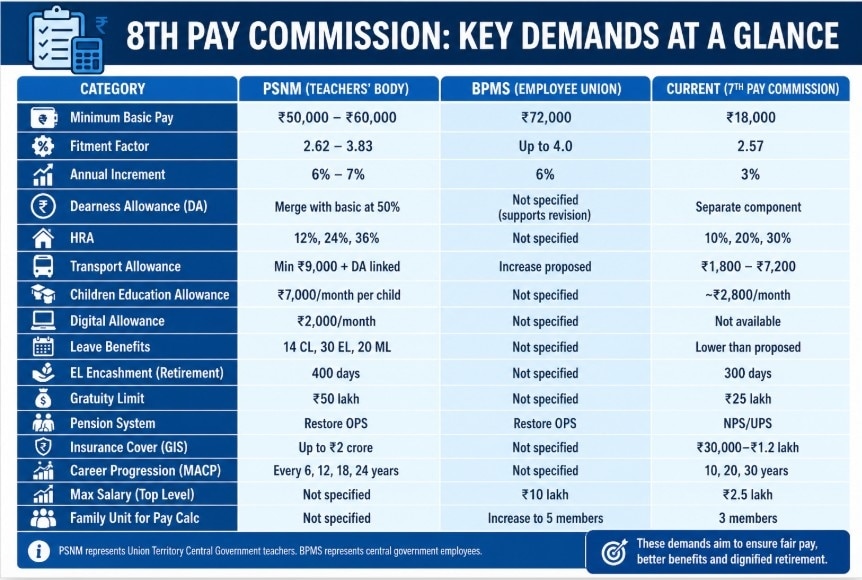
The Pragatisheel Shikshak Nyaya Manch (PSNM), representing Union Territory central government teachers, has called for a comprehensive restructuring of compensation. In its memorandum, the body has demanded a minimum basic pay of ₹50,000–₹60,000 for Level 1 employees, a sharp increase from the current ₹18,000 under the 7th Pay Commission.
It has also proposed a fitment factor ranging from 2.62 to 3.83, compared to the existing 2.57, along with annual increments of 6-7%, more than double the current 3%. According to the body, these changes are essential to ensure meaningful income growth and keep pace with rising living costs.
PSNM has further recommended structural reforms such as merging dearness allowance (DA) with basic pay once it reaches 50%, and improving the precision of DA calculations. It has also sought a substantial increase in Children Education Allowance to ₹7,000 per month per child, compared to the current level of around ₹2,800.
MUST READ: 8th Pay Commission: Tech hurdles emerge amid demands for higher pay, HRA, allowance overhaul
Higher allowances and benefits
On the allowances front, the teachers’ body has proposed raising house rent allowance (HRA) to 12%, 24%, and 36%, up from the current 10%, 20%, and 30%. It has also recommended enhancing transport allowance to a minimum of ₹9,000, with additional revisions linked to DA.
Other key demands include a digital support allowance of ₹2,000 per month, expanded leave entitlements, and increasing earned leave encashment to 400 days at retirement, compared to the existing cap of 300 days.
In addition, PSNM has called for restoration of the Old Pension Scheme (OPS), higher gratuity limits up to ₹50 lakh, improved group insurance coverage, and faster career progression through more frequent promotions.
Four-fold salary hike
In a more aggressive proposal, the Bharatiya Pratiraksha Mazdoor Sangh (BPMS) has sought a four-fold increase in minimum basic pay to ₹72,000, along with a fitment factor of 4. The union has also proposed a maximum salary of ₹10 lakh for top-level positions.
Under its suggested pay structure, entry-level salaries would rise sharply, with Level 1 pay increasing from ₹18,000 to ₹72,000, and higher levels scaling proportionately up to ₹10 lakh at Level 18.
BPMS has also recommended doubling the annual increment rate to 6% and expanding the “family unit” used for salary calculations from three to five members, reflecting real household financial responsibilities.
MUST READ: 8th Pay Commission: What it means for you as employees push for Old Pension Scheme
Economic rationale
To justify its proposals, BPMS has cited data from the Ministry of Statistics and Programme Implementation, highlighting that per capita net national income has risen by 86.76%, from ₹1.03 lakh in 2016–17 to ₹1.92 lakh in 2024–25.
The union argues that linking wage revisions to income growth would create a more transparent and rational framework, balancing employee welfare with fiscal considerations.
Implications for government finances
If implemented, these recommendations could significantly increase the government’s salary and pension outgo. However, employee bodies maintain that higher wages are necessary to ensure a dignified standard of living and to align compensation with economic growth.
With multiple stakeholders presenting varied demands—from moderate hikes to substantial pay revisions—the 8th Pay Commission faces the complex task of balancing fiscal discipline with employee expectations. The final recommendations are likely to have far-reaching implications for millions of government employees and pensioners across India.

 US Senate bill proposes 100% tariffs on India over Russian oil: What it could mean
 Warren Buffett changed his mind twice on Big Tech: First Apple, now Alphabet
 India-UK CETA kicks in: Kolkata ships first jewellery exports to Britain with zero import duty
 Nifty Pharma hits record high; Divi's Labs, Torrent Pharma, Sun Pharma shares shine
  Cabinet approves Semicon 2.0 with budget outlay of ₹1.27 lakh crore
 Q1 Earnings Beat Expectations: Ambareesh Baliga Bets Big On These Bank Stocks
 Silver Crashes 16% In A Month! Should You Buy The Dip? Expert Explains
 Why Has India Stopped Buying Gold & Silver? Expert Explains The Real Reasons
 Copper Ready For A Comeback? Expert Predicts Fresh Rally Despite China Slowdown
 Gold Price Outlook: Will West Asia Tensions Push Gold Higher? Fed, Oil & Safe Haven
 Nifty Pharma hits record high; Divi's Labs, Torrent Pharma, Sun Pharma shares shine
  Sensex, Nifty close higher; Eternal, UltraTech, SBI among top gainers
  Bharti Airtel shares: Should one buy this telecom stock ahead of Jio IPO?
 HDFC AMC Q1 earnings: Net profit rises to Rs 837 crore, stock closes higher
  BEL share price: Defence stock may face resistance at Rs 430-440, says Vishnu Kant Upadhyay