











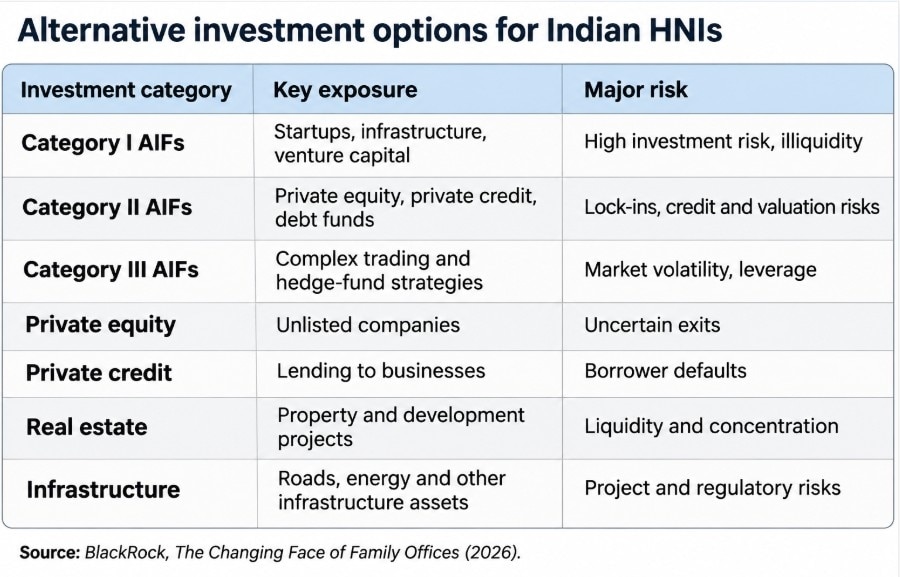



 In India, wealthy investors can access alternative assets through SEBI-regulated Alternative Investment Funds (AIFs), alongside other investment structures.
Wealthy investors are increasingly looking beyond traditional stocks and bonds to private equity, private credit, real estate and infrastructure. A BlackRock survey reveals that 74% of family offices across the Americas allocate more than 20% of their portfolios to alternative investments, raising questions about how India's high-net-worth individuals (HNIs) are diversifying their wealth.
BlackRock's 2026 report, The Changing Face of Family Offices: Insights Across Generations, surveyed 206 single-family offices managing an estimated $491 billion in investable assets.

 Pay bills, borrow money, manage bookings: Kunal Shah reveals WhatsApp's next priorities
 Just 1% higher India allocation could bring $12 billion: Citi explains the foreign money opportunity
 At first a conundrum, then Dr Manmohan Singh: Sonia Gandhi writes about turning down the PM’s role in memoir
 Trump loses, rupee gains: How US midterm elections triggered a turnaround in India's currency
 Ex-CEA Arvind Subramanian praises PM Modi's three big achievements, but says India's rise is 'a bit overdone'
 Nvidia's $200 Billion Shock: Jensen Huang Spy Scandal Raises Questions Over AI Future
 Indian-Origin Democrat Pia Dandiya Wins In Florida, Speaks Exclusively To India Today
 Yogi’s 80:20 vs Akhilesh’s PDA: The Battle For U.P. 2027
 India's Pollution Crisis Hits Sports: Chennai Open Tennis Final Postponed Amid Heavy Smog
 Nvidia CEO’s China Links Under Scrutiny: A Timeline Of Huang’s Trump Meetings

 Tata Power to report Q2 earnings on November 11, here's what to expect
 Ola, GRSE, Cochin Shipyard, Kalyan Jewellers among 1,270 companies set to report earnings this week
 BHEL, ONGC, LIC, Indian Bank, SAIL and BOM among PSUs with 4 quarters of FII buying
 Brent crude falls to lowest level since August; will markets extend recovery?
 Market rally on Wednesday? Gift Nifty surges 300 pts on rising FII inflows, falling Brent crude prices
 Luxembourg tops list of world's most trade-dependent countries; India ranks 139th
 Bengaluru to Mangaluru in 7 hours? Vande Bharat Express launch expected on November 13
 'Time for winter IPL': Billionaire Harsh Goenka backs Lalit Modi's idea Pay bills, borrow money, manage bookings: Kunal Shah reveals WhatsApp's next priorities
 Canada to expand rural immigration opportunities for foreign workers, allocates 5,500 spaces


