












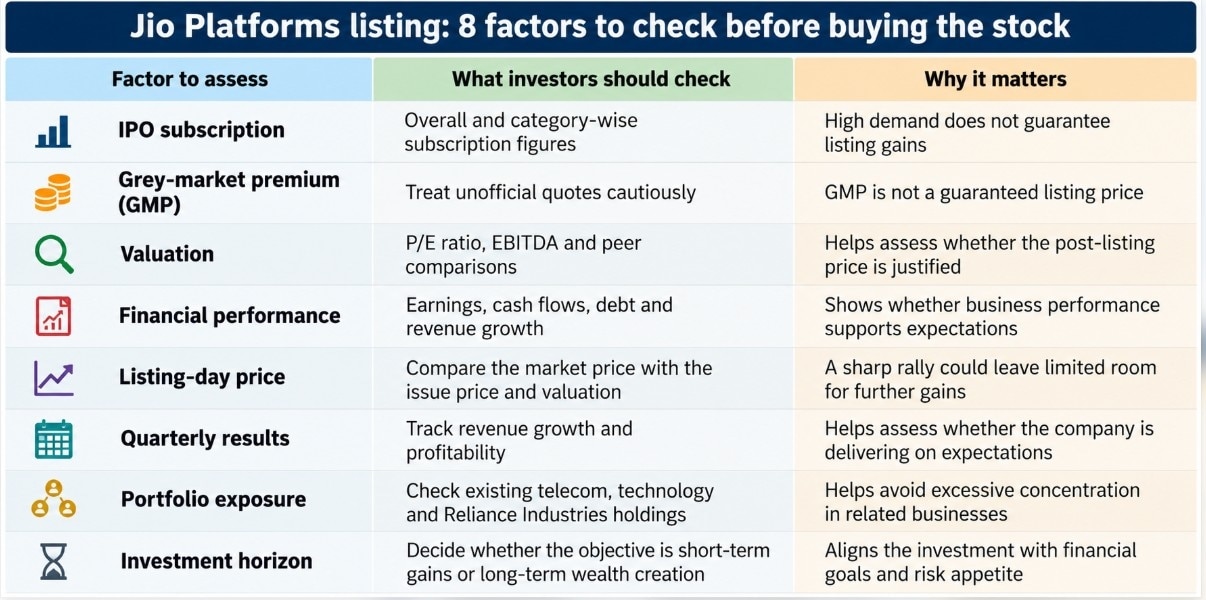



 Investors who missed allotment should avoid rushing into the stock simply because it lists at a premium.
Investors who missed the Jio Platforms IPO allotment will have another opportunity to buy the stock after listing. However, strong subscription demand and a high grey-market premium do not guarantee listing gains, making valuation, earnings prospects and portfolio allocation important considerations before entering the stock.
Richa Bhansali, Partner at Mindspright Legal, cautions against treating oversubscription as an assurance of returns. “High demand is a signal to interpret, not a return to assume,” she told Business Today.

 Three more PSUs headed for stock market: Govt plans IIFCL, Mahanadi Coalfields, SECL listing in FY27
 Adani finds a way around airline resistance: IndiGo, Air India to begin shift to Navi Mumbai
 China's mega dam, India's Siang project: Why are Arunachal locals protesting against it?
 'Don't assume FCNR money is untouched': ISB professor flags RBI's $200 billion exposure
 B28 trainset designed for 280 kmph: Ashwini Vaishnaw reveals the engineering behind India's first bullet train
 New Delhi Railway Station Food Safety Exposed: Dirty Kitchens, Cockroaches And Hygiene Questions
 NDMC Proposes 30% Property Tax Rebate: Who Benefits And Income Tax Impact
 Joint Home Loan Tax Benefits Explained: Gauri Chaddha On Ownership, Deductions And Rental Income
 What Are ETFs And BeES? How They Work, Key Differences And Benefits For Stock Market Investors
 Trump Says Europe Is In ‘Big Trouble’, Blames Immigration For France’s Unrest And Violence
 Three more PSUs headed for stock market: Govt plans IIFCL, Mahanadi Coalfields, SECL listing in FY27
 Markets Next Week: Crude oil at $117, broader market selloff and Q2 earnings in focus
 Jio Platforms IPO GMP at 21%: What could investors earn on listing day?
 Jio Platforms IPO: Record Rs 4.90 lakh crore in bids, 1.35 cr applications; check allotment odds
 IndusInd Bank Q2 profit at Rs 1,242 crore; NII up 4% YoY
 Digital gold purchases jump 83%: Is convenience changing how Indians buy gold?
 No number, no strategy, just luck: Kerala businessman and 5 friends win 200-gram gold bar in UAE draw
 Financial Horoscope Today, October 26, 2026: Capricorn Signs Should Avoid Carelessness in Financial Matters, Know Your Sign’s Outlook
 Sudden rains, flooded roads: Which motor insurance add-ons can protect your car from expensive repairs?
 'If anyone is an enemy of J&K, it is Pakistan': Ghulam Nabi Azad counters Farooq Abdullah


