












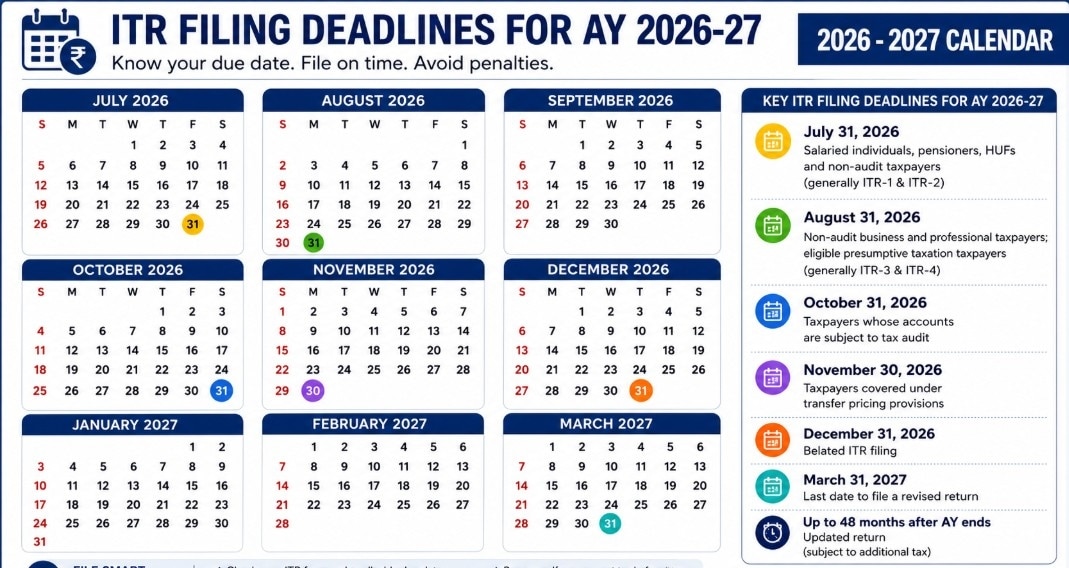



 If you fail to file by the deadline applicable to your category, you can still submit a belated return until December 31, 2026.
 The July 31 deadline for filing income tax returns (ITRs) for Assessment Year (AY) 2026-27 has come and gone. But if you haven't filed your return yet, it doesn't necessarily mean you're late. Under the revised ITR filing calendar introduced through the Finance Act, 2026, July 31 is no longer the due date for all taxpayers.
Instead, different categories of taxpayers now have different statutory deadlines depending on the nature of their income and whether their accounts are subject to audit. While most salaried individuals were required to file by July 31, many business owners, professionals, tax audit cases and transfer pricing cases still have time to submit their returns. The key is to determine which deadline applies to your category before assuming you've missed it.

 Why Zerodha Fund House is bullish on life cycle funds
 Ex-IMF economist Surjit Bhalla backs 7.8% GDP number: 'No evidence of exaggeration'
 Air India sacks Phuket-Delhi pilot after psychoactive substance test comes back positive
 BT Explainer: Why Volkswagen Group plans to axe 12% of its workforce in India
 NSE IPO update: SEBI approval likely next week; Check expected dates of price band and listing
 #DemocraticNewsroom | '800 Million People On Subsidies': Siddharth Zarabi On India’s K-Shaped Economy
 #DemocraticNewsroom | India Inflation Data: Are Official Numbers Hiding The Real Economic Picture?
 GDP Real Or Fudged? Siddharth Zarabi Defends India’s Growth Numbers With Data
 Financial Planning For Couples: How To Build A Strong Financial Plan, Budget & Wealth Together
 “High Sugar, Salt, Fat”: FSSAI CEO On Proposed Red Warning Labels On Food Packs
 56% rally in TBZ stock: Upper circuit led to record high today; here's why
  Sensex, Nifty snap four sessions of losing streak; RIL, Tata Steel, Bajaj Finance boost sentiment
  Physicswallah shares jump 9% as Motilal Oswal sees 66% upside
 KEC International: At 52-week low, Geojit expects more downside in infra stockNSE IPO update: SEBI approval likely next week; Check expected dates of price band and listing
 HbA1c of 6.4% is NOT 'almost normal': Why this borderline reading can be a warning sign
 China’s oil use drops sharply: Expert says EV shift is changing global energy demand
 BRICS Summit 2026: Patiala House Courts may function virtually amid security, traffic curbs
 WMO warns El Niño could intensify through February 2027: What it means for India? Check here
 GDP growth at 7.8%: Arvind Subramanian says India’s data needs more transparency, trust


