












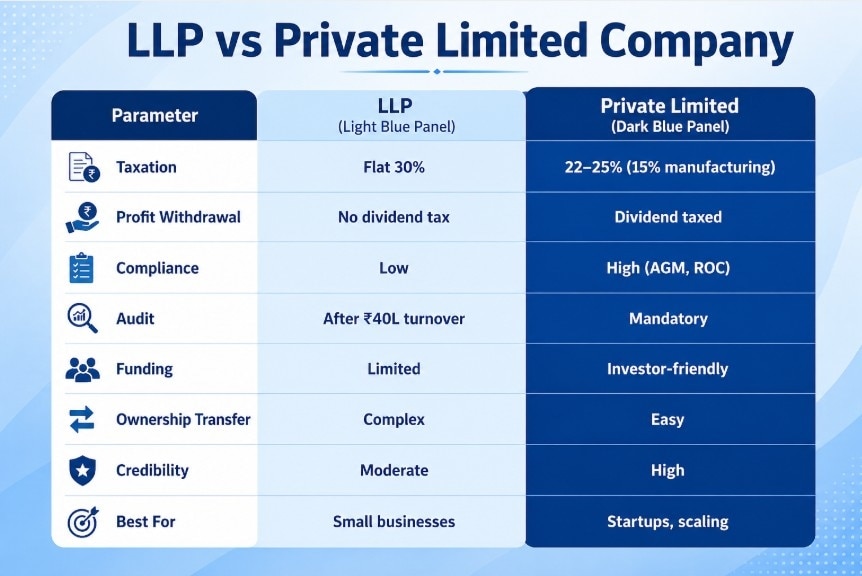



 LLPs allow tax-free profit withdrawals, while Private Limited dividends are taxed in shareholders’ hands.
Choosing the right business structure is one of the most critical decisions for entrepreneurs, as it shapes taxation, compliance burden, funding access, and long-term scalability. In India, the two most common structures are Limited Liability Partnerships (LLPs) and Private Limited Companies, each offering distinct advantages depending on business goals.
Taxation

 Trump says the US could just decide to stay in Iran and ‘keep the oil’ like Venezuela
 ‘If it’s not under human control, it’s not worth pursuing’: Satya Nadella's warning on AI
 Anthropic sets sights on Nasdaq for potential October IPO, eyes $2 trillion valuation: Report
 Stock market holiday: Why NSE, BSE will remain closed on September 14
 Gold and silver ETFs beat equity ETFs in FY26: What investors should make of the shift
 Amit Shah Hails India’s Rise From Fragile Five To Top Five, Politics Of Performance Since 2014
 MEA Details BRICS Summit Outcomes as India Pushes Practical and People-Centric Cooperation
 Modi@25: Amit Shah Highlights 25 Years Of Leadership, Governance And 2047 Vision
 “Development And Environment Are Complementary”: PM Modi On Sustainability At BRICS
 Modi@25: Amit Shah Announces Seva Sankalp Campaign From Sept 17 To Mark Modi’s 25 Years Of Service
 SoftBank shares tumble 13% as OpenAI, Anthropic raise AI safety alarm
 IPOs this week: NSE, Hero Motors, SS Retail, Jindal Supreme, Sonaselection; check GMP, key datesStock market holiday: Why NSE, BSE will remain closed on September 14
 Avoid jewellery; stick to ETFs, bars and coins for investment this festive season: Navneet Damani
 SEBI’s CAS proposals: Expert weighs in on new expiry-day settlement price methodologySoftBank shares tumble 13% as OpenAI, Anthropic raise AI safety alarmIPOs this week: NSE, Hero Motors, SS Retail, Jindal Supreme, Sonaselection; check GMP, key dates
 China spies on us, we spy on China too: Trump after Iran satellite images report
 LPG, CNG, PNG prices today (September 14): Check latest rates in Delhi, Mumbai, Kolkata, other cities
 Petrol, diesel prices today, September 14: Check latest rates in Delhi, Mumbai, Chennai, Kolkata & more


