


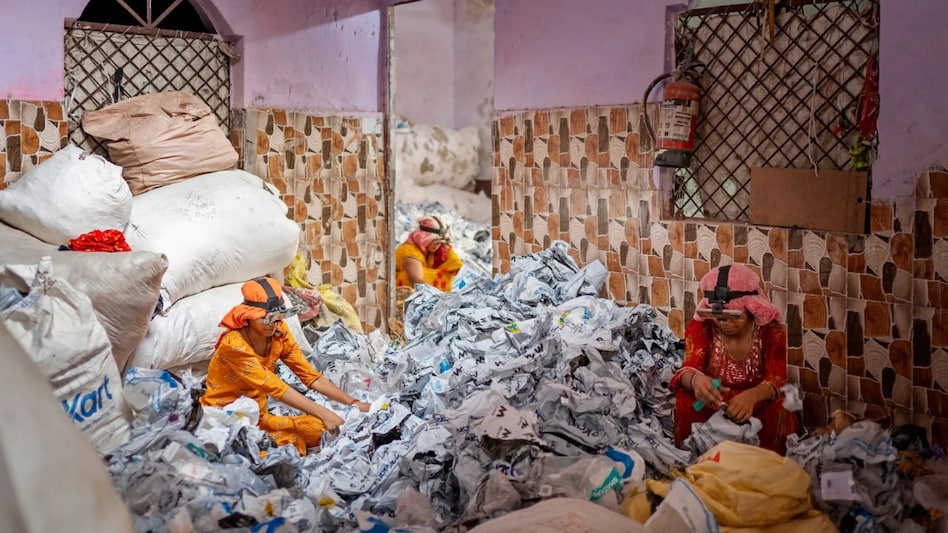
 Indian workers film daily tasks as AI companies gather data to train future robots.
If you work a routine job, you may not expect your everyday movements to become valuable data for the next generation of machines. But that is increasingly happening in India, where workers are recording physical tasks that could help robotics companies teach machines how humans work.
For 43-year-old Sunita Rathore, the day begins much like any other. She sorts and cleans discarded plastic at a recycling colony in Karan Vihar, on the western edge of New Delhi. Her work includes removing labels from plastic bags, separating waste by grade and stacking sacks for recycling.

 Brent climbs past $100 as US-Iran clashes in Strait of Hormuz reignite global energy fears
 GOP midterms bid: Trump offers $5,000 payout to American adults if party wins
  SFIO recommends investigation into Xiaomi’s India business over alleged irregularities: Report
 The iPhone folds! Apple unveils its first-ever foldable ‘iPhone Duo’ at Rs 2,99,900
 Apple launches iPhone 18 Pro, iPhone 18 Pro Max: Brings upgraded performance, camera, and more
 Gold Or Silver? Expert Reveals Best Investment Route Ahead Of Festive Season
 ETF Explained: How Exchange-Traded Funds Work, Costs, SIPs, Trading & Tax
 Tata Curvv EV: First Look At The Tech-Packed Electric SUV
 IDBI Bank Stake Sale: Fairfax Bid, ₹53,000 Cr Valuation & Deal Delay Explained
 Adani Group Plans $2.5 Billion Offshore Loan To Refinance Cement Acquisition Deb
 CPCL, MRPL, HPCL, BPCL, IOC shares: Brent nears $102; impact on oil stocks
 Dilip Buildcon shares jump 12% on Rs 1,800 crore LPG pipeline project win
 Coforge, Persistent, Tech Mahindra: Choice shares top IT picks; check targets
 HDFC AMC shares set for a 31% upside, MOFSL lists key catalysts
  Ather Energy shares climb 4% as Nomura raises target price; what foreign brokerage saysCPCL, MRPL, HPCL, BPCL, IOC shares: Brent nears $102; impact on oil stocks
 Apple announces iOS 27 release date: Check when your iPhone gets the latest update and new featuresDilip Buildcon shares jump 12% on Rs 1,800 crore LPG pipeline project winCoforge, Persistent, Tech Mahindra: Choice shares top IT picks; check targets
 Apple enters the foldable game. Now everyone has to follow.












