Now, that playbook appears to be moving beyond silicon and beyond China.
The recent restrictions on Anthropic’s Fable 5 and Mythos 5 models for non-US individuals suggest that frontier AI models, too, are beginning to be treated as strategic assets. The official justification may centre on national security and preventing misuse. But the broader signal is harder to ignore: access to critical AI capabilities can no longer be taken for granted.
“The US is moving from semiconductor control to software control as the capability of the US-driven AI stack is too powerful for rival companies or nations to boost their economies or develop meaningful and impactful technological prowess based on those,” said Neil Shah, vice president at Counterpoint Research.
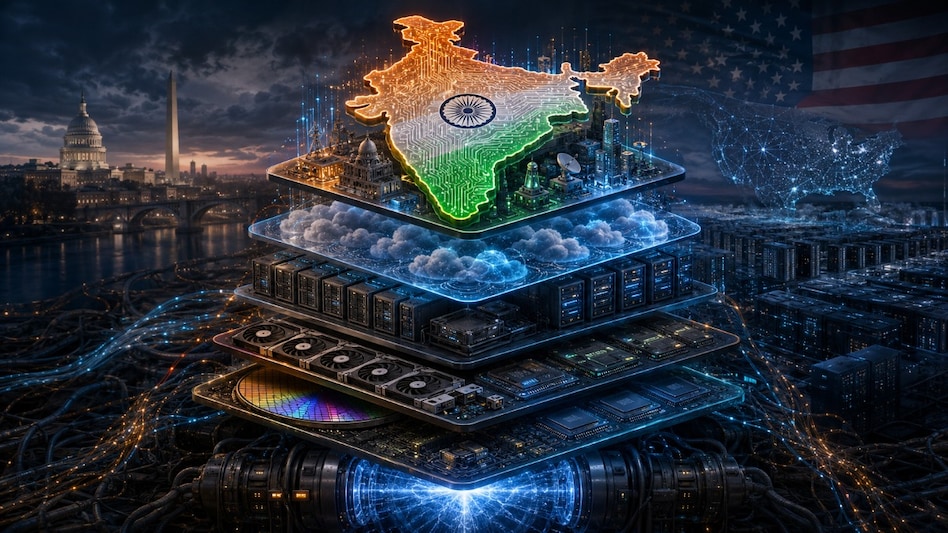
Shah said the restrictions are a wake-up call for India’s technology sector and the country at large, given their heavy reliance on foreign technologies across AI semiconductors and software. India, he said, cannot build its digital future or sovereignty solely on rented intellectual property.
The dependent stack
India is in the middle of its most ambitious push yet to build sovereign AI capabilities. Through the IndiaAI Mission, the government is creating a national compute infrastructure with more than 38,000 GPUs to support startups, researchers and public-interest AI projects, while also backing the development of indigenous foundation models.
Must read: Sarvam's Vivek Raghavan on why sovereign AI is no longer optional
But underneath this self-reliance push lies a structural dependence that is difficult to ignore. Much of the compute being deployed under the mission is powered by chips from US companies, with NVIDIA accounting for the bulk of the infrastructure, alongside processors from AMD and Intel.
The risks of this dependence have surfaced before. The Biden administration’s proposed AI Diffusion Framework, before it was later withdrawn by the Trump administration, had placed India in Tier 2 for access to advanced AI hardware.
While existing GPU infrastructure is protected by contracts and is unlikely to be switched off overnight, Shah said software-based restrictions on deployed infrastructure cannot be entirely ruled out, though such measures could have legal ramifications from a contractual perspective.
Pareekh Jain, CEO at EIIRTrend & Pareekh Consulting, said the bigger risk may lie not in existing deployments, but in future access.
The restrictions are more likely to affect future capabilities than existing infrastructure, Jain said. The real concern, he added, is the possibility of losing access to future chips, model updates, cloud services, technical support and next-generation AI systems.
Must read: Here's why HCLTech is betting $150 million on Sarvam
Sovereign AI, imported foundations
The vulnerability extends well beyond GPUs.
Backed by the IndiaAI Mission, Bengaluru-based Sarvam AI has become the poster child for India’s sovereign AI ambitions, building foundation models tailored to the country’s linguistic and public-service needs.
But Sarvam’s leading models have been trained using NVIDIA’s Megatron-LM and NeMo frameworks on thousands of imported H100 GPUs. While the intellectual property and end-user applications may be developed domestically, the underlying compute infrastructure, software ecosystem and hardware remain overwhelmingly American.
“Sarvam’s reliance on advanced foreign accelerators and the dominant training frameworks does show dependence on the US AI ecosystem. But it also shows India building serious capability on the most mature tools available, which is the usual way technological maturity begins,” said Sanchit Vir Gogia, chief analyst and CEO at Greyhound Research.
Must read: India accelerates AI development by backing 12 AI projects after Anthropic Fable 5 ban
The deeper lock-in, however, may not be the hardware alone. It is the software ecosystem built around it. Developers are trained on it, libraries are designed for it, and performance optimisation is centred on it.
“Once a team builds deeply around that ecosystem, substitution becomes slow, costly and operationally risky,” Gogia said.
The risk of being locked out
The latest restrictions around Anthropic reinforce a wider shift: frontier AI models are increasingly becoming subject to strategic controls.
Any tightening of licensing rules, export restrictions or geopolitical tensions could affect the pace of AI development, the availability of compute resources and India’s competitiveness in the global AI race.
“AI models are increasingly becoming strategic geopolitical assets. If India lost access to services such as ChatGPT, Claude, or Gemini, Indian startups, enterprises, and researchers, IT companies would face immediate disruption, higher costs, and slower innovation,” Jain said.
Must read: Indian IT’s AI partnerships face first sovereignty scare after US curbs Anthropic models
The stakes are not limited to startups or research labs. India is a preferred global location for IT services work, and the country now wants to be known for AI capabilities as well. Jain said any lack of access to advanced AI systems could create reputational risk for India as a geography for AI work, both for IT service providers and global capability centres.
Reducing dependence
Experts caution that complete technological independence is neither realistic nor economically desirable. India’s task, they say, is not to build every layer of the stack from scratch, but to reduce dependence where the risks are highest and the alternatives are within reach.
“India should focus on inference sovereignty, model portability, infrastructure resilience, Indian-language capabilities and disciplined procurement. The immediate priority should be to make AI workloads portable, build fallback options for critical systems, and secure clear audit and exit rights,” Gogia said.
After models, the next priority is compute access.
“Without GPUs and large-scale compute, India cannot train or deploy advanced AI systems. GPUs are dominated by NVIDIA and there are few viable substitutes as well,” Jain said.
As governments increasingly weaponise technology in pursuit of national interests, AI is emerging as the next major geopolitical lever. India’s challenge is not to build everything on its own, but to ensure that its AI ambitions are anchored in capabilities and ecosystems it can reliably access, shape and leverage.




 'Vietnam revised GDP by 25% in 2019': Economist explains why last year's estimate changed
 NITI Aayog launches new platforms to scale up electric truck adoption
 'Beginning first round of reductions': JLR confirms 4,000 job cuts over next 2 years
 Honda outsells Hero MotoCorp for second straight month in August
  India goes big on defence: Rs 1.10 lakh crore acquisition plan cleared. What Army, Navy, IAF will get
 Non-Local Electric Bus Software Is A National Security Risk, Warns Eka Mobility Chairman Sudhir Mehta
 Mounjaro Sales Surge 502%: Why GLP-1 Drugs Are Taking Over India’s Pharma Market
 Auto Stocks Outlook: Why Investors Should Be Cautious Despite New Model Launches And Strong Demand
 U.S.-Iran War, Elevated Crude Hit Indian Stocks: Can Nifty Reverse Its Downward Trajectory Now?
 Crude Oil, Gold & Silver: What’s The Next Big Move? | Kunal Shah
 Tata Steel, Hindustan Copper, Lloyds Engineering shares: Expert weighs in; names top pharma, broking bets
 Adani Power secures LoI to acquire GVK Energy; details here
 Two upper circuits for Sterlite Technologies shares as firm discloses FY29 targets
 Sensex falls 383 points, Nifty settles at 23,779; IT, metals among top drags
 APL Apollo Tubes, KDDL, Globus Spirits among 11 stocks to turn ex-dividend tomorrow
 Geopolitics Is Now A Business Priority
 Ahmedabad Gets A Major Aviation Boost: Why The Hub-And-Spoke Model Could Be A Game Changer
 Sustained Competitiveness Is The Key To Growth
 Maruti Baleno Facelift Launched At Rs 6.10 Lakhs












