Anthropic, the maker of Claude, withdrew access to its Fable 5 and Mythos 5 models over the weekend after a June 12 directive from the US government required the company to restrict access for non-US citizens. The restriction also covered Anthropic’s own employees in the US who are not US citizens. Since enforcing such access controls was not practical, the company has, for now, pulled both models.
The development came just a day after Tata Consultancy Services announced a partnership with Anthropic, under which India’s largest IT services company said it would train 50,000 employees on Claude, build industry solutions on the platform and enter into a joint go-to-market agreement.
TCS is not alone. Over the past few months, Infosys and HCLTech have also announced partnerships with Anthropic and OpenAI. TCS already works with Mistral AI to help customers deploy custom AI models and has also partnered with OpenAI to jointly create industry-specific agentic AI solutions and develop AI infrastructure.
While announcing the Anthropic partnership, K Krithivasan, CEO and MD of TCS, said, “Enterprise AI value comes from understanding business context, orchestrating complex systems, and applying deep AI engineering talent. By combining Claude with our industry expertise, engineering rigor, and large-scale transformation capabilities, we will help customers move faster to production, especially in industries where trust, resilience, and regulatory discipline are critical.”
HCL Tech was amongst the first Indian firms to partner with OpenAI in June 2025 to integrate it into its own AI models and to develop agentic and enterprise AI solutions. It is now investing $150 million in home-grown artificial intelligence startup Sarvam AI, marking the first time an Indian IT services major is taking a stake in an Indian sovereign AI venture.
The Noida-headquartered company will be the lead strategic investor in Sarvam’s $300 million Series B round, which values the startup at $1.5 billion post-money. As part of the all-cash deal, HCLTech will acquire 41,421 equity shares, translating into a 10.46% stake in Sarvam.
No immediate disruption
Analysts said the US directive is unlikely to immediately disrupt Indian IT firms because most of these partnerships are still in the early stages. Companies are training employees, building solutions and helping clients move from proof-of-concept projects to enterprise-scale deployment.
An analyst at a leading brokerage said most companies are still moving from pilots to production. "This development is unlikely to impact ongoing projects. We have to see whether this situation continues in order to gauge the overall impact since a lot of these projects would rely on having early access to advanced AI models," said the analyst.
The concern is not only about Anthropic. It is about whether access to frontier AI models can become subject to shifting national security, export control and sovereignty rules.
Most large IT services firms have also hedged their bets by working with more than one AI company. That could limit the impact of restrictions on any single model or platform. Tech Mahindra and Wipro, for instance, are part of the Microsoft Azure OpenAI ecosystem, while TCS has partnerships with Anthropic, OpenAI and Mistral AI.
However, another analyst said sovereignty-based controls could make enterprise customers cautious.
“Sovereignty-based controls mean that companies too may not be able to run the same model or platform across their different global locations and might make them more cautious before investing in these AI tools,” the analyst said.
Sovereign AI debate returns
The Anthropic episode has also revived calls for India to build its own frontier AI capabilities rather than depend heavily on US technology platforms.
Zoho founder Sridhar Vembu, in a post on X, said India needs to build technological self-reliance and reduce dependence on foreign technology platforms.
Not everyone agrees. Infosys Chairman Nandan Nilekani had earlier argued that India should focus on becoming the “use-case capital of the world” instead of building “one more LLM”. Speaking at Meta’s ‘Build with AI’ summit in Bengaluru in 2024, Nilekani had said India’s strength lies in applying AI at scale rather than competing directly with global model makers.
Must read: Why Nandan Nilekani is facing social media heat after US Anthropic curbs
That argument has found support in the way Indian IT firms are positioning themselves. Rather than building foundational models, they are trying to become the layer that helps enterprises adopt, customise and govern AI systems.
Why IT firms still matter
The rise of generative AI had initially triggered fears that coding tools such as OpenAI Codex, Claude Code and GitHub's Coding Copilot, among others, could eat into traditional IT services revenue. But the past year has also shown that companies need help integrating these systems into complex business environments.
A MIT Media Lab report from late 2025 found that 95% of AI pilots fail because of flawed enterprise integration. This is the gap Indian IT services companies are trying to fill. “Once large system integrators (SIs) come behind a platform, they build enterprise-class solutions that run within the guardrails, governance, and business constraints of enterprises. This is where the role of SIs becomes so critical,” said Yugal Joshi, Partner, Everest Group.
Must read: TCS to take $70 million Q1 hit after US Supreme Court rejects appeal in DXC trade secrets case
There is a growing recognition of the role IT companies can play in helping drive AI adoption. A report by ICICI Securities, titled Sound and Fury: The AI Question, said AI-led services could create a total addressable market of $300-400 billion by 2030. That would be a significant expansion compared with the current IT services market, which the report pegged at $280-300 billion. The report also said AI could create 170 million jobs even as it displaces 92 million traditional jobs.
Over the past year, several IT firms have been running pilot projects for clients, using generative AI and agentic AI to streamline functions across industries. The recent partnerships with OpenAI, Anthropic, Mistral AI and Microsoft suggest the industry is now trying to move from experimentation to wider enterprise deployment.
Infosys CEO Salil Parekh made a similar point when the company announced its collaboration with OpenAI in February.
“Generative and Agentic AI will redefine how enterprises operate and grow. Our collaboration with OpenAI establishes an operating model to unlock AI value at scale – uniting technology, talent, and transformation playbooks so clients can move decisively from pilots to performance, creating competitive advantage,” Parekh said.
A new growth engine, with risks
For Indian IT companies, AI is both a threat and an opportunity.
Market watchers remain cautious about the near-term impact on traditional IT services. ICICI Securities said there could be 2-3% annual deflation in traditional services revenue over the next couple of years as automation improves delivery efficiency and compresses effort-based pricing models.
But analysts also expect AI to open up new areas of work over time.
“In the short term, the impact will be in AI-related efficiencies and delivering cost take-out programs. However, eventually clients will build newer businesses using AI technologies and that will drive AI-related expansion for services firm. This opportunity will, however, be unequal and will depend on C-suite access of service providers,” said Joshi.
That puts Indian IT firms in a delicate position. They need access to the best global models to serve clients, but they also need to manage the risk of depending too heavily on platforms that can be restricted by foreign governments.
For now, the US directive on Anthropic’s Fable 5 and Mythos 5 models may not derail Indian IT’s AI plans. But it is an early warning sign. As AI becomes more strategic, access to frontier models may increasingly be shaped not just by technology and pricing, but by geopolitics.



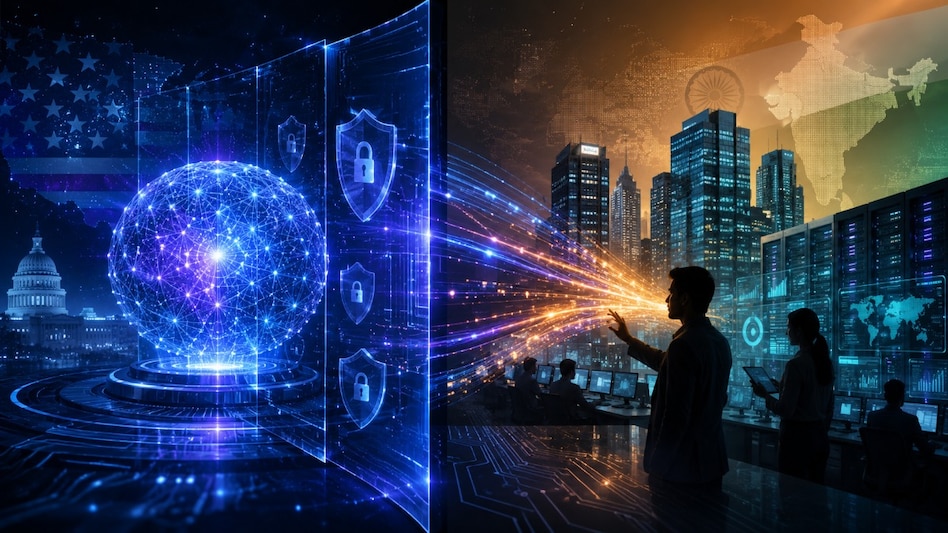 The Anthropic episode has also revived calls for India to build its own frontier AI capabilities rather than depend heavily on US technology platforms.
 India’s energy lifeline runs through the Indian Ocean: Why this maritime corridor matters
 20 Asia-Pacific stocks with up to 145% upside: Full ‘Going For Glory’ list, no Indian stock included
 Govt won't step into Singapore Airlines' Air India call, says Singapore minister
  Tax filing 2026: Missed crypto income in ITR? Why investors could receive an Income Tax notice
 $1 trillion, 500+ investors: India to host landmark BRICS sovereign capital summit in New Delhi
 LIC CEO On Sustaining Blockbuster Q1 Growth Amid Market Uncertainty
 Travel Insurance Mistakes: Sub-Limits, Pre-Existing Conditions & Medical Evacuation Explained
 Home Loans & Insurance: How Couples Can Structure Them For Tax Efficiency
 Money & Marriage: How Couples Can Divide Household Expenses, Track Spending And Stay On Budget
 Parag Parikh Flexi Cap Fund Underperformance: Is Fund Size Becoming A Major Challenge For Investors?
 IHCL, LemonTree, Chalet among 5 hotel stocks to buy; analysts see up to 49% upside
 FCNR(B) windfall lifts NBFCs, small private banks: Why these stocks may be the bigger winners
 Tata Technologies: Former CEO Patrick McGoldrick sells shares worth nearly Rs 165 crore
 Tata Power stock: Choice Broking expects recovery, assigns two price targets
  Central govt officials resist Aadhaar integration for health benefits despite mandate: Report
 'It is a simple test...': Sanjeev Sanyal counters US man on why Indians eat using their hands
 'Mirzapur: the movie' Box Office collection Day 2: Collects ₹79.55 cr in 2 days; eyes ₹100 cr with strong weekend
 ₹5,000 lifeline: This IIT-Delhi device can cut emissions of old buses & trucks to BS-VI levels












