


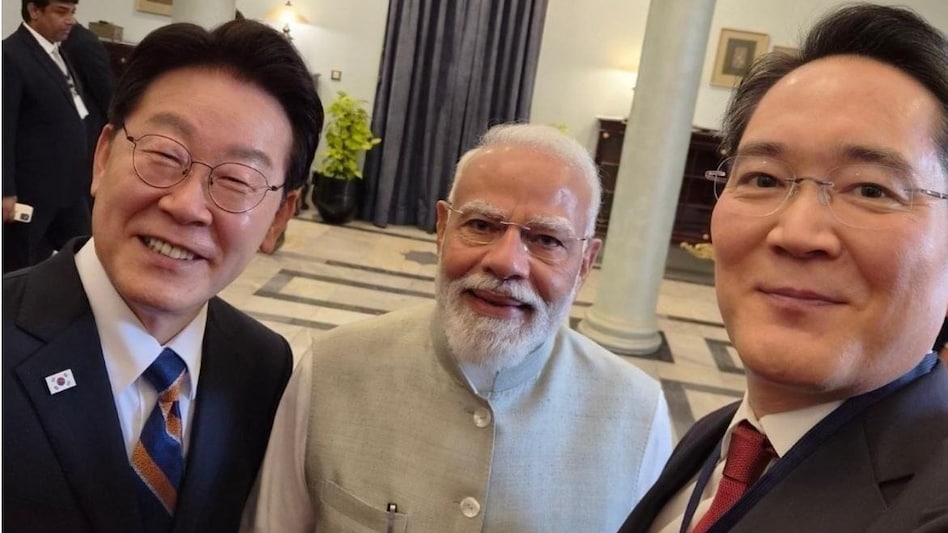
 Samsung Electronics Chairman Lee Jae-yong (right) with South Korean President Lee Jae-myung and Prime Minister Narendra Modi. The image was captured on a Galaxy Z Flip7 manufactured at Samsung’s Noida plant.
India and South Korea, on April 20, unveiled a new technology-focused partnership aimed at accelerating collaboration in artificial intelligence (AI) and semiconductors, as Prime Minister Narendra Modi and South Korean President Lee Jae-myung signalled a sharper strategic alignment amid global supply chain shifts.
Speaking at a joint press conference, PM Modi framed the launch of the “India-Korea Digital Bridge” as a cornerstone initiative that will anchor cooperation in next-generation technologies.

 'Vietnam revised GDP by 25% in 2019': Economist explains why last year's estimate changed
 NITI Aayog launches new platforms to scale up electric truck adoption
 'Beginning first round of reductions': JLR confirms 4,000 job cuts over next 2 years
 Honda outsells Hero MotoCorp for second straight month in August
  India goes big on defence: Rs 1.10 lakh crore acquisition plan cleared. What Army, Navy, IAF will get
 Non-Local Electric Bus Software Is A National Security Risk, Warns Eka Mobility Chairman Sudhir Mehta
 Mounjaro Sales Surge 502%: Why GLP-1 Drugs Are Taking Over India’s Pharma Market
 Auto Stocks Outlook: Why Investors Should Be Cautious Despite New Model Launches And Strong Demand
 U.S.-Iran War, Elevated Crude Hit Indian Stocks: Can Nifty Reverse Its Downward Trajectory Now?
 Crude Oil, Gold & Silver: What’s The Next Big Move? | Kunal Shah
 Tata Steel, Hindustan Copper, Lloyds Engineering shares: Expert weighs in; names top pharma, broking bets
 Adani Power secures LoI to acquire GVK Energy; details here
 Two upper circuits for Sterlite Technologies shares as firm discloses FY29 targets
 Sensex falls 383 points, Nifty settles at 23,779; IT, metals among top drags
 APL Apollo Tubes, KDDL, Globus Spirits among 11 stocks to turn ex-dividend tomorrow
 Hydrogen train gets a speed push: Railways eyes 110 kmph operation
 India’s metro network is closing in on the US — and the gap is shrinking fast
 Scammers posing as CEOs on the rise: How fraudsters' WhatsApp, email and Teams messages can steal money
 Mercedes-Benz’s new electric bicycle: 100 km range, ₹4.2 lakh price and more
 Nubia launches a phone cooler that can hit -18°C and slash heat during gaming












