








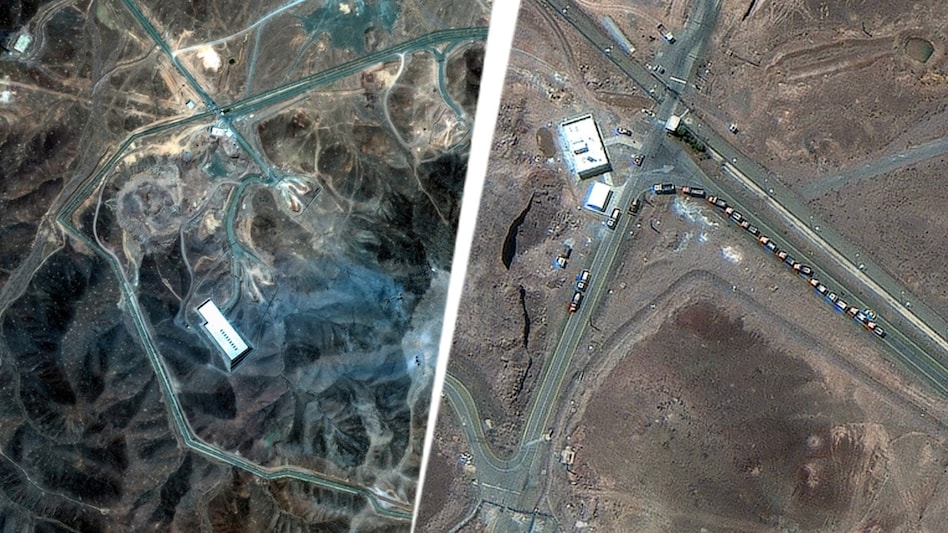
 Iran has not disclosed the status of its 400 kg of enriched uranium — enough material for nearly 10 nuclear bombs — or the condition of its advanced centrifuges.
 Iran has not disclosed the status of its 400 kg of enriched uranium — enough material for nearly 10 nuclear bombs — or the condition of its advanced centrifuges.
Iran’s foreign minister, Abbas Araghchi, has conceded that US airstrikes last weekend inflicted “significant and serious damages” on the country’s nuclear infrastructure. “The losses have not been small, and our facilities have been seriously damaged,” Araghchi told Iran’s state television, confirming the impact of Operation Midnight Hammer, according to the New York Times.
The strikes, carried out by US B-2 bombers armed with bunker-busting bombs, targeted Iran’s nuclear facilities at Fordo, Natanz, and Isfahan. Araghchi’s candid assessment stood in sharp contrast to Iran’s Supreme Leader Ayatollah Ali Khamenei, who earlier in the day dismissed US President Donald Trump’s claims of “obliteration” as “exaggerated.”
While Khamenei declared in a prerecorded video that the attacks “were unable to do anything important,” Araghchi painted a grimmer picture and warned that Iran might halt its cooperation with the International Atomic Energy Agency (IAEA). “Without a doubt, we are obliged to enforce this law,” he said, referring to legislation passed by hard-liners and ratified by the Guardian Council, mandating suspension of collaboration with the UN nuclear watchdog.
He added, “Our relationship with the agency will take a different shape,” and noted that a visit by IAEA chief Rafael Grossi “would not be welcomed” at this time. Iran has also suggested it may cease IAEA inspections and stop submitting monitoring reports — a prospect causing global alarm.
Iran’s foreign ministry spokesperson Esmail Baghaei earlier admitted the nuclear sites were “badly damaged.” Israeli military and US intelligence assessments have echoed that view, with Brig. Gen. Effie Defrin saying Iran’s nuclear program has been “set back by years.”
President Trump has defended the strikes, likening them to decisive actions taken in World War II. “I don’t want to use an example of Hiroshima or Nagasaki… but that was essentially the same thing. That ended that war. This ended the war,” he said.
Yet major questions remain unanswered. Iran has not disclosed the status of its 400 kg of enriched uranium — enough material for nearly 10 nuclear bombs — or the condition of its advanced centrifuges. These details could come to light only if Iran permits IAEA inspectors to return.
Analysts like Sina Azodi of George Washington University believe Tehran is exploiting the uncertainty. “Iran wants to keep everything in the dark… to play the diplomatic game of poker,” Azodi told the New York Times.
Despite Araghchi stating “no agreement has yet been reached” to resume negotiations, the White House maintains a cautious hope for diplomacy. Press Secretary Karoline Leavitt reaffirmed the administration’s stance, saying, “The president wants peace. He always has… and we’re on a diplomatic path with Iran.”
 NSE IPO may unlock mega gains for billionaire investors RK Damani, Premji
 'The real sting is the monitoring': Brahma Chellaney flags risk for India in Trump's Russian oil order
 Moltbook hype unravels: Viral posts were human-written, not AI, finds MIT Technology Review
 After mass layoffs, Washington Post publisher Will Lewis resigns; Jeff D’Onofrio named acting CEO
 India-US BTA: Harley Davidson bikes to get 0% duty, gradual tariff reduction on luxury cars
 BT Golf 2025-26 Kochi, Kerala Awards Ceremony Marks A High-Energy, Successful Conclusion
 Golf Is An Addiction. We Eat And Sleep Golf!
 The Fairway Fixes Everything. Mindset, Life, Relationships
 BT Golf LIVE: Join AU Small Finance Bank Presents BT Golf 2025-26 For Its 4th Leg In Kochi, Kerala
 AI Will Change MBAs, Not Leadership: IMD President On India’s Global Education Rise
 RIL, SBI, Kotak Bank, Kalyan, HAL, BEML, BDL among stocks in focus next week; here’s whyNSE IPO may unlock mega gains for billionaire investors RK Damani, Premji
 SBI Q3 Results: Profit jumps 24% to Rs 21,028 crore; asset quality improves
 IDBI Bank stake sale: Kotak Mahindra Bank says ‘has not submitted a financial bid’
 BDL, Mazagon Dock, MRF, Hindustan Copper, RVNL, others to turn ex-dividend next week