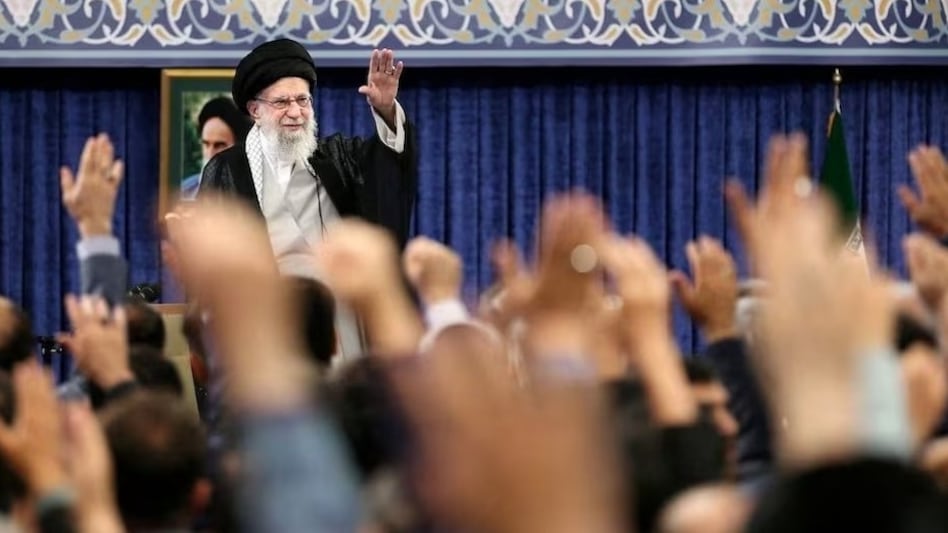
Iran's Supreme Leader Ali Khamenei was killed in opening strikes on February 28
When US President Donald Trump began the war on Iran on February 28, he clearly hinted that he wanted regime change in Tehran. More than a week into the conflict, however, there are still no signs that the Islamic Republic is on the verge of collapse.
A leading Iranian-American expert said on Saturday the absence of an uprising should not come as a surprise. The reality inside Iran, he suggested, is far more complex than the assumption that military pressure would quickly bring down the government.
Vali Nasr, a professor of international affairs and Middle East studies at the Johns Hopkins School of Advanced International Studies in Washington, said public sentiment in Iran currently reflects two competing narratives.
On the one hand, many Iranians are frustrated with decades of authoritarian rule, economic sanctions, and political isolation. On the other hand, the war itself has triggered a sense of nationalism that discourages people from supporting outside efforts to topple their government.
Advertisement
Responding to a question about which of these narratives better reflects reality, Nasr said both dynamics are visible inside the country. "I think both narratives are correct. People are tired of the regime for varieties of reasons. They think it's authoritarian. Many Iranian people are much more secular and don't subscribe to the religious edicts of the regime," he said in an exclusive interview with India Today TV.
"And there's a large number of Iranians who also are fed up with isolation, economic sanctions, and no longer subscribe to the idea of resistance and combat with the United States, confrontation with the United States, the kind of anti-imperialism of the old order that drove Iran's leadership. So they wanted a basically different regime."
Advertisement
But he said the ongoing military campaign has shifted the public mood. "It's very clear to them that the war is not removing the regime. The war is being waged on the country. There is nationalism there, which all Indians would associate with. Nationalism does not mean support for the regime. It means support for the country."
According to Nasr, wartime conditions make it unlikely that people would rise against their own government while foreign forces are attacking the country. He said that in the middle of the war, people are not going to rebel to support an invading military. "And also they cannot really organize and support the regime change when bombs are falling on top of them."
The expert, whose latest book on Iran is 'Iran's Grand Strategy: A Political History', said the immediate concern for many Iranians is survival rather than political change. "They are angry at the regime, but they're also angry at the invaders. And the more it goes on, the more they will see that Israel and the United States are not doing this for them. It's actually destroying their homeland. And so people can have very complicated sets of emotions."
The noted author said even citizens who blame the leadership for the crisis may still oppose foreign intervention. "They may even fault their leadership for bringing him to this point. But at the same time, that does not mean that they would embrace the devastation of their homeland."
Advertisement
The comments come as Trump and Israeli officials have repeatedly suggested that the war could trigger an internal uprising in Iran. Trump has clearly called on Iranian citizens to seize the moment to challenge their government.
Nasr dismissed that expectation as unrealistic. "There is no alternative to the Islamic Republic. It's not like there's a political party out there or an organisation that can take over."
According to the professor, the destruction unfolding in Iran’s capital makes any organised political movement unlikely. "The devastation that the city of Tehran is being subjected to right now is not liberation. This is destruction. It's not only the destruction of the headquarters of the Revolutionary Guards. Hospitals are being destroyed. All kind aspects of the economic and social lives of people are being destroyed."
Under such circumstances, he said, organising a political revolt becomes nearly impossible. "And at the same time, the Iranian people cannot organise to wage war against their government when bombs are falling on top of them."
Nasr said political change in Iran may eventually emerge once the war ends, but not during the conflict itself. "One day, when the dust settles, then you'll see politics and where it goes from now. But in the middle of this fight, they are not looking at this as a war being waged to liberate them."
Advertisement
Calls for regime change have grown louder since the US and Israel began striking Iranian targets and killing Supreme Leader Ali Khamenei. Trump has also suggested that a successor to the country's late supreme leader should be someone who can "bring harmony and peace to Iran."
But intelligence assessments in Washington paint a more cautious picture. A classified report by the US National Intelligence Council concluded that the Iranian system is unlikely to collapse even under large-scale military pressure, citing succession protocols within the leadership and the fragmented nature of the opposition.
Business Today brings you the latest news, views and analysis from the world of finance, economy, markets, corporates, startups, tech, and the digital economy. You can find everything from breaking news to deep dives to immersive essays and more on a variety of subjects across all formats - online, magazine, television, data visualisation, et al.



 Iran's Supreme Leader Ali Khamenei was killed in opening strikes on February 28
 10 investing mistakes retail investors should avoid, from overpaying to panic selling
 Markets Next Week: Jio Platforms IPO, high crude oil prices and Q2 earnings in focus
 Over 1,200 arrested: Historic 143-year-old town hall in Limoges burnt down amid widespread French riots
 Top 10 industries where women make up the majority of the workforce: Here's the list
 36-year low: New York restaurant count plunges by 2,000 in Q1 2026 amid soaring costs
 Gold, Silver ETF Purchases Halted: Why Mutual Funds Have Restricted Fresh Investments Before Diwali
 SIR Explained: Forms 6, 7 And 8—What Voters Must Know | Akshita Nandagopal Explains
 Gold Investment Options: ETFs, EGR And MCX Explained | How To Invest In Gold Beyond Physical Buying
 Redmi Note 17 Pro Max Review , Vivo V80, Vivo Vision | Tech Gear EP 20 | Business Today
 Mahindra XUV 3XO ZNG Review: Turbo Power Meets CNG Mileage
 YES Bank Q2 profit rises 65% to Rs 1,080 cr; proforma impact of restatement of AT-I bonds revealed
 ICICI Bank Q2 results: Net profit jumps 20% to Rs 14,843 crore; NIM contracts
 IDBI Bank Q2 net profit falls 39% to Rs 2,205 crore on year-ago's one-off gain
  From Dior and Celine to Hermès and Apple, major stores looted as violent protests sweep across France
 Marco Rubio set to meet Mukesh Ambani in Jamnagar amid Texas refinery investment plans: Report
 'Need a balanced system': JD Vance stresses shared values in immigration debate, clarifies H-1B remarks
  Mumbai mishap: MMRDA fines contractor ₹2 crore after 12-tonne steel cage collapses on car in Thane
 Can hackers take control of your smart fridge? France attack highlights risks of connected devices












