














 He campaigned for many Republican candidates, urging voters at rallies to pretend as if he was on the ballot.
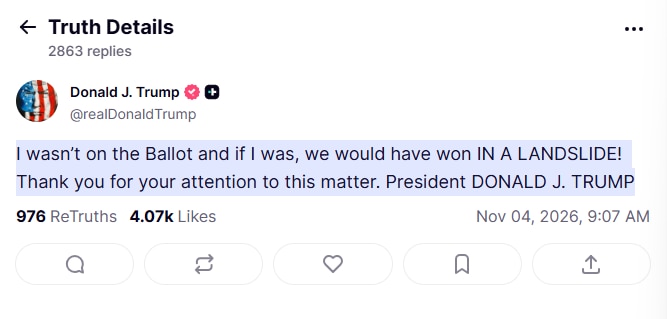
US President Donald Trump on Wednesday said that the Republicans would've logged a massive victory had the elections been fought on ballot paper. His post on social media came as the Republicans continued to log massive losses, with the most notable being in South Carolina.
In a post on Truth Social, the US President wrote, "I wasn’t on the Ballot and if I was, we would have won IN A LANDSLIDE! Thank you for your attention to this matter. President DONALD J. TRUMP."

 BT BIG STORY: Can scrapping LTCG tax bring foreign investors back to Indian equities?
 US midterm elections: Democrats flip one of the four Senate seats they need to wrest control of the Congress
 Huge setback to Trump: Republicans lose Lindsey Graham's Senate seat, Democrats win by huge margin
 'Won't be paying $4 billion a year to Israel': Donald Trump's big announcement on Election Day
 Rupee may slide to 102 against US dollar by December 2027, 106 by 2028: Report
 Market Masters Diwali Special | Shankar Sharma's Big Market Outlook For Samvat 2083
 Is SIF Right For You? Strategy, Risk And Returns Explained
 India's Gold Demand Crashes 29%: Modi's Appeal, High Prices Hit Buying Appetite
 Trump’s Plan B: How White House Could Govern Without Congress | US Midterm Elections
 32,490 Trees At Risk? Maharashtra’s Saidongar Project Sparks Row

 Groww, Nuvama Wealth, Prestige Estates: Top stocks to trade — Check key levels, targets & stop loss
 NSE share price: Morgan Stanley, Jefferies, Macquarie, JPMorgan targets post Q2 results
 NSE, Jio Platforms, BHEL Lupin, CleanMax, Cocord Biotech, MK Sons among top stocks in focus
 Jio Platforms shares in focus amid report of tech-for-equity talks with Comcast, CharterBT BIG STORY: Can scrapping LTCG tax bring foreign investors back to Indian equities?Market Masters Diwali Special | Shankar Sharma's Big Market Outlook For Samvat 2083Huge setback to Trump: Republicans lose Lindsey Graham's Senate seat, Democrats win by huge marginGroww, Nuvama Wealth, Prestige Estates: Top stocks to trade — Check key levels, targets & stop lossNSE share price: Morgan Stanley, Jefferies, Macquarie, JPMorgan targets post Q2 results
 ‘Ramayana’ advance booking: Before first day first shows, Ranbir Kapoor, Sai Pallavi-starrer nears ₹100 crore in India


