


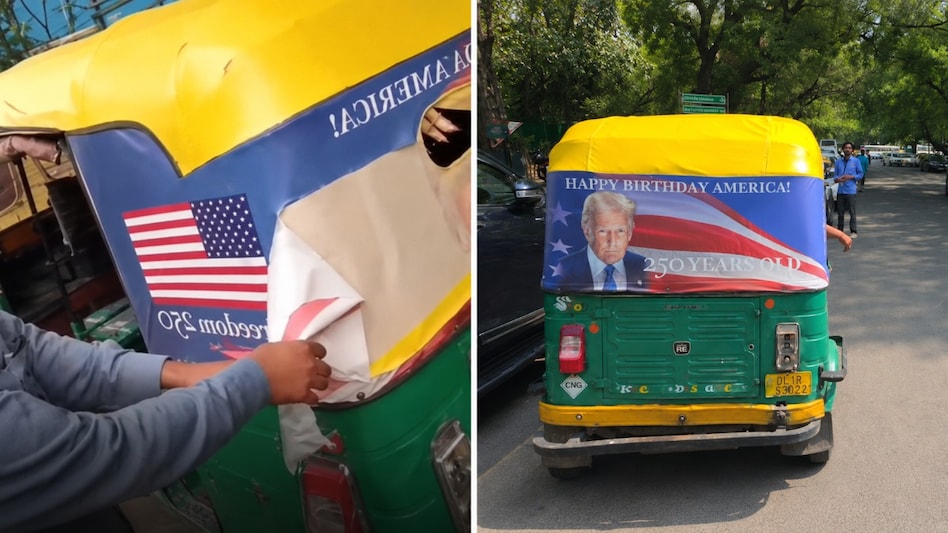
 The posters were part of the US Embassy's "Freedom 250" campaign, launched to mark the 250th anniversary of American Independence.
Videos of Delhi auto-rickshaw drivers tearing down posters featuring US President Donald Trump have gone viral on social media, days after a US military strike in the Gulf of Oman killed three Indian sailors.
The posters were part of the US Embassy's "Freedom 250" campaign, launched to mark the 250th anniversary of American Independence. But days after the strike on a commercial tanker carrying Indian crew members, the campaign has become the target of public anger.
Don't Miss: India remains Russia's No. 2 oil buyer, imports jump 21% in May
Strike on tanker leaves 3 Indians dead
The outrage stems from a US attack on the MT Settebello, a Palau-flagged tanker that was struck in the Gulf of Oman on Wednesday.
The vessel had 24 Indian crew members on board. Twenty-one were rescued, while three sailors lost their lives. India's Ministry of Ports, Shipping and Waterways identified them as Aditya Sharma, a cadet; Shivanand Chaurashiya, a fitter; and Patnala Suresh, a chief engineer, according to a report by BBC.
Shipping Minister Sarbananda Sonowal said in a post on X that the bodies of the three sailors would be brought back to India.
The US Central Command (CENTCOM) said one of its aircraft fired "precision munitions" into the tanker's engine room after the crew repeatedly failed to follow instructions.
The vessel's operator, iOS Marine, has strongly disputed that version of events.
"To the best of our knowledge and based on information available to us, no warning call, message, or communication was ever successfully established with the vessel prior to the actions taken against it," the company said.
It also rejected allegations that the tanker had any connection to Iran or was transporting Iranian oil.
"The vessel was a civilian merchant vessel engaged in legitimate commercial operations and should be viewed as such. Any assertions to the contrary are rejected and should be subjected to independent scrutiny as part of a transparent international investigation," the statement said.
The company further claimed that the tanker had "remained stationary at its position for approximately 10 days prior to the incident and had made no movement whatsoever during that period".
Third vessel involving Indian crew to come under attack
The Settebello incident was not the first involving Indian sailors this week.
Just days earlier, the MT Marivex, another tanker reported to be operating under the Palau flag, was struck by US forces in the Gulf. All 24 Indian crew members on board were rescued before the vessel later sank.
On Thursday, a third vessel, MT Jalveer, sailing under the Guinea-Bissau flag, came under attack near Oman's Shinas port. All 20 crew members on board were reported safe, with Omani authorities assisting in their evacuation.
While all three vessels were registered under foreign flags, the majority of those working on board were Indians.
Jaishankar speaks to Rubio
Anger has also grown among foreign policy commentators over US Secretary of State Marco Rubio's remarks following the deaths of the three Indian sailors.
External Affairs Minister S Jaishankar on Saturday raised the issue with Rubio, saying he had "reiterated India's strong protest at the attacks by the US Navy in the Gulf that killed three Indian mariners" and that "such lethal actions against commercial shipping are not justified."
However, in its readout of the call, the US State Department said Rubio stressed that "all commercial vessels should immediately comply with orders from US forces as they seek to uphold peace and security in the Strait."
He also underscored that "violations of the US blockade and the illicit transport of Iranian oil will not be tolerated," according to Principal Deputy Spokesperson Tommy Pigott.
US blockade of Iranian oil in Hormuz
The US military has been enforcing a blockade on Iranian ports after Tehran effectively closed the Strait of Hormuz, one of the world's most important shipping routes. Around 20% of global oil and gas supplies pass through the narrow waterway.
According to CENTCOM, US forces have disabled eight vessels and redirected 134 others since the blockade began on April 13.
The situation remains tense. Both countries have exchanged strikes for a second consecutive day, further straining a fragile ceasefire reached in April.
According to the shipping ministry, there are currently 562 Indian seafarers on Indian-flagged vessels in the region, including 329 in the Gulf west of Hormuz and 233 in the Gulf of Oman east of Hormuz.
Officials estimate that more than 18,000 Indian seafarers are working across the wider Gulf region.
As videos of Delhi autowallahs removing Trump posters continue to spread online, the deaths of the three Indian sailors have become a flashpoint, drawing attention to the risks faced by Indian crew members caught in the middle of an increasingly volatile conflict.

 Rupee falls 57 paise to 96.20 against dollar; further weakness likely, say analysts
 SC slaps ₹10 lakh fine on Samay Raina, says taken the court for a ride and has brazenly violated the orders
 Mahadev betting app case: ED arrests EBIX Chairman Vikas Garg
 Census 2027 SIR guide: How to register, submit details and get your SE ID
 India-UK CETA is India's most aspirational trade agreement to date: Trade Secretary
 Crude Oil Rises To A 1-Month-High Above $86. What Does This Mean Fot The Indian Market?
 Indian Railways Unveils One Pan-India Licence to Transform Container Freight Business
 Market Commentary LIVE | DSP Quant Fund & Multi Allocation Fund | Aparna Karnik
 Ashwini Vaishnaw Unveils Container-Based Fly Ash Transport to Cut Pollution And Truck Use
 Audit Flags ₹22.74 Crore Irregularities At Butati Dham, Missing Gold And Suspect Bills Under Scanner
 Sensex falls 561 pts as crude oil price boils, rupee sinks; what's next for investors? Rupee falls 57 paise to 96.20 against dollar; further weakness likely, say analysts
 Is Swiggy the next Eternal? Quest PMS' Vyas reveals portfolio view after stock correction
 Brent crude rally revives pressure on paint, tyre and aviation stocks; should investors be worried?
 Suzlon, BHEL, Adani Power, Waaree, Adani Green, Tata Power: Check fresh ratings & targets









