

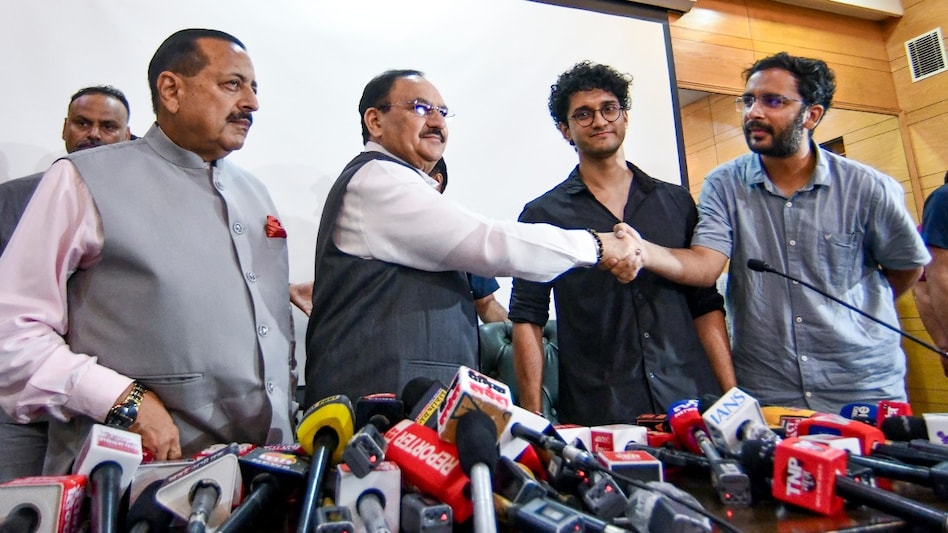
 Union Minister JP Nadda with MoS Jitendra Singh and CJP Spokespersons Saurav Das and Ashutosh Ranka, during a joint press conference after Education Minister Dharmendra Pradhan resigned from the Union Cabinet. (PTI)
When the Centre offered to shift Dharmendra Pradhan's portfolio instead of removing him from Cabinet, the Cockroach Janata Party's response was unambiguous: no.
Sources told India Today that the CJP delegation, which met Union Ministers JP Nadda and Jitendra Singh on Saturday, rejected the proposal outright. The government's negotiators had argued that reshuffling or removing a minister was the Prime Minister's prerogative alone. The CJP countered that it would accept nothing short of Pradhan's resignation, and that is what eventually came.
 Hormuz crisis exposed world's energy weak spots: Why the next shock could hurt more
 Battle lines are drawn: Tata Trusts prepares to challenge N Chandrasekaran’s reappointment in the court
 'Hormuz will never be...': Qatar Energy chief dismisses Bessent's 'worthless in 2 years' claim
 ‘Very big things are coming’: Trump in ‘deciding mode’ as Iran sets 7 key demands
 Weather alert: IMD warns of heavy rain, thunderstorms across several states. Will Delhi get rain?
 Gold Price Target 2026: Expert Sees MCX Gold At ₹1.8 Lakh By Year-End Amid Strong Demand
 Health Insurance: Why Pre-Existing Diseases And Waiting Periods Matter For Buyers
 Crude Oil Above $100: How High Energy Prices And Rupee Weakness Impact Gold Prices In India
 CEA On India’s Manufacturing Rise, Atmanirbhar Bharat And Modi’s Economic Policy
 Health Insurance Buying Guide: 7 Things First-Time Buyers Must Check Before Choosing A Policy
 HDFC Bank shares: Buy, hold or sell? Bear case scenario in the price, says UBS
 HDFC Bank, Vodafone Idea, Welspun Corp: Top stocks to trade — Key levels, target price & stop loss
 Top stocks in news: Lenskart, Nestle, Hy-Tech, Manika, RVNL, Mazagon, Coforge, GR Infra, HEG, Lumino
 Block deal today: Lenskart stock in focus as 3 crore shares to change hands; key details
  SpaceX weight in Nasdaq 100 to jump to 2.82% following quarterly index rebalance: ReportHDFC Bank shares: Buy, hold or sell? Bear case scenario in the price, says UBSBattle lines are drawn: Tata Trusts prepares to challenge N Chandrasekaran’s reappointment in the courtHDFC Bank, Vodafone Idea, Welspun Corp: Top stocks to trade — Key levels, target price & stop loss'Hormuz will never be...': Qatar Energy chief dismisses Bessent's 'worthless in 2 years' claimTop stocks in news: Lenskart, Nestle, Hy-Tech, Manika, RVNL, Mazagon, Coforge, GR Infra, HEG, Lumino












