





Search
Advertisement
Diabetes can silently damage your eyes: Why 101 million Indians must not ignore this warning

Diabetes can silently damage your eyes: Why 101 million Indians must not ignore this warning

Diabetes can damage the retina long before patients notice blurred vision or other symptoms, increasing the risk of permanent vision loss. Ahead of World Diabetes Day on November 14, experts are urging patients to prioritise regular retinal screening alongside blood sugar management.

Business Today Desk
Business Today Desk
  • Updated Nov 13, 2026 6:51 PM IST
Diabetes can silently damage your eyes: Why 101 million Indians must not ignore this warningWorld Diabetes Day 2026 falls on November 14, with the theme “Early Action on Diabetes”, emphasising early detection and timely care.

India is facing a growing diabetes burden, with more than 101 million adults living with the condition, according to figures cited from the International Diabetes Federation (IDF). While managing blood sugar, medication and diet remains central to diabetes care, doctors warn that an equally serious complication often goes unnoticed — damage to the eyes.

Advertisement

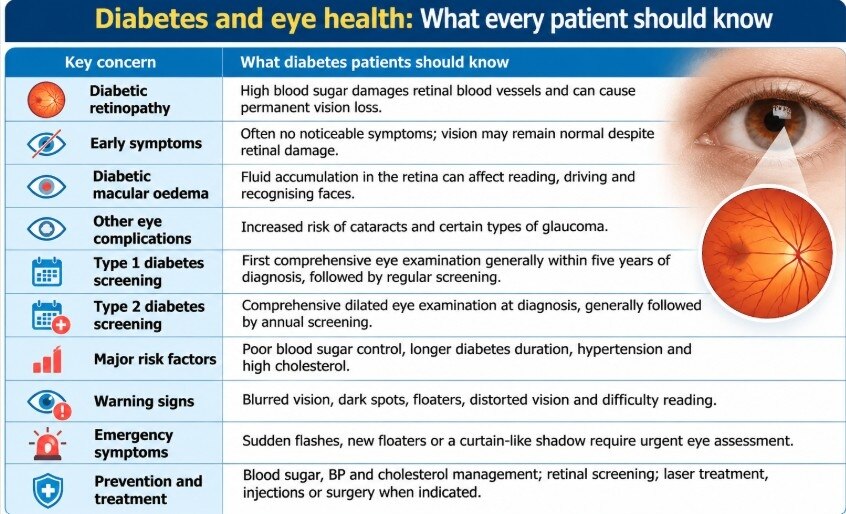
Diabetic retinopathy, a potentially sight-threatening complication, can develop silently, even when a person's vision appears completely normal. By the time symptoms emerge, significant retinal damage may already have occurred.

How diabetes silently damages eyesight

Prolonged high blood sugar levels can damage the tiny blood vessels supplying the retina, the light-sensitive tissue responsible for vision. Over time, these vessels may weaken, leak fluid or blood, and cause swelling.

In advanced stages, abnormal blood vessels can develop, potentially leading to bleeding, scar tissue formation, retinal detachment and permanent vision loss.

Another complication, diabetic macular oedema, occurs when fluid accumulates in the macula, the central part of the retina responsible for sharp vision. This can affect everyday activities such as reading, driving and recognising faces.

Advertisement

Dr Lalit Verma, Director, Retina Services, Centre For Sight and Former President, All India Ophthalmological Society (AIOS), warned that the absence of symptoms should not be mistaken for healthy eyes.

"Diabetic retinopathy is a major complication of diabetes, as retinal damage can progress even without noticeable visual symptoms. Regular retinal screening helps identify early vascular changes, examine the extent of retinal involvement, and understand the most suitable treatment plan. It's crucial to acknowledge that diabetes isn't only about managing blood sugar levels; timely eye checkups should also be promptly prioritized to keep away the risks of vision-threatening complications," he said.

Why normal vision doesn't mean healthy eyes

One of the biggest challenges is that early diabetic retinopathy frequently produces no noticeable symptoms. Even patients maintaining relatively stable blood sugar levels may develop retinal complications.

Advertisement

The risk increases with longer diabetes duration, poor glucose control, hypertension and high cholesterol.

Importantly, retinal damage can already be present when Type 2 diabetes is first diagnosed, particularly if the condition remained undetected for years.

A 2025 study examining diabetic retinopathy screening in rural Punjab highlighted another concern: some patients declined screening because they believed their eyes were healthy. Transportation difficulties and limited access to healthcare facilities also affected participation.

When should diabetes patients get their eyes checked?

Indian consensus guidelines developed by AIOS and the Vitreo-Retinal Society of India recommend that people with Type 2 diabetes undergo a comprehensive dilated eye examination at diagnosis, followed by annual screening.

For Type 1 diabetes, the initial examination is generally recommended within five years of diagnosis, with subsequent regular monitoring.

Warning signs include blurred vision, dark spots, floaters, distorted images and difficulty reading. Sudden flashes of light, new floaters or a curtain-like shadow require urgent medical attention.

Doctors emphasise that maintaining recommended blood sugar levels, controlling blood pressure and cholesterol, and undergoing regular retinal examinations can substantially reduce the risk of serious complications.

Advertisement

Specialised treatment for diabetic eye complications

Diabetic eye care often requires regular screening and timely retinal evaluation, as the nature and progression of the condition can vary from person to person. Specialised care may include procedures such as intravitreal injections, laser treatment and vitreoretinal surgery, depending on individual clinical assessments. With over three decades of experience in eye care and a network of more than 95 centres across India, Centre For Sight offers these specialised services as part of its diabetic eye care and retinal treatment offerings.

Early detection also allows timely treatment, including laser procedures, anti-VEGF injections or surgery where necessary.

ABOUT THE AUTHOR

Business Today Desk
Business Today Desk

Business Today brings you the latest news, views and analysis from the world of finance, economy, markets, corporates, startups, tech, and the digital economy. You can find everything from breaking news to deep dives to immersive essays and more on a variety of subjects across all formats - online, magazine, television, data visualisation, et al.

Published on: Nov 13, 2026 6:51 PM IST