But that 75 per cent release rule has now been revised.
Under the Agnipath scheme, only 25 per cent of each specific batch of Agniveers were to be enrolled in the regular cadre of the Armed Forces, while 75 per cent were to be discharged. The first batch is due to complete its four-year tenure this month, November 2026.
However, just weeks before they were to be discharged, the government has given a two-year extension to the remaining 75 per cent of Agniveers who were to be discharged. After the completion of these two years, all Agniveers - as the soldiers are called in the new scheme - will be absorbed into the army, provided they meet the selection criteria.
Effectively, the revised scheme creates a pathway for all willing Agniveers to join the regular armed forces after six years.
But will this be enough to persuade Nepal to resume Gorkha recruitment into the Indian Army?
Binoj Basnyat, former Major General of the Nepali Army, doesn't think so. He says whatever changes the Indian government has made do not address Nepal's demands. He, however, says Kathmandu should resume the recruitment process.
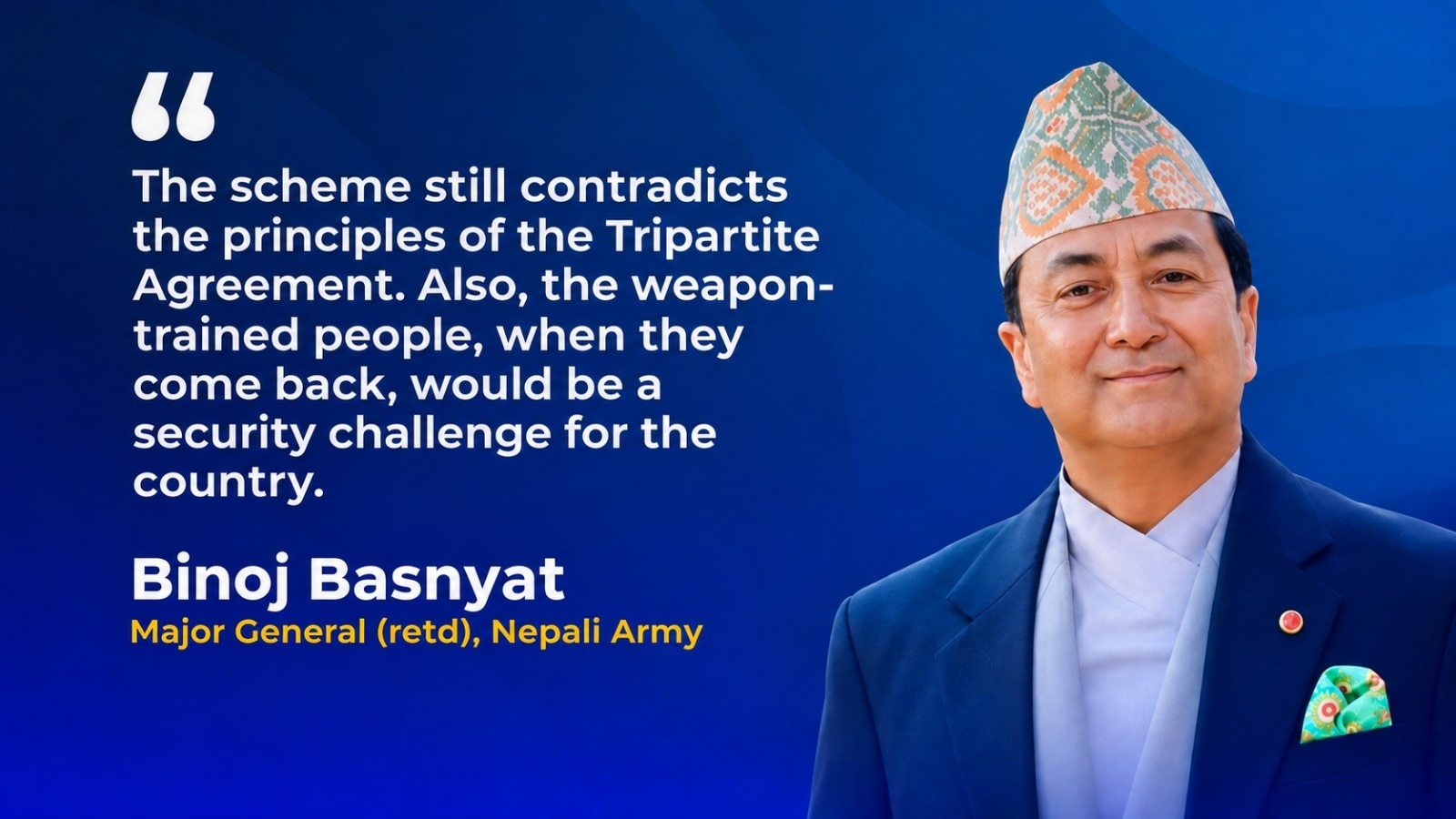
"The scheme still contradicts the principles of the Tripartite Agreement," Basnyat told Business Today. "Also, the weapon-trained people, when they come back, would be a security challenge for the country. Those are the two fundamental principles that the Nepal government did not agree to."
"But my take on this is that, considering the regional geopolitical shifts, we should start or resume the recruitment process. At the same time, both governments must form a panel, so that they can look into what the possibilities are. They should do it before the Gorkha soldiers' four years are finished," the former general said.
Basnyat suggested that Delhi and Kathmandu explore other ways to strengthen the relationship because the political security environment in Nepal and the original security architecture in South Asia are shifting. "Nepal should take this (change in the Agnipath scheme) as an opportunity to resume the recruitment process," he said.
After the announcement of the Agnipath Scheme, Nepal Parliament's House Committee demanded a formal review or termination of the Tripartite Treaty. It claimed that the treaty and the scheme no longer met the needs of the Gorkha soldier and that the policies had failed to take into account their traditional practices.
The Tripartite Agreement was an agreement signed between India, Nepal, and the UK that allowed Nepal Gorkha soldiers to continue serving in the Indian and British armies after India's independence. The agreement established principles for comparable basic pay, allowances, and pension eligibility.
Till 2025, the Indian Army had about 32,000 Gorkha soldiers.
"As the Gorkha soldiers begin to retire, the overall strength of Gorkha battalions is expected to be cut in half within the next seven years, and by 2037, it is possible that there may not be any Nepalis in these battalions," Basnyat writes in a chapter contributed to a book, 'Shared Bonds, Strategic Interests: India-Nepal Relations in a Strategic World'.
The major general (retd) also highlighted that the salary and pensions of the 1.35 lakh former Gorkha soldiers come to around $620 million annually. "It is more than Nepal's current defence budget of USD 430 million and affects the employment scenario."
Lieutenant General Rakesh Sharma (retd), too, said that New Delhi should begin a dialogue to resume the recruitment of Nepali Gorkhas. Sharma was commissioned in the Gorkha Rifles in 1977. He also served as Adjutant General responsible for the Indian Army's Human Resource Management.
"The recruitment of Nepali soldiers into the Indian Army did not start yesterday. It was part of the Treaty of Sugauli. Even before that, in Maharaja Ranjit Singh's army, people were coming from Nepal," the retired general told BT.
Sharma said Gurkha soldiers have demonstrated tremendous valour and sacrifice. When the Prime Minister visited Nepal in 2014, he said that Gurkha soldiers had shed blood in every war they had fought here. "So, when the Agnipath scheme was promulgated, Nepal disallowed the recruitment of Nepal-domiciled Gurkhas."
Gorkha Battalions Under Pressure
Before the Agnipath scheme was introduced, the Indian Army recruited approximately 2,000 Gorkhas a year. About 65-70% would come from Nepal, with the rest being recruited from within India.
There are seven Gurkha regiments. Across these seven regiments, there are about 39-40 battalions, along with one artillery regiment and a mechanised infantry unit. "So, 42 battalions constitute a very large force. Of this, recruitment from Nepal accounted for 65-70% of the intake," the army veteran said.
The army has recruited some people from Uttarakhand's Garhwal and Kumaon regions to fill the strength in a Gurkha regiment. Sharma, however, said that it is not easy to recruit from India because of the paucity of Indian-domiciled Gorkhas. "As time passes, it is becoming difficult to maintain the strength of the Gurkha battalions. That is an issue that needs to be addressed."
The former general said Nepal was not very happy about having soldiers with four years of military training and experience return home unemployed.
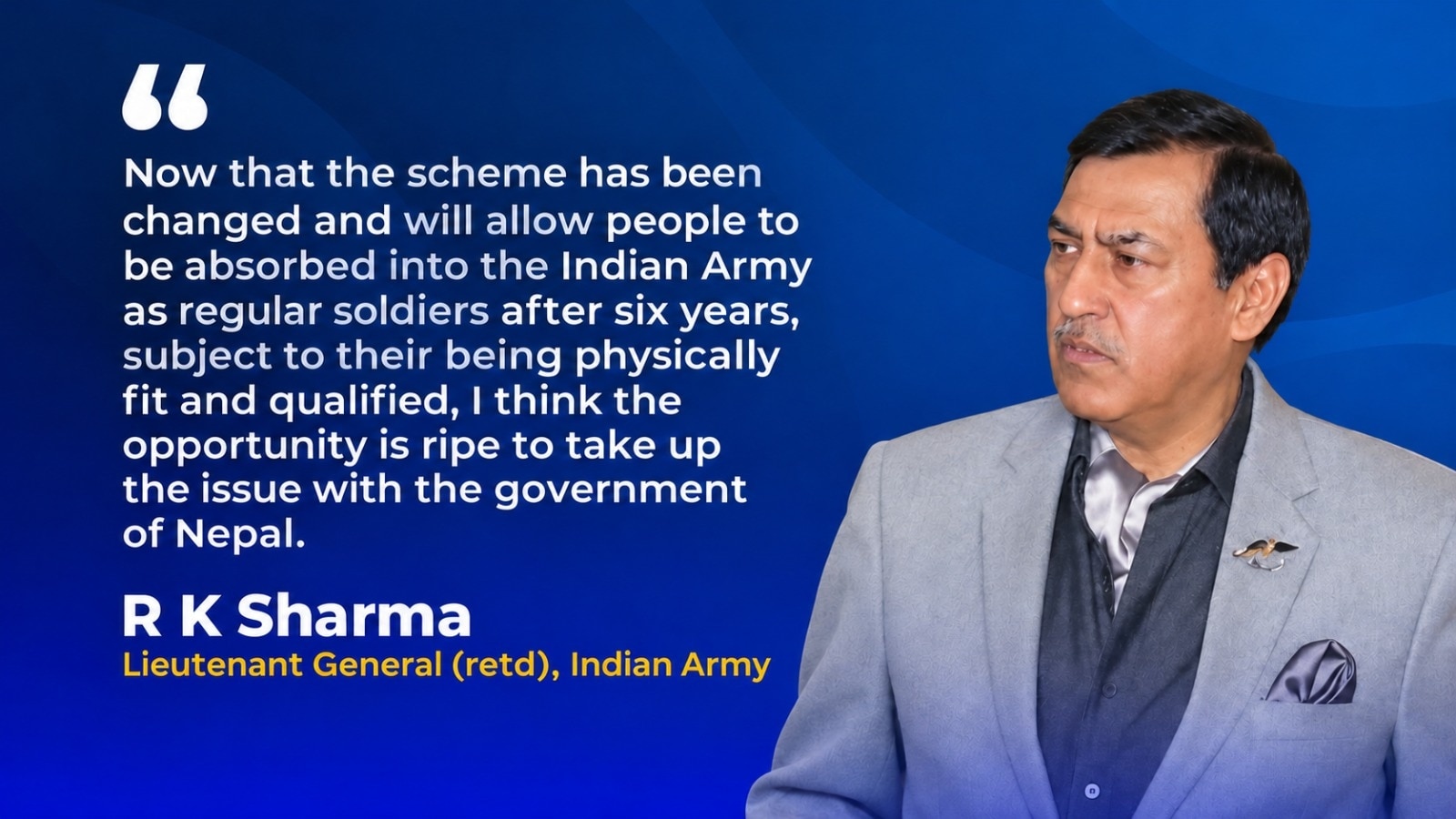
"Now that the scheme has been changed and will allow people to be absorbed into the Indian Army as regular soldiers after six years, subject to their being physically fit and qualified, I think the opportunity is ripe to take up the issue with the government of Nepal," the army veteran said. "We can tell them the opportunities are now at par and just as good, and that the likelihood of being absorbed is very credible. So, we should start recruitment."
Sharma said that the recruitment of Gorkhas in the Indian Army was one of the most significant aspects of India's relationship with Nepal. For over 130 years, he added, the relationship was underpinned by the large number of Indian Army ex-servicemen who had settled across Nepal. "30,000-odd Nepalese were serving in the Indian Army at any given time. This was a very significant relationship on which our broader ties were based."
The former general also cautions that the long-term termination of Gorkha recruitment will inevitably lead to reduced military ties between Nepal and India. "This, in turn, would weaken people-to-people ties and historical traditions," he warns in his chapter for the book, Shared Bonds, Strategic Interests.
"India sees the termination of Gorkha recruitment as a strategic setback that may lead to increased foreign influence. The economic and diplomatic space will be exploited by strategic competitors, leading to security vulnerabilities for India."
Former Nepal Ambassador Ranjit Rae, too, had earlier said that Gorkhas joining the Indian Army is a very important aspect of the overall relationship between India and Nepal. He warned that when Nepal becomes vulnerable, hostile forces may seek to take advantage of the situation
"We have 1,25,000 Nepalis - we call them Bhutpurva Gorkha soldiers - who are in Nepal, and they get pensions from India. The pension itself is about three per cent of Nepal's GDP. This is a very important element," he told BT in December 2025.
The former ambassador had said that New Delhi should see whether the Agniveer scheme needs to be liberalised for these Nepalese Gorkhas or if an exception can be made.
"They (Nepal) feel that so many soldiers will come back after four years, and these are people well-trained in weapons. This might create security problems in Nepal. They say, 'Look, we had a very violent Maoist insurgency for ten years. Seventeen thousand people were killed. Now, if these soldiers come back, how will they reintegrate? These people can use modern weapons.'"
When asked whether Kathmandu will now accept the changed scheme, retired general Sharma said that Nepal is one of the closest friends we have as a country, and we need to reopen the issue of recruiting Nepal-domiciled Gurkhas into the Indian Army in light of the policy change.
"My view is that if they are being offered the possibility of full-time employment, even after four or six years, I think it assuages the fear of soldiers being sent back there."
Agnipath 2.0 - Who benefits?
Beyond Gorkha recruitment, Sharma said the revised Agnipath scheme could benefit the armed forces by allowing them to retain experienced personnel. He called the change "an overdue reform", but questioned whether the revised scheme would help in bringing down salary and pension costs.
"Organisationally, it is advantageous because you tend to select the best after four years. And, of course, you sift through and select the best after six years. The meritorious ones are retained and become part and parcel of the organisation."
"But whether it is organisationally advantageous in terms of pensions and salaries, I'm not very sure whether it makes a credible difference. I don't think that, in this particular change, will matter because everybody is being offered retention after six years. This means that hardly anybody will be leaving after six years. So, willy-nilly, the effect on pensions and salaries, if any, will be very limited."
Sharma also said that a large number of people in the armed forces come from rural areas, and an uncertain job is disliked in our society. "This new change allows everybody an opportunity at four and six years to get absorbed, provided they meet the criteria."
Despite welcoming the changes, the retired officer said there could be inequities in the emoluments given to soldiers for battle casualties and physical casualties, etc. "Those issues have not been addressed. They need to be addressed," he said. "We will now have people with four years of service, people with six years of service, and different salary structures."
Another unresolved issue, according to Sharma, is whether the six years spent as an Agniveer would count towards pensionable service after regular enrolment.
"After six years, you get absorbed as a soldier. This needs to be sorted out when the terms and conditions for this changeover are promulgated. It should not create problems later, at retirement."
When asked whether we have ended up with a complicated scheme, Sharma said the fine print is not out yet, so that cannot be said. "Having said that, I think simplicity is the biggest advantage in matters of recruitment. The simpler the recruitment method and the simpler the terms and conditions, the better."
"There cannot be one group of people in a battalion, which is a cohesive unit, feeling ill will towards or resentment against the others. I would agree with you that, as you are suggesting, the scheme ought to be a little simpler. But I will take a call on it when I see the fine print of the entire scheme as it comes out."















 India changes Agnipath rules, but will Nepal send its Gorkhas back to the Indian Army?

 Nvidia shares plunge after CEO Jensen Huang admits to affair, board launches spy probe
 PM Modi speaks with Zelenskyy, says India ready to help end Russia-Ukraine war
 HDFC Mutual Fund gets IRDAI nod to increase Star Health stake to 9.99%
 India's aviation boom faces its first reversal in a decade
 'Nothing but a smear campaign': China denies spy claims after Nvidia CEO Jensen Huang admits affair
 Exclusive | CM Yogi Adityanath Accuses SP Of Leaving UP With A ‘Law And Order Crisis’
 Who Is Alice Huang? The Woman At The Centre Of Jensen Huang-Nvidia Controversy
 Govt Slashes Prices Of 137 Cancer Drugs By Up To 96%: What Patients Need To Know?
 PSU Banks Set For Re-Rating? Deven Choksey Explains Two Key Triggers For Samvat 2083
 FIIs May Return To India: Which Sectors Could Attract Fresh Foreign Investor Buying Next?

 Honasa Q2: CLSA retains 'Hold' call, check target price post Q2 earnings
 NBCC shares up 19% since October 23; worth buying?
 Sansera Engineering shares rise up to 7%; Nomura, Goldman Sachs on future outlook
 Jubilant FoodWorks: CLSA cuts target price after Q2 results; stock tanks 5%
 Jensen Huang's future at Nvidia uncertain as Yale professor puts CEO job chances at 50-50
 BT BIG STORY | Behind the glamour: How to build a career in luxury
 Chhath 2026 from 13 to 16 November: The four days and the exact sunset and sunrise times
 World Bank warns against mandatory digital wallets: Could millions be excluded from essential services?
 Who could be Nvidia's next CEO? Jensen Huang reveals where he hopes to find his successor